What are ASHRAE 170 requirements for airborne infection isolation rooms?
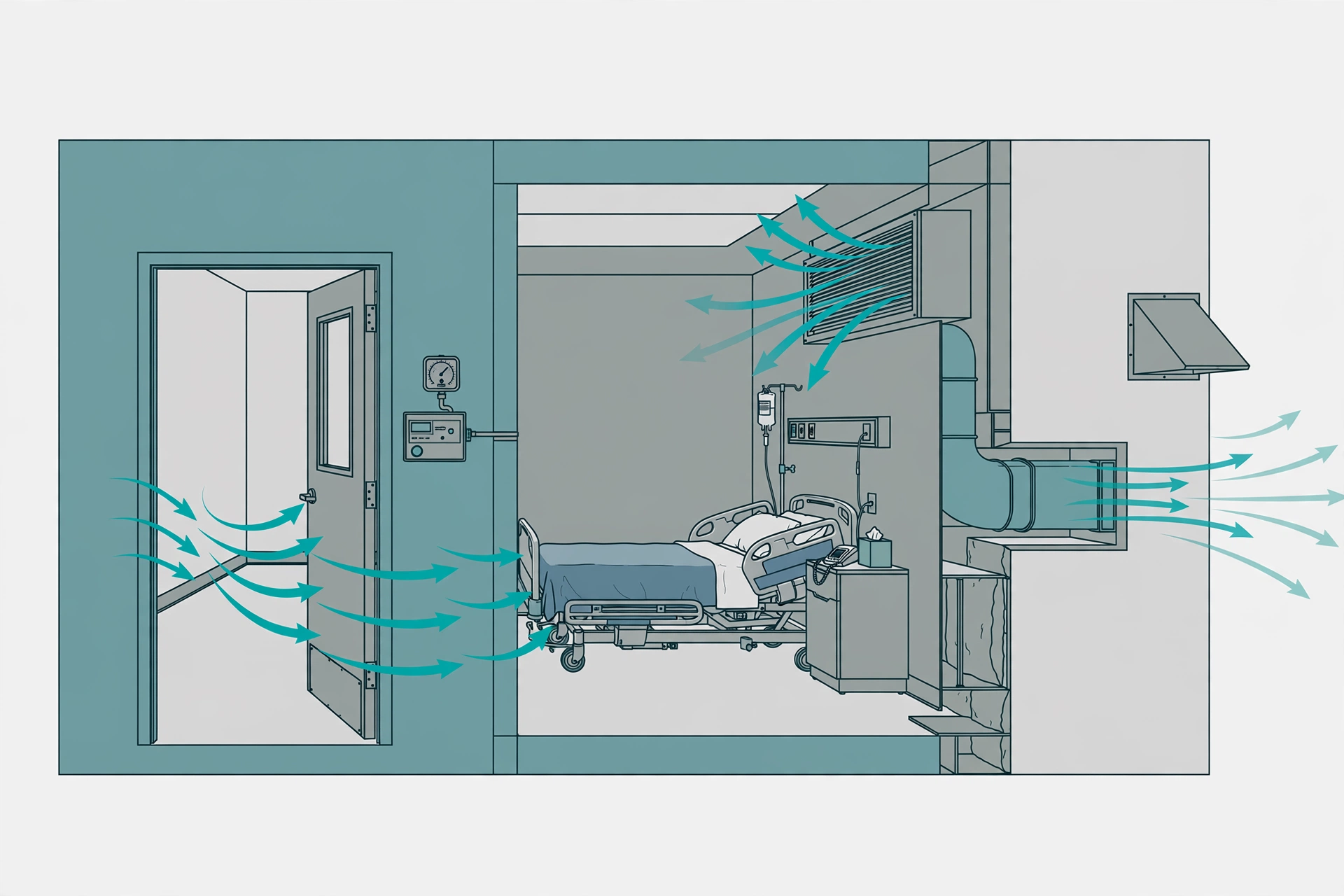
Airborne infection isolation (AII) rooms require negative pressure at a minimum of -0.01″ water column (2.5 Pa) relative to the corridor or anteroom, 12 total air changes per hour for new/renovated rooms (6 for existing), exhaust directly outdoors (the 2021 edition allows discharge to general exhaust under specified conditions), and documented pressure monitoring, ideally with a permanently installed visual monitor. Supply and exhaust must be arranged so clean air flows from the corridor-side toward the patient and out the exhaust — never short-circuiting.
The AII package
- Pressure: negative, minimum -0.01″ w.c. to corridor/anteroom; anterooms (where provided) at neutral or negative with their own 10 ACH.
- Air changes: 12 ACH new/renovated, 6 ACH existing; minimum 2 outdoor ACH typical.
- Exhaust: directly outdoors, away from intakes and occupied areas (25+ ft separation); 170-2021 permits general-exhaust discharge under conditions.
- Monitoring: permanent visual monitoring of pressure differential; alarms where required.
- Envelope: well-sealed — windows, doors, intake/exhaust penetrations constructed to hold the differential; self-closing doors.
- Recirculation: no recirculation by room units; HEPA filtration required if air must be recirculated.
AII vs. protective environment (PE)
Don’t confuse them: AII rooms are negative (protect others from the patient — TB, measles, COVID); PE rooms are positive (protect the patient from the environment — transplant, neutropenic). Combination AII/PE rooms exist with anterooms managing the pressure flip — among the most demanding designs in the standard.
Isolation room specifications, source by source
AII vs. PE in one line each. An airborne infection isolation (AII) room runs at negative pressure so air flows in and stays in; ASHE says AII rooms “are designed to prevent the spread of droplet nuclei expelled by a patient with disease” (ASHE 2021 ventilation guidance, p. 11). A protective environment (PE) room runs at positive pressure to keep contaminants away from an immunocompromised patient; CDC calls for positive room air pressure in relation to the corridor for PE rooms.
Pressure differential: 0.01 in. w.c. (2.5 Pa). CDC calls for AII rooms to maintain continuous negative air pressure of 2.5 Pa (0.01-inch water gauge) relative to the corridor, and for PE rooms to hold at least 2.5 Pa (0.01-inch water gauge) positive. ASHE gives the AII figure as at least -0.01 in. of water (-2.5 Pa) for newly constructed rooms, or -0.001 in. of water (-0.25 Pa) for rooms constructed before 2005 (ASHE, p. 11).
Air changes: 12 ACH new or renovated, 6 ACH existing AII. CDC says to provide at least 12 ACH for new and renovated AII rooms and at least 6 ACH for existing AII rooms, and to ventilate PE rooms to at least 12 ACH. ASHE states the AII split by building age: 12 ACH for newly constructed rooms, or 6 ACH for rooms constructed before 2005 (ASHE, p. 11).
PE supply air is HEPA-filtered. For PE rooms, CDC says to install central or point-of-use HEPA filters for supply (incoming) air, and to locate supply and exhaust grilles so clean, filtered air enters on one side of the room, flows across the patient’s bed and exits on the opposite side.
AII exhaust goes outdoors, or through HEPA if it must recirculate. CDC says to direct AII exhaust air to the outside, away from air-intake and populated areas; if that is not practical, room air can be recirculated after passing through a HEPA filter. CDC also says to locate exhaust outlets more than 25 ft from air-intake systems. ASHE adds that AII exhaust should sit at least 10 feet off rooftop level and 25 feet from outside air intakes to meet ASHRAE/ASHE Standard 170-2017 (ASHE, p. 17).
Pressure monitoring for AII rooms. CDC’s wording is to monitor air pressure periodically, preferably daily, using audible manometers or smoke tubes at the door for existing AII rooms, or a permanently installed visual monitoring mechanism, and to document the results. For PE rooms, CDC calls for daily airflow monitoring with permanently installed visual means in new or renovated construction.
Where the design values live in ASHRAE 170. The standard’s inpatient ventilation values sit in Table 7-1, which ASHRAE’s own published Addendum u to Standard 170-2021 titles “Design Parameters—Inpatient Spaces.” HFH does not reproduce rows from the paywalled standard. Check your licensed edition, the one your AHJ enforces, and see our ASHRAE 170 healthcare HVAC design guide for how to read the table.
Negative protects others. Positive protects the patient. Never confuse them.
FAQ
What pressure must an isolation room maintain?
Negative, minimum -0.01 inches water column (2.5 Pa) relative to the corridor or anteroom.
How many air changes does an AII room need?
12 total ACH for new/renovated rooms; 6 ACH for existing.
What is the difference between AII and PE rooms?
AII rooms are negative pressure (protect others from the patient); PE rooms are positive pressure (protect the immunocompromised patient from the environment).