Category: Regulatory Compliance

Joint Commission, CMS, OSHA, and state health department compliance requirements for healthcare facility managers.

  • Healthcare Regulatory Convergence in 2026: CMS, Joint Commission, NFPA, FGI, and the ESG Overlay

    Healthcare facilities in 2026 face simultaneous updates to CMS Conditions of Participation (CoP), Joint Commission Environment of Care standards, NFPA 101 and 99 amendments, FGI Guidelines 2026 edition, and emerging ESG disclosure requirements. What was once managed by separate compliance teams — clinical operations, facilities, environmental health & safety, and quality assurance — is now converged into a single facility governance and resilience framework.

    The Five-Layer Healthcare Compliance Stack

    Layer 1: CMS Conditions of Participation (CoP)
    CMS establishes baseline requirements for Medicare/Medicaid participation. In 2026, CMS is updating CoP standards in several critical areas:

    • Emergency Preparedness and Business Continuity: Facilities must have documented BC plans, test annually, and maintain redundancy for critical systems (power, water, communications).
    • Cybersecurity and Data Security: CMS is aligning with HHS cybersecurity guidance, requiring encryption, access controls, and incident response capability.
    • Infection Prevention and Control: Updates to environmental standards for ventilation, surface disinfection, and pathogen transmission prevention (influenced by post-COVID lessons).
    • Environmental Safety: Standards for hazardous materials, medical waste, and facility maintenance.

    CMS CoP compliance is mandatory for Medicare/Medicaid participation. Non-compliance triggers payment suspension and facility closure risk.

    Layer 2: Joint Commission Accreditation (JCAHO)
    Joint Commission sets accreditation standards above and beyond CMS CoP. In 2026, the Environment of Care standards update includes:

    • Life Safety and Evacuation: Updated guidance on evacuation procedures, especially for vulnerable populations (ICU, pediatrics).
    • Medical Equipment Management: Rigorous tracking and maintenance of critical medical equipment, including backup and redundancy.
    • Utility Systems: Management of water, power, steam, medical gas, and waste systems with documented contingencies for failure.
    • Construction and Renovation Safety: Dust control, worker health, and infection control during facility modifications.
    • Climate Resilience: Guidance on facility design and operations to withstand extreme weather, floods, and supply chain disruption.

    Joint Commission accreditation is voluntary but widely required by payers, insurers, and state licensing boards. Loss of accreditation has significant financial and reputation impact.

    Layer 3: NFPA 101 Life Safety Code and NFPA 99 Health Care Facilities Code
    NFPA standards establish detailed technical requirements for facility design and operations:

    • NFPA 101 (Life Safety Code): Defines exit requirements, fire detection, suppression, smoke control, and emergency lighting. The 2024 edition (adopted widely in 2026) includes updates to occupant evacuation time calculations and high-rise requirements.
    • NFPA 99 (Health Care Facilities Code): Covers medical gas systems, electrical power, water systems, fire protection, and emergency preparedness. 2026 amendments include updates to backup power duration and medical gas redundancy.

    Many states adopt NFPA codes as minimum standards for facility licensing. NFPA compliance is often a prerequisite for Joint Commission accreditation and CMS CoP surveyor expectations.

    Layer 4: FGI Guidelines 2026 Edition
    The Facility Guidelines Institute (FGI) publishes detailed design and operational guidance for healthcare facilities. The 2026 edition includes new guidance on:

    • Infection Prevention and Control Design: Ventilation specifications for isolation rooms, negative pressure requirements, air handling to minimize pathogen transmission.
    • Resilience and Redundancy: Facility design for operational resilience (single points of failure identified and mitigated).
    • Sustainable Operations: Energy efficiency, water conservation, renewable energy integration, waste reduction — increasingly required by state regulations and payer contracts.
    • Pandemic Preparedness: Design flexibility to accommodate surge capacity, rapid reconfiguration, and flexible staffing models.

    FGI Guidelines are voluntary but increasingly referenced in construction specifications, architect contracts, and Joint Commission standards.

    Layer 5: ESG and Sustainability Disclosure
    Healthcare systems are increasingly required to disclose ESG performance, especially regarding:

    • Climate Risk Disclosure (CSRD, state requirements): Large hospital systems must disclose climate risk exposure (flood risk, supply chain vulnerability, heat stress on staff and patients) and mitigation strategies.
    • Community Health and Equity: Requirements to address health disparities, community needs, and environmental justice (overlaps with CMS CoP social determinants of health requirements).
    • Supply Chain Resilience: Disclosure of critical supplier concentration, single points of failure in pharmaceutical and medical device supply chains.
    • Environmental Compliance and Waste Management: Disclosure of hazardous waste handling, pharmaceutical disposal, and environmental compliance.

    ESG disclosure is becoming a requirement for public health systems, health plans, and large hospital networks. Private equity and lender requirements are also driving adoption.

    The Convergence Pressure: Three Integration Challenges

    Challenge 1: Governance Fragmentation**
    Healthcare facility governance is traditionally fragmented:

    • Clinical Operations: Infection control, medical equipment management, clinical quality
    • Facilities Management: Building systems, maintenance, emergency preparedness
    • Environmental Health & Safety: Hazardous materials, medical waste, occupational health
    • Quality and Accreditation: Joint Commission, CMS CoP, state licensing
    • Sustainability/ESG: Energy, water, waste, carbon reporting (emerging function)

    These teams often report to different executives and use different risk assessment frameworks. But in 2026, regulators expect integrated governance: one board-level accountability for facility safety, resilience, and compliance.

    Challenge 2: Building System Interdependencies**
    Facility systems are interdependent in ways that regulations now explicitly address:

    • Infection control depends on ventilation (NFPA 99, FGI) and water safety (CMS CoP, NFPA 99)
    • Emergency preparedness depends on backup power (NFPA 99), communication systems (CMS CoP), and medical gas (NFPA 99)
    • Climate resilience depends on building envelope (FGI), backup systems (NFPA 99, CMS CoP), and supply chain (ESG)

    Managing these interdependencies requires integrated facility risk assessment, not separate compliance audits.

    Challenge 3: Continuous Compliance**
    Each regulatory framework has different compliance timelines and evidence requirements:

    • CMS CoP: biennial surveys, documented compliance
    • Joint Commission: triennial accreditation with unannounced surveys
    • NFPA: code adoption by states, periodic inspection (varies by state)
    • FGI: design guide update every 4 years (advisory, not mandatory)
    • ESG: annual disclosure, third-party assurance (emerging)

    The only practical approach is continuous compliance monitoring that feeds all frameworks simultaneously.

    Integrated Facility Governance: How to Structure It

    1. Single Facility Risk Register**
    Map all facility-related risks (system failures, environmental hazards, climate events, supply chain disruption) to a single register. Cross-reference which frameworks each risk maps to:

    • Ventilation system failure → Infection control (clinical), NFPA 99, FGI infection prevention
    • Water system contamination → CMS CoP, infection control (clinical), environmental compliance
    • Power failure → CMS emergency preparedness, NFPA 99 backup systems, operational resilience
    • Supply chain disruption → ESG disclosure, CMS CoP continuity of care, Joint Commission standards

    2. Consolidated Governance**
    Create single facility accountability structure:

    • Board Facility and Resilience Committee: Oversight of CMS CoP compliance, Joint Commission standards, NFPA/FGI implementation, ESG disclosure, reported as single agenda item
    • Chief Facilities Officer or Equivalent: Accountable for integrated facility compliance (not just maintenance)
    • Facility Compliance Program: Coordinates CMS CoP standards, Joint Commission compliance, NFPA/FGI implementation, and ESG disclosure

    3. Integrated Assessment and Testing**
    Design one annual compliance cycle that covers all frameworks:

    • Q1: Facility Risk Assessment — comprehensive assessment of all facility-related risks (systems, environmental hazards, climate events, supply chain). Maps to CMS CoP, Joint Commission, NFPA, FGI, and ESG.
    • Q2: Utility Systems Audit — evaluate power, water, gas, communications, waste systems. Verify redundancy and contingency plans (NFPA 99, CMS CoP, Joint Commission).
    • Q3: Emergency Preparedness Drill — full-scale test of emergency operations (power failure, water outage, supply disruption). Covers CMS CoP, Joint Commission, NFPA 101 evacuation requirements.
    • Q4: Regulatory Readiness Review — internal audit of CMS CoP standards, Joint Commission standards, NFPA compliance, FGI implementation, ESG disclosure readiness.

    4. Continuous Compliance Monitoring**
    Implement technology-enabled monitoring that feeds all frameworks:

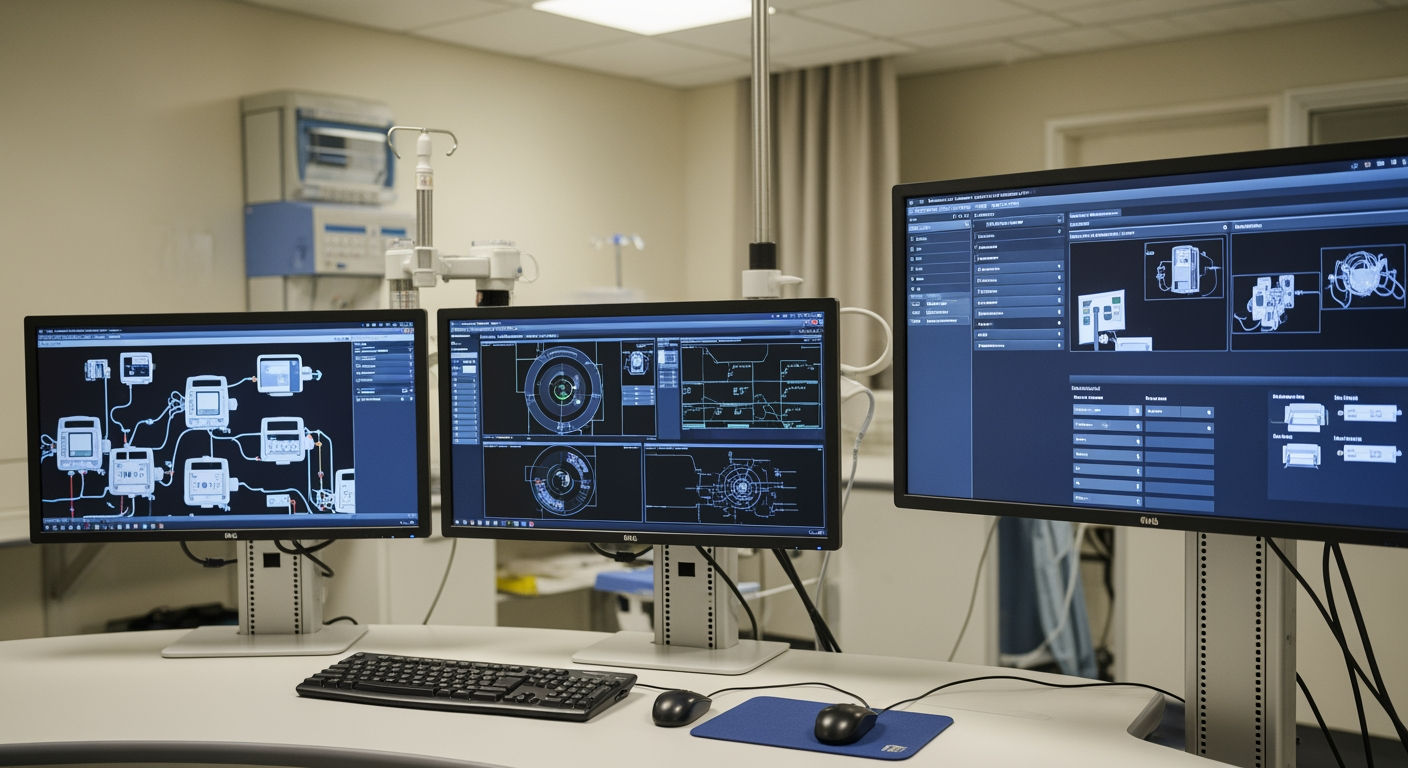
    • Building Management System (BMS): Real-time monitoring of HVAC, water, power, medical gas. Automated alerts for anomalies or failures. Documentation for CMS, Joint Commission, NFPA audit.
    • Medical Equipment Management System: Inventory, maintenance tracking, and testing documentation. Meets Joint Commission and CMS CoP standards.
    • Environmental Compliance Tracking: Hazardous waste generation, disposal, and documentation. Meets CMS CoP and environmental compliance requirements.
    • Supply Chain Risk Monitoring: Tracking of critical suppliers (pharmaceuticals, medical devices, sterile processing chemicals). Meets ESG disclosure and operational resilience requirements.

    Cross-Sector Context

    Healthcare facility compliance is experiencing the same convergence pressure that other sectors face. For broader context on regulatory convergence, see The 2026 Regulatory Convergence: ESG, Climate, AI, and Operational Standards.

    Business continuity teams are applying the same integration logic to operational resilience. Read Business Continuity Regulatory Convergence: DORA, CISA, ISO 22301.

    What Healthcare Facilities Must Do in 2026

    1. Map Your Regulatory Scope
    Determine which frameworks apply to your facility (CMS CoP is universal for Medicare/Medicaid; Joint Commission is accreditation-based; NFPA is state-dependent; FGI is design-based; ESG is emerging). Use Healthcare Regulatory Compliance: Complete Guide 2026 as your starting point.

    2. Establish Integrated Governance**
    Move from siloed compliance teams (clinical, facilities, EH&S, quality) to consolidated facility accountability. Assign a Chief Facilities Officer or equivalent with board-level visibility.

    3. Conduct Integrated Facility Assessment**
    Use Continuous Compliance Monitoring to assess all facilities across CMS CoP, Joint Commission, NFPA, FGI, and ESG simultaneously. Identify gaps and remediation priorities.

    4. Implement Continuous Monitoring Technology**
    Deploy building management systems, medical equipment tracking, and supply chain monitoring that feed all regulatory frameworks.

    5. Plan Your Audit Schedule**
    Coordinate CMS surveys, Joint Commission accreditation visits, and internal audits. Use one integrated audit program that addresses all frameworks simultaneously.

    Conclusion

    In 2026, healthcare facility compliance is no longer siloed by function (facilities, clinical, EH&S). It’s converged into a single facility governance and resilience capability that must satisfy CMS CoP, Joint Commission, NFPA, FGI, and ESG requirements simultaneously. Facilities that implement integrated governance, continuous monitoring, and consolidated audits will reduce cost, improve regulatory readiness, and emerge as compliance leaders. Those that maintain silos will fragment, burn resources, and face increasing regulatory friction.

  • AI Governance in Healthcare Facilities: FDA QMSR, CMS Oversight, and the Patient Safety Accountability Framework

    The FDA’s Quality Management System Regulation (QMSR) took full effect in January 2026, and it fundamentally changed how AI and machine learning systems in healthcare facilities are governed. Under QMSR, AI and ML medical devices are now treated as subject to expanded FDA oversight. Simultaneously, CMS is flagging AI systems in clinical operations, requiring healthcare facility leaders to document governance and accountability.

    The complexity: clinical AI (systems that influence diagnosis or treatment decisions) and operational AI (systems that manage facility operations, maintenance, or resource scheduling) follow different regulatory tracks, but both require governance frameworks that most healthcare facilities haven’t built.

    Healthcare facility leaders now face a governance challenge with multiple dimensions: FDA compliance for clinical AI, CMS oversight of clinical operations, facility management implications, and patient safety accountability. Getting this wrong creates regulatory liability and patient safety risk. Getting it right requires integrating FDA compliance, CMS coordination, and clinical governance into a unified framework.

    The FDA QMSR Framework for AI/ML Medical Devices

    Under QMSR, AI and ML medical devices are subject to FDA quality management system requirements. This applies both to devices that are themselves AI/ML systems and to medical devices that incorporate AI/ML components.

    The QMSR requirements for AI/ML systems include:

    Design History File (DHF): Comprehensive documentation of the design process, requirements, specifications, design inputs and outputs, design review records, and design changes. For AI/ML systems, this must include: training data sources, data preprocessing methods, model architecture, training procedures, validation testing, and design rationale.

    Design Verification and Validation: Testing to ensure the AI/ML system meets design requirements and performs as intended in its actual use environment. For clinical AI, this means testing across diverse patient populations, testing for bias and fairness, testing for edge cases, and testing for failure modes.

    Risk Management: Identification of potential failure modes and their consequences. For an AI diagnostic system, what happens if the system misdiagnoses? What’s the severity? What controls are in place? For an AI treatment recommendation system, what if the recommendation is incorrect? What safeguards exist?

    Cybersecurity and Software Integrity: Controls to ensure the AI system isn’t compromised through cyberattack, and controls to ensure the system maintains integrity throughout its lifecycle.

    Post-Market Surveillance: Ongoing monitoring of device performance. For AI/ML systems, this includes monitoring for model drift (performance degradation as new data is processed), monitoring for bias that emerges in clinical use, and systematic collection of adverse events.

    Here’s the critical requirement: any organization deploying an FDA-regulated AI/ML medical device in a healthcare facility must maintain documentation demonstrating QMSR compliance. If an FDA inspection occurs and the facility can’t produce design history, validation testing, risk management documentation, or post-market surveillance records, the facility is non-compliant.

    Many healthcare facilities have deployed clinical AI systems without building these documentation systems. They have the technology; they don’t have the regulatory framework. That gap is the vulnerability.

    CMS Oversight and Clinical AI Governance

    Beyond FDA oversight of medical devices, CMS is scrutinizing AI systems in clinical operations. CMS is asking: what AI systems are used in clinical decision-making? How are they governed? How are patient safety risks managed? What documentation exists?

    CMS guidance focuses on several areas:

    Transparency and Disclosure: Patients and clinicians should understand when AI is influencing clinical decisions. If an AI system is recommending a diagnosis, treatment, or medication, that should be disclosed. Both clinicians and patients should know they’re receiving AI-assisted care.

    Clinician Oversight: AI systems should not make autonomous clinical decisions. A human clinician must review AI recommendations, understand them, have the authority to override them, and take responsibility for the clinical decision. The AI is a tool; the clinician is the decision-maker.

    Bias and Fairness: AI systems used in clinical settings must be tested for bias across patient demographics. If an AI diagnostic system performs differently across racial or ethnic groups, that’s a patient safety risk. Testing and documentation required.

    Data Governance: Patient data used to train clinical AI systems must be managed under strict privacy and security controls. HIPAA applies. But also, the facility must understand: what patient data was used to train the model? Does the model incorporate biases present in historical data? Has historical bias been identified and corrected?

    CMS is also monitoring adverse events: if a clinician relies on an AI recommendation and that recommendation leads to patient harm, the facility must be able to demonstrate it followed appropriate governance protocols. Without documentation, the facility is liable.

    Clinical AI vs. Operational AI: Different Tracks

    Healthcare facilities use AI systems in two categories: clinical and operational. The governance paths differ significantly.

    Clinical AI: Systems that influence diagnosis, treatment, medication, or patient safety decisions. Examples: AI diagnostic imaging analysis, AI-powered clinical decision support, AI drug interaction checking, AI adverse event prediction.

    Clinical AI is regulated. FDA QMSR applies (if the system is a medical device). CMS oversight applies. Patient safety is at risk. Governance is mandatory and stringent.

    Operational AI: Systems that manage facility operations but don’t directly influence clinical decisions. Examples: predictive maintenance (AI predicts equipment failure), resource scheduling (AI schedules staff or OR time), supply chain optimization (AI manages inventory).

    Operational AI is less heavily regulated but still carries risk. If predictive maintenance fails and critical equipment breaks during surgery, that’s a patient safety risk. If staff scheduling fails and ER is understaffed, patient care is compromised. Operational AI needs governance, but it’s not as stringent as clinical AI governance.

    The key for healthcare facility leaders: understand which category each AI system falls into. If there’s ambiguity (does this system influence clinical decisions indirectly?), err on the side of clinical governance. Clinical governance is stricter, but it’s the safe path.

    Building the Healthcare AI Governance Framework

    Healthcare facilities that move decisively in 2026 on AI governance will establish a framework with these components:

    AI System Inventory: Document every AI system in use: clinical and operational. For each, record: purpose, decision authority (does it decide or recommend?), regulatory classification (is it a medical device? Does FDA oversight apply?), training data sources, validation testing completed, CMS oversight status.

    Clinical AI Validation Protocol: For clinical AI systems, establish systematic validation: accuracy testing across patient demographics, bias testing (does performance differ by race, gender, age?), testing for edge cases (rare conditions, unusual presentations), validation in actual clinical environment with real clinicians and real patients.

    Design History and Documentation: For FDA-regulated AI systems, maintain comprehensive design history: training data sources and preprocessing, model architecture and training procedures, design inputs and outputs, validation testing results, risk management documentation, design change history.

    Clinician Governance and Oversight: Establish that human clinicians are accountable for AI-assisted clinical decisions. Document: which clinicians are authorized to use AI systems? What training have they received? How do they evaluate AI recommendations? What’s the escalation path if they disagree with AI recommendations?

    Patient Safety and Adverse Event Reporting: Implement systematic monitoring for adverse events. If an AI-assisted clinical decision leads to patient harm, document the event, investigate the cause, and determine whether the AI system failed or whether the clinician’s use was inappropriate. Report findings to FDA MedWatch if applicable.

    Post-Market Surveillance: For clinical AI systems, establish ongoing monitoring: track system performance over time. Has accuracy degraded? Has bias emerged in clinical use? Are there patterns in adverse events? Review monitoring results quarterly with clinical leadership.

    Privacy and Data Governance: Ensure patient data used for training and testing AI systems is managed under HIPAA controls. Document: what patient data was used? How was it de-identified? Was consent obtained? Can the data be traced back to patients? Audit regularly.

    The CMS and FDA Coordination Challenge

    One complexity: FDA oversight and CMS oversight sometimes create different requirements. FDA may require extensive validation documentation; CMS may require different transparency disclosures. Healthcare facilities need governance that satisfies both.

    The path forward: build governance that satisfies the stricter requirement. If FDA requires Design History documentation and CMS requires patient transparency, do both. The facility that can produce comprehensive documentation satisfies both regulators and demonstrates commitment to patient safety.

    The Patient Safety Accountability Framework

    At the core: accountability. When AI is involved in clinical care, who is accountable if something goes wrong?

    The answer: the healthcare facility and the clinician who made (or approved) the clinical decision. Not the AI vendor. Not the algorithm. The clinical team.

    This means:

    Clinicians must understand AI systems well enough to evaluate recommendations. If a clinician can’t explain why they accepted an AI recommendation, they’re not practicing medicine responsibly.

    Healthcare facilities must ensure clinicians are trained on AI systems and authorized to use them. If a clinician is using an AI system without training, the facility is liable.

    The facility must have documented governance showing that AI systems are appropriately validated, monitored, and governed. If the facility deploys AI without governance, regulators and courts will assume the facility is negligent.

    Patients should know when AI is influencing their care. Transparency builds trust and protects both clinicians and facilities from future disputes about whether informed consent was obtained.

    The 2026 Regulatory Timeline

    QMSR is in effect now. CMS is actively reviewing AI governance at healthcare facilities. We expect:

    Q2-Q3 2026: CMS and state health departments conduct surveys and audits of clinical AI governance at healthcare facilities.

    Q4 2026: FDA issues guidance on post-market surveillance for clinical AI systems. Possible enforcement actions against facilities with inadequate governance.

    2027: Possible updates to CMS conditions of participation to explicitly require clinical AI governance frameworks.

    Healthcare facilities building governance now will move smoothly through future surveys and audits. Facilities without frameworks will face enforcement risk.

    Related Reading:

  • Healthcare Cybersecurity and Medical Device IoT Security: NIST Framework, FDA QMSR, and CMS Compliance in 2026

    Healthcare Cybersecurity and Medical Device IoT Security: NIST Framework, FDA QMSR, and CMS Compliance in 2026


    Healthcare Cybersecurity and Medical Device IoT Security: NIST Framework, FDA QMSR, and CMS Compliance


    Healthcare Cybersecurity and Medical Device IoT Security: NIST Framework, FDA QMSR, and CMS Compliance

    Healthcare Cybersecurity: The practice of protecting healthcare information systems, medical devices, and patient data from unauthorized access, theft, and damage through technical controls, administrative policies, and continuous monitoring aligned with NIST, FDA, and CMS standards. Medical device IoT security refers specifically to the protection of connected biomedical equipment—including ventilators, infusion pumps, monitors, and diagnostic systems—that communicate across networks and require encryption, authentication, and real-time threat detection to prevent both operational disruption and patient harm.

    The 2026 Healthcare Cybersecurity Landscape and Regulatory Acceleration

    Healthcare organizations face an unprecedented convergence of cybersecurity mandates in 2026. The FDA’s Quality Management System Regulation (QMSR), effective February 2, 2026, fundamentally elevates cybersecurity requirements for all connected medical devices by incorporating ISO 13485:2016 standards. Simultaneously, NIST SP 800-213, released in final form in early 2025, provides the definitive framework for medical device cybersecurity posture, and CMS continues expanding its audit scope to include real-time cybersecurity compliance verification during Medicare surveys.

    Unlike previous years when cybersecurity was treated as an IT concern isolated from clinical operations, 2026 requirements demand integrated governance where facility operations teams, clinical engineering, IT security, and risk management collaborate on a unified cybersecurity program. The stakes are clarified: a ransomware attack disabling medical devices is now understood as a patient safety incident requiring immediate reporting, FDA investigation, and potential enforcement action.

    This article details the regulatory framework, technical implementation requirements, and governance structures that healthcare facilities must establish to achieve compliance and maintain operational resilience in 2026.

    NIST SP 800-213: The Authoritative Medical Device Cybersecurity Standard

    NIST SP 800-213, published in final form, establishes the comprehensive cybersecurity framework specifically designed for medical device manufacturers, healthcare organizations, and third-party service providers. Unlike the broader NIST Cybersecurity Framework, SP 800-213 addresses the unique constraints of medical devices: they cannot always be patched immediately (due to FDA validation requirements), their failure can directly cause patient harm, and their operational environments (hospital networks, isolated systems, bedside devices) require context-aware security approaches.

    The framework organizes medical device cybersecurity across five core functions: Identify (knowing what devices exist, their connectivity, and vulnerabilities), Protect (implementing technical and administrative safeguards), Detect (monitoring for unauthorized access or anomalous behavior), Respond (containing and remediating incidents), and Recover (restoring device functionality and data integrity).

    For facility operations teams, NIST SP 800-213 compliance translates into several operational requirements:

    • Device Inventory and Asset Management: Maintaining an authoritative list of all medical devices, their models, firmware versions, connectivity status (wired, wireless, cellular), and communication protocols. This inventory must be updated at minimum quarterly and synchronized with biomedical engineering and IT security departments.
    • Vulnerability Monitoring: Subscribing to FDA Medical Device Reporting (MDR) databases, manufacturer security bulletins, and NIST’s Medical Device Cybersecurity Database to stay informed of known vulnerabilities affecting devices in your facility’s inventory.
    • Risk Assessment Integration: Conducting device-specific risk assessments that evaluate the likelihood and impact of cybersecurity events on clinical operations and patient safety. Devices with high consequence-of-failure (such as infusion pumps, ventilators, patient monitors) require enhanced protections.
    • Segmentation and Network Architecture: Designing network infrastructure that isolates critical medical devices from general IT networks, implementing air-gapped systems where appropriate, and controlling data flows using firewalls, VLANs, and demilitarized zones (DMZs).

    FDA QMSR (Effective February 2, 2026) and ISO 13485:2016 Integration

    The FDA’s Quality Management System Regulation revision represents a watershed moment for medical device cybersecurity accountability. By incorporating ISO 13485:2016—which includes explicit cybersecurity and software security requirements—the QMSR makes cybersecurity an integral part of device quality, not a bolt-on afterthought. For healthcare facility operations, this manifests in several critical areas:

    Device Selection and Procurement: Facilities must now evaluate manufacturer cybersecurity maturity before purchasing. The QMSR requires manufacturers to demonstrate documented processes for identifying and managing cybersecurity risks throughout a device’s lifecycle. During procurement, facility teams should request evidence of the manufacturer’s cybersecurity program, including vulnerability disclosure procedures, patch management timelines (how quickly they can release patches and whether they require FDA approval), and incident response capabilities.

    Post-Market Surveillance Obligations: Healthcare facilities are increasingly viewed as extensions of the manufacturer’s quality system. When you purchase a connected medical device, you assume responsibility for monitoring its performance and reporting adverse events—including cybersecurity-related failures—to the manufacturer and FDA. A HVAC system breach that cascades to affect a hospital’s connected ICU monitors could trigger MDR reporting obligations for both the HVAC vendor and the healthcare facility.

    Software Update and Patch Management: The QMSR’s incorporation of ISO 13485:2016 Chapter 8 on software lifecycle management means devices must have defined, validated update procedures. Facilities cannot simply defer security patches indefinitely; instead, a documented risk assessment must justify any decision to remain on an older, vulnerable version. Patch deployment schedules must align with clinical downtime windows and be documented as part of the facility’s cybersecurity risk management plan.

    The practical implication: facilities must allocate dedicated biomedical or clinical engineering resources to oversee software updates for dozens or hundreds of connected devices, coordinate with IT security on deployment timing, and maintain audit trails proving compliance with manufacturer and FDA requirements.

    Connected Medical Device Vulnerability Landscape: Understanding the Threat Environment

    Medical device cybersecurity threats in 2026 have evolved from theoretical concerns to documented attack patterns. According to CISA (Cybersecurity and Infrastructure Security Agency) alerts from 2025, threat actors specifically target healthcare networks for ransomware deployment, targeting HVAC systems, building automation, and networks connected to medical devices. The attack surface has expanded as devices that were never designed to be connected—legacy infusion pumps, laboratory analyzers, surgical equipment—have been network-enabled for remote monitoring and data collection.

    Common vulnerability categories affecting healthcare facilities include:

    • Weak or Default Authentication: Many medical devices ship with default passwords or support hardcoded credentials. Facility teams often find that legacy devices cannot have passwords changed due to firmware limitations, creating persistent security gaps that require network-level compensating controls.
    • Unencrypted Data Transmission: Older medical devices may communicate using unencrypted protocols (HTTP instead of HTTPS, unsecured MQTT instead of secure MQTT), allowing network eavesdropping of patient data or device commands.
    • Lack of Mutual Authentication: Some devices accept commands from any source on the network without verifying the sender’s identity. An attacker on the same network segment could impersonate a legitimate monitoring system and send false commands to change infusion rates, ventilator settings, or imaging parameters.
    • Firmware Supply Chain Vulnerabilities: Manufacturers source components from multiple vendors; a vulnerability in a third-party library used across dozens of device models can affect your entire facility inventory at once.
    • Lack of Anomaly Detection: Many devices have no built-in capability to detect unusual access patterns, configuration changes, or command sequences. A ransomware infection on the facility’s EHR network could enumerate devices and initiate destructive commands without any device-level alerting.

    Encryption, MFA, and Continuous Monitoring: Technical Implementation Requirements

    Meeting 2026 compliance requirements demands specific technical controls that must be implemented across the medical device ecosystem:

    FIPS 140-2 Cryptography: All data in transit and sensitive data at rest involving medical devices must use encryption algorithms validated under NIST’s Federal Information Processing Standards (FIPS) 140-2 Level 1 as a minimum. For healthcare facilities, this means: all wireless medical device communication must use WPA3 enterprise or equivalent, all device-to-cloud communication must use TLS 1.2 or higher with FIPS-validated cipher suites, and any locally stored device configuration or patient data must be encrypted using AES-256 or equivalent.

    In practice, facilities often discover that legacy devices support only outdated encryption standards (TLS 1.0, WEP, proprietary encryption). These devices must be segregated onto dedicated network segments, behind network access control systems that verify device identity before allowing connection.

    Multi-Factor Authentication (MFA) for Administrative Access: Any person accessing medical device configuration, firmware update functions, or network settings must authenticate using at least two independent factors. In healthcare settings, this typically means: something you know (a strong password with complexity requirements) plus something you have (a hardware token, certificate, or app-based TOTP generator). Biometric factors can serve as a second factor in lower-assurance scenarios but should not be the sole factor.

    The challenge: many facilities have dozens of technicians and IT staff with device access. Managing credentials, enforcing MFA across legacy devices that don’t support it natively, and maintaining audit logs of who accessed what device when requires significant infrastructure investment in identity and access management (IAM) systems specifically configured for medical device environments.

    Continuous Monitoring and Real-Time Threat Detection: The 2026 standard moves beyond periodic vulnerability scans to continuous monitoring. Facilities must implement network monitoring that logs all device communication in real time, analyzes traffic for anomalies (devices connecting to unexpected destinations, unusual data volumes, commands to devices from unauthorized sources), and generates alerts when suspicious patterns occur.

    This monitoring must be automated—a facility cannot manually review millions of network transactions daily. Modern approaches use machine learning to establish baseline device behavior and flag deviations: if a particular infusion pump has never communicated outside the hospital network but suddenly attempts to reach an external IP address, the system should alert security and clinical engineering immediately, potentially isolating the device before it propagates ransomware.

    Implementation requires investment in security information and event management (SIEM) systems or managed detection and response (MDR) services that understand healthcare device protocols and can distinguish between legitimate clinical workflows and malicious activity.

    Integration with Healthcare Facility Risk Management and Incident Response

    Cybersecurity incidents involving medical devices are patient safety incidents. A ransomware attack that disables infusion pumps or locks clinicians out of ventilator settings is not merely an IT problem—it triggers patient safety reporting obligations, incident investigation requirements, and potentially FDA involvement.

    Facilities must integrate cybersecurity incident response into their broader patient safety and risk management infrastructure:

    • Cybersecurity events must be escalated to the patient safety officer and clinical leadership immediately, not after IT personnel have investigated for hours.
    • Incident response procedures must account for device-specific recovery challenges: some devices require FDA approval before deploying security patches; some cannot be rapidly rebooted without disrupting patient care.
    • Post-incident analysis must feed into device procurement decisions, network architecture improvements, and staff training updates.

    Governance, Accountability, and 2026 Compliance Roadmap

    Healthcare cybersecurity cannot be delegated to IT alone. Effective governance requires a defined committee structure with representation from clinical operations, biomedical engineering, IT security, compliance, and risk management. This committee must meet monthly at minimum to review device inventory changes, approve new device procurement, evaluate vulnerability reports, and oversee incident response.

    Building Your 2026 Compliance Program:

    Phase 1 (Q2 2026): Complete a comprehensive inventory of all networked and potentially connectable medical devices. Document each device’s: model and firmware version, network connectivity method, encryption capabilities, authentication mechanisms, update/patch history, and clinical consequence-of-failure rating. This inventory is the foundation for all subsequent risk management.

    Phase 2 (Q2-Q3 2026): Conduct a NIST SP 800-213 gap assessment. For each device category, evaluate your current state against the framework’s requirements. Identify devices lacking FIPS-compliant encryption, administrative access without MFA, lack of firmware update mechanisms, and absence of anomaly detection. Document remediation strategies: upgrading devices, implementing network segmentation, deploying monitoring systems, or accepting risk through documented exceptions.

    Phase 3 (Q3-Q4 2026): Implement highest-priority controls. Begin with network segmentation (isolating medical devices from general IT networks and from each other based on risk), enabling MFA for administrative access across your device estate, and deploying continuous monitoring for critical device traffic.

    Phase 4 (Ongoing): Establish vendor management processes requiring cybersecurity maturity assessment during procurement, subscription to manufacturer security bulletins, and incident response collaboration agreements. Update procurement RFPs to include NIST SP 800-213 compliance requirements and FDA QMSR adherence.

    FAQ: Medical Device Cybersecurity and FDA/CMS Compliance

    Q: Our hospital has legacy devices that cannot be updated to meet FIPS 140-2 encryption standards. Are we out of compliance?

    A: Not necessarily, but you must document the risk and implement compensating controls. NIST SP 800-213 allows for risk-based exceptions when devices cannot meet all requirements, provided you have conducted a formal risk assessment, documented the specific vulnerabilities, implemented alternative controls (network segmentation, access restrictions, continuous monitoring), and obtained authorization from your organization’s risk management committee. These exceptions must be reviewed annually and included in your compliance documentation for CMS audits.

    Q: Who owns responsibility for medical device cybersecurity compliance in a healthcare facility?

    A: This is a shared responsibility, but typically: the Chief Information Security Officer (CISO) or equivalent oversees the overall program and network security; the Chief Medical Information Officer (CMIO) or clinical engineering director manages device inventory and procurement decisions; biomedical/clinical engineering staff handle device-specific configurations and firmware updates; and the compliance officer ensures reporting obligations are met. Effective governance requires a medical device cybersecurity committee with representation from all these functions that meets regularly and has decision-making authority.

    Q: How frequently must we scan medical devices for vulnerabilities, and what tools should we use?

    A: Vulnerability scanning must be continuous for critical devices (those with high consequence-of-failure) and at minimum quarterly for others. However, traditional network vulnerability scanners can disrupt medical devices. Most facilities use specialized healthcare-approved tools that understand device communication protocols and can safely assess security posture without interfering with clinical operations. Conduct passive network monitoring continuously, schedule active scanning during planned maintenance windows, and partner with specialized healthcare cybersecurity vendors who understand the constraints of medical device environments.

    Q: What is the FDA’s current enforcement posture on medical device cybersecurity violations?

    A: As of 2026, the FDA has moved from advisory guidance to enforcement. Healthcare facilities that cannot demonstrate a documented cybersecurity program aligned with NIST SP 800-213 face potential warning letters, consent decrees, and device recalls. The QMSR changes effective February 2, 2026, signal that FDA expectations are now regulatory requirements, not recommendations. Manufacturers must demonstrate compliance during pre-market review and post-market surveillance. Healthcare facilities that fail to maintain reasonable security controls over high-risk devices could face citations during Medicare surveys and potential payment adjustments under CMS quality programs.

    Conclusion: 2026 as the Turning Point for Healthcare Device Security

    The convergence of NIST SP 800-213, FDA QMSR, and CMS enforcement in 2026 represents the maturation of healthcare cybersecurity from a nice-to-have to a fundamental operational requirement. Healthcare facilities that begin their compliance journey now—completing device inventories, assessing gaps, and implementing priority controls—will navigate 2026 Medicare surveys and regulatory audits with confidence. Those that delay risk warning letters, device restrictions, and the operational disruption of remediation under enforcement pressure.

    The path forward requires sustained commitment: budget allocation for specialized staff and tools, governance structures that integrate cybersecurity into clinical operations, and vendor partnerships that support ongoing vulnerability management. The investment is substantial, but the alternative—a healthcare facility vulnerable to ransomware, device compromise, or patient harm from cyberattack—is far more costly in terms of reputation, legal liability, and patient safety.


  • Continuous Compliance Monitoring: Real-Time CMS Survey Readiness and Technology-Enabled Healthcare Operations

    Continuous Compliance Monitoring: Real-Time CMS Survey Readiness and Technology-Enabled Healthcare Operations


    Continuous Compliance Monitoring: Real-Time CMS Survey Readiness and Technology-Enabled Operations


    Continuous Compliance Monitoring: Real-Time CMS Survey Readiness and Technology-Enabled Operations

    Continuous Compliance Monitoring: The practice of using integrated technology systems to track, update, and document healthcare facility compliance status across all regulatory domains (CMS conditions of participation, state licensure, accreditation standards) in real time rather than preparing for point-in-time audits. Technology-enabled operations shift compliance from a reactive function (preparing for surveys) to a proactive operational reality where compliance is embedded in daily workflows, automatically captured in auditable systems, and continuously verified against regulatory requirements.

    The Compliance Paradigm Shift: From Audits to Operations

    For decades, healthcare facility compliance operated on a predictable cycle: CMS surveyors would announce a visit weeks in advance, triggering intensive preparation—staff meetings, document gathering, facility inspections, staff retraining, and rapid remediation of observed deficiencies. This “point-in-time” approach created an adversarial relationship between compliance teams and operations, where the goal was to “pass the survey” rather than maintain continuous operational excellence.

    In 2026, this model is becoming indefensible. CMS has shifted toward unannounced surveys and complaint-triggered reviews, reducing the advance notice period from weeks to days or hours. Simultaneously, the regulatory environment has become more sophisticated: surveyors now review electronic records in real time, audit automated monitoring systems, and assess how facilities use data to drive continuous improvement. This convergence creates an inescapable reality: the only defensible way to achieve compliance at scale is to make compliance an operational function, not an audit preparation function.

    Healthcare facilities that have implemented continuous compliance monitoring report three transformative outcomes: first, they pass surprise CMS surveys without intensive preparation because compliance is genuinely continuous; second, they reduce the burden on clinical staff because compliance documentation is automated rather than manually assembled before surveys; third, they identify and remediate deficiencies in real time, preventing patient harm and regulatory violations from occurring in the first place.

    Modern Systems Tracking and Automated Compliance Documentation

    Continuous compliance monitoring requires integration across multiple technology systems that traditionally operated in silos: the facility management system (tracking environment of care, maintenance, repairs), the electronic health record (documenting clinical processes and infection control), the human resources management system (tracking staff competency, training, immunization), the quality management system (recording incidents, near-misses, complaint investigations), and specialized compliance platforms that aggregate data from these systems and assess it against regulatory requirements.

    Environment of Care Monitoring: CMS requires healthcare facilities to maintain safe, clean, and functional physical environments. Traditionally, this meant facility staff conducting monthly or quarterly inspections, documenting findings in paper logs or spreadsheets, and hoping surveyors didn’t discover the areas not recently inspected. Modern facilities now implement building management systems (BMS) integrated with mobile-based inspection tools that capture real-time data on environmental conditions.

    Example workflow: A nurse notices a maintenance issue (water stain on ceiling in patient care area). Instead of calling maintenance and hoping the issue is documented, she uses the BMS app on her phone to photograph the issue, document the location, assign it to maintenance, and set a due date for repair. The system automatically logs this as an environment of care issue, creates a maintenance work order, tracks repair completion, and archives the documentation for CMS audit. When surveyors ask about environment of care compliance, the facility can produce the complete audit trail: when the issue was identified, what action was taken, when it was resolved, and what follow-up was performed.

    Clinical Process Documentation and Infection Control Compliance: Infection control and clinical processes (medication administration, patient identification, fall prevention) require constant verification that staff are following established protocols. Traditionally, supervisors conducted periodic chart audits and observations to verify compliance. The challenge: these spot checks cover only a tiny fraction of care episodes. A patient may receive medications for a week with correct identification procedures 100 times, but if an auditor happens to observe the one instance where verification was missed, that becomes a surveyor finding.

    Continuous monitoring approaches use a combination of electronic verification and targeted auditing. For example, medication administration can be verified electronically through the EHR’s barcode administration system, which logs patient identification, medication verification, and administration details for every single dose. Infection control protocols can be tracked through real-time hand hygiene monitoring systems (RFID tracking of staff movements near hand hygiene stations) combined with periodic observational audits that target specific high-risk moments (central line care, wound care, contact precautions) rather than random times.

    The shift from random spot checking to systematic, continuous data capture fundamentally changes compliance assurance. Instead of hoping your spot-check sample happened to find problems, you now have complete data. If an adverse event occurs (medication error, healthcare-associated infection), you can analyze the complete data stream to understand whether established protocols were followed or failed, and implement system-wide corrections before the next surveyor visit.

    Staff Competency and Training Automation: CMS requires that staff maintain current competency in their roles, with documentation of training, competency assessments, and continuing education. Historically, staff pulled together their own training records, HR compiled lists of who was current and who was not, and before surveys, there would be a scramble to get staff trained on whatever topic was deemed likely to be surveyed.

    Modern learning management systems (LMS) track all training and competency requirements, auto-alert when renewals are due, document completion and assessment scores, and generate compliance reports on demand. When a surveyor asks “Are your ICU nurses current on the hospital’s sepsis protocol?”, the compliance officer can query the system and provide real-time data: all 47 ICU nurses completed sepsis training, the average assessment score was 92%, and 45 of 47 have completed competency assessments by supervised observation. This data-driven compliance posture is far more persuasive than paper certificates or “we’re pretty sure everyone is trained.”

    Environment of Care Rounds Automation: Making Compliance Visible

    One of the most visible and frequently cited areas during CMS surveys is environment of care compliance—is the physical facility safe, clean, and functional? Traditionally, this was managed through monthly or quarterly rounds where facilities staff inspected specific areas, completed checklists, documented findings, and attempted repairs before surveyors arrived. The process was labor-intensive, coverage was incomplete, and by the time a survey arrived, new issues had typically emerged.

    Continuous monitoring approaches automate environment of care rounds by implementing mobile-based systems that integrate with facility management software. The workflow: facilities define a structured set of environment of care metrics based on CMS standards (air handling, water temperature, pest control, emergency lighting, fire safety equipment, flooring integrity, paint condition, equipment functionality). These are organized by zone (ICU, ED, OR, patient rooms, hallways, storage areas) and assigned to specific staff members for daily, weekly, or monthly assessment depending on risk.

    Staff use mobile apps to perform rounds, which include photo capture, automated GPS tagging of location, and structured assessment questions. Results are logged in real time to the facility management system, which automatically generates work orders for deficiencies, assigns them to maintenance, sets due dates, and tracks completion. The system also generates compliance dashboards for operations and quality leadership: “97% of environment of care checkpoints completed this month; 14 issues identified; 12 resolved; 2 in progress with target dates.”

    This approach offers two critical advantages for compliance. First, environment of care monitoring becomes continuous rather than survey-driven. Surveyors walking through the facility are not discovering new environmental issues because they’re already identified and being remediated through the ongoing monitoring process. Second, facilities have complete documentation of their compliance activity: when each area was inspected, what was found, what action was taken. When surveyors ask about a specific area, the facility can produce the inspection history for the past six months, demonstrating systematic attention to environment of care.

    Complaint and Incident Management as Compliance Intelligence

    Patient complaints, staff concerns, near-miss events, and adverse incidents are not just patient safety data—they’re also compliance intelligence. A pattern of complaints about wait times in the ED might indicate capacity compliance issues. A cluster of infection control near-misses might reveal gaps in protocol understanding or environmental hazards. Medical staff credentialing concerns might signal quality assurance deficiencies.

    Sophisticated facilities now integrate their incident management systems with compliance tracking, allowing the compliance officer to identify trends and systemic issues before they reach surveyor attention. For example, if five different staff members report difficulty accessing emergency equipment in a specific patient care unit, the system flags this as a potential environment of care compliance concern and triggers engineering assessment and remediation. When surveyors later inspect that unit and find emergency equipment easily accessible with current inspection documentation, the facility has already demonstrated its commitment to continuous compliance improvement.

    Real-Time Compliance Dashboards and Escalation Protocols

    The practical implementation of continuous monitoring requires a control center of sorts: a central compliance dashboard that aggregates data from all monitoring systems and presents actionable status information to facility leadership. This dashboard should show:

    • Compliance status across all CMS conditions of participation (scores, trend lines)
    • Number of open compliance-related incidents or deficiencies and days overdue
    • Staff training and competency currency rates by department and risk area
    • Environment of care round completion rates and identified issues
    • Patient safety event trends and root cause analysis status
    • State licensure and accreditation-specific compliance metrics

    Leadership should review this dashboard weekly and establish clear escalation protocols: if training completion drops below 95%, if environment of care round completion falls below 90%, or if critical deficiencies remain open beyond defined timelines, automatic escalation triggers occur (email alerts to department heads, reporting to compliance committee, assessment by executive leadership).

    This approach prevents the “surprise” CMS finding. Issues don’t fester for months until a survey uncovers them; they’re identified and remediated in real time because leadership has visibility and accountability. When surveyors eventually arrive, they’re not discovering new problems—they’re verifying that the facility’s continuous monitoring systems are functioning effectively.

    Technology Implementation Roadmap: Building Continuous Compliance Infrastructure

    Phase 1: Assessment and System Integration (Q2 2026)

    Begin by conducting a comprehensive assessment of existing systems. Most healthcare facilities already have multiple compliance-related tools in place: electronic health records, facility management systems, learning management systems, incident reporting platforms. The first phase of continuous monitoring is integration—connecting these systems so that compliance data flows from operational systems into a central compliance intelligence platform rather than requiring manual data gathering before surveys.

    Identify the regulatory requirements that are most frequently cited in surveys and highest-risk. For most hospitals, these fall into categories like: medication administration safety, infection prevention, environment of care, staff competency, medical staff credentialing, and quality assurance processes. Design data collection processes that capture evidence of compliance in these areas on an ongoing basis.

    Phase 2: Mobile and Sensor Infrastructure (Q3 2026)

    Implement mobile tools that enable staff to document compliance observations and issues in real time rather than collecting data retrospectively. This includes environment of care inspection apps, incident reporting apps, training completion tracking through mobile LMS access, and staff competency assessments. Depending on facility size and complexity, consider adding sensor infrastructure: automated hand hygiene monitoring at key locations, environmental sensors for temperature and humidity control verification, equipment monitoring that logs functionality and maintenance intervals.

    Phase 3: Data Integration and Automation (Q4 2026)

    Connect data flows from operational systems to the compliance intelligence platform. This requires IT infrastructure work: APIs connecting the EHR to the compliance system, integration of facility management system data, linking the LMS to compliance dashboards. Once data flows are integrated, implement automated alerts: when training completion drops below thresholds, when environment of care round completion lags, when incident patterns emerge, or when critical deficiencies remain open beyond defined timelines.

    Phase 4: Analytics and Continuous Improvement (2027 and Beyond)

    Once continuous data collection is operational, implement analytics that identify trends, predict compliance risks before they materialize, and inform facility-wide process improvements. For example, if hand hygiene compliance is 87% on day shift but only 72% on night shift, the data signals a staffing or process issue that can be addressed before infection rates increase. If medication administration errors cluster in specific units or shifts, targeted interventions become possible.

    Change Management: Shifting Culture from Survey-Driven to Operations-Driven Compliance

    The biggest challenge in implementing continuous compliance monitoring is not technological—it’s cultural. For years, staff have learned that compliance is something that happens before surveys. Implementing continuous monitoring requires changing that perception so that compliance becomes routine, built into daily workflows, and seen as part of operational excellence rather than a separate function.

    This requires explicit communication and leadership commitment. When a CEO or COO publicly states “Our CMS survey readiness target is to be ready for an unannounced survey on any given day,” and backs that statement with resources and accountability structures, it fundamentally shifts how staff approach their work. Training should emphasize that continuous monitoring benefits everyone: staff have less intensive survey preparation burden because compliance is continuous; patients receive safer, more compliant care because protocols are continuously verified and improved; the facility avoids the disruptive and expensive aftermath of regulatory sanctions.

    FAQ: Continuous Compliance Monitoring and Technology-Enabled Operations

    Q: Doesn’t continuous compliance monitoring require massive technology investment that smaller hospitals can’t afford?

    A: Not necessarily. While enterprise-scale implementations can be complex, the foundational components can be phased and prioritized. Start with the highest-risk areas and most frequently cited deficiencies. Many healthcare facilities already have core systems in place (EHR, facility management, incident reporting); the initial investment is integration and mobile tools, not necessarily all-new platforms. Cloud-based compliance software solutions have significantly reduced capital requirements compared to legacy on-premise systems.

    Q: How do you handle false alerts when automated systems flag compliance issues that turn out to be non-issues?

    A: Alert fatigue is a real challenge. The solution is calibration and feedback loops. Start with conservative thresholds that are more likely to trigger false positives; work with operational staff to understand which alerts are genuinely valuable and which are noise. Implement automated feedback mechanisms where staff can flag false alerts, which the system learns from to refine future alerts. After several months of tuning, alert quality improves significantly.

    Q: What if continuous monitoring reveals that the facility is not actually compliant? Doesn’t documenting issues create liability?

    A: This is a legitimate concern but reflects a misunderstanding of how compliance works. If issues exist, they exist whether you monitor them or not. The question is whether you discover and remediate them before harm occurs or before surveyors find them. Continuous monitoring with documented remediation demonstrates good faith compliance efforts and is far more defensible than surveyors discovering previously unknown deficiencies. Additionally, using discovered issues to drive improvements is the essence of risk management and quality assurance.

    Q: How do you ensure that automated compliance data is actually accurate and not just producing false confidence?

    A: Continuous monitoring should never be purely automated. Instead, automation captures and flags potential issues, but human verification remains essential. For example, an automated environment of care scan might show all checkpoints completed, but periodically, supervisors should physically verify findings. The combination of automated data collection with periodic validation provides confidence while reducing manual workload significantly compared to traditional approaches.

    Conclusion: Compliance as Operational Excellence

    The shift from point-in-time compliance to continuous operations represents the maturation of how healthcare facilities manage regulatory requirements. In 2026, facilities with continuous monitoring systems will be fundamentally ahead of those still preparing for surveys: they’ll experience fewer surveyor findings, reduce the operational burden of compliance activities on clinical staff, and identify and remediate risks before they cause patient harm or regulatory sanction.

    The investment is significant—in time, technology, and organizational change management. But the return is equally substantial: a healthcare facility that is genuinely survey-ready on any given day is a facility that has embedded compliance into its operational DNA, delivering not just regulatory compliance but operational excellence and patient safety as standard outcomes.


  • CMS Conditions of Participation: Environment of Care Requirements for Hospitals


    CMS Conditions of Participation: Environment of Care Requirements for Hospitals


    CMS Conditions of Participation: Environment of Care Requirements for Hospitals

    Federal Standards, Compliance Requirements, and Best Practices

    Overview

    CMS Conditions of Participation (CoPs) establish federal requirements that Medicare-participating hospitals must meet to receive federal funding. The environment of care standards (42 CFR 482.22 for hospitals) require organizations to maintain safe, sanitary, and comfortable physical environments that support patient care and safety.

    Introduction to CMS Conditions of Participation

    CMS Conditions of Participation represent the federal minimum standards for healthcare quality and safety. Unlike state survey standards or accreditation standards, CMS CoPs carry direct financial consequences through Medicare reimbursement. Hospitals must maintain compliance continuously, not just during survey periods.

    The environment of care provisions specifically address the physical infrastructure, safety systems, and operational practices necessary to protect patients, staff, and visitors from harm. This foundational requirement supports all clinical operations and patient care delivery.

    Regulatory Authority and Scope

    • Federal regulation: 42 CFR Part 482 (Conditions of Participation for Hospitals)
    • Enforcement: Centers for Medicare & Medicaid Services (CMS) and State Survey Agencies
    • Applicability: All hospitals accepting Medicare and Medicaid patients
    • Compliance verification: Unannounced surveys by State Survey Agency representatives
    • Consequences for non-compliance: Termination of Medicare/Medicaid provider agreement, loss of federal funding

    Core Environment of Care Standards (42 CFR 482.22)

    The CMS environment of care rule establishes requirements across multiple domains of facility management and safety.

    Safety Program Requirements

    • Establish an integrated patient and worker safety program
    • Conduct comprehensive risk assessment of the physical environment
    • Develop written policies addressing safety hazards, environmental risks, and mitigation strategies
    • Establish mechanisms for reporting and investigating safety incidents and near-misses
    • Maintain documentation of all safety assessments, policies, and corrective actions
    • Provide staff training on safety procedures and hazard recognition

    Building Safety and Emergency Preparedness Standards

    • Maintain compliance with applicable building codes and fire codes (NFPA 101 Life Safety Code)
    • Conduct regular fire drills and safety inspections
    • Maintain emergency lighting, alarm systems, and fire suppression equipment
    • Establish emergency evacuation procedures and ensure staff competency
    • Develop and maintain comprehensive emergency operations plans (42 CFR 482.54)
    • Conduct emergency preparedness testing and training on an ongoing basis

    Sanitation and Infection Prevention Standards

    • Maintain clean and sanitary conditions throughout the facility
    • Implement evidence-based infection prevention and control protocols
    • Establish cleaning schedules and procedures for all areas, equipment, and supplies
    • Manage medical waste according to regulatory requirements
    • Maintain environmental monitoring for air quality, water quality, and other parameters as appropriate
    • Implement isolation precautions and maintain isolation rooms for infectious patients

    Utility System Management

    • Establish backup power systems (generator) with regular testing and maintenance
    • Maintain medical gas delivery systems with safety mechanisms and quality assurance
    • Ensure adequate water supply and management of water treatment systems
    • Maintain HVAC systems appropriate to facility needs and patient populations
    • Establish preventive maintenance programs for all critical infrastructure
    • Document utility system testing, maintenance, and repairs

    Equipment Management and Safety

    • Maintain inventory of all medical equipment and non-medical equipment affecting patient care
    • Conduct preventive maintenance on equipment according to manufacturer specifications
    • Remove unsafe or non-functional equipment from patient care areas
    • Maintain documentation of equipment maintenance, testing, and repairs
    • Establish procedures for handling malfunctioning equipment and reporting incidents
    • Ensure equipment operator competency through appropriate training

    Key Compliance Point

    CMS CoP compliance is mandatory and continuous. Unlike accreditation standards that require compliance at specific survey intervals, CoPs must be maintained every day. This means establishing sustainable processes and robust documentation systems, not just “getting ready for a survey.”

    Comparison: CMS CoPs vs. Joint Commission Standards

    While both CMS and Joint Commission establish healthcare facility standards, they differ in scope, timing, and enforcement:

    CMS Conditions of Participation

    • Federal minimum standards; mandatory for Medicare participation
    • Continuous compliance requirement
    • Enforced through unannounced surveys
    • Non-compliance results in loss of federal funding
    • More prescriptive in some areas; less detailed in others

    Joint Commission Standards

    • Voluntary accreditation; chosen by hospitals for quality improvement and competitive advantage
    • Scheduled triennial surveys (every three years)
    • More comprehensive and detailed standards across all operational areas
    • Non-compliance may result in loss of accreditation and Medicare Conditions of Coverage assumption
    • Greater emphasis on outcomes, patient safety culture, and continuous improvement

    Most hospitals must meet both CMS CoPs (federal requirement for Medicare) and Joint Commission standards (for accreditation and quality improvement). A comprehensive compliance program addresses both frameworks.

    Documentation and Compliance Evidence

    Successful CMS compliance depends on robust documentation and evidence of ongoing compliance. State Survey Agencies expect to find:

    Required Documentation

    • Written policies addressing all aspects of the environment of care and safety program
    • Results of comprehensive risk assessments, including updates as needed
    • Records of preventive maintenance for all equipment and infrastructure
    • Fire drill records with dates, participants, and observations
    • Emergency preparedness test results and after-action reports
    • Staff training records demonstrating competency on safety topics
    • Incident reports and investigations of safety concerns or near-misses
    • Corrective action plans addressing identified deficiencies
    • Meeting minutes from safety committees demonstrating ongoing oversight
    • Medical equipment inspection and maintenance records

    Documentation Best Practices

    • Maintain centralized documentation system for easy accessibility during surveys
    • Establish clear documentation standards and template usage across departments
    • Implement regular documentation audits to identify gaps or deficiencies
    • Train staff on proper documentation procedures and compliance expectations
    • Preserve historical documentation to demonstrate ongoing compliance over time

    Compliance Implementation Strategy

    Hospitals establishing or strengthening their CMS environment of care compliance program should adopt a systematic approach:

    Step 1: Baseline Assessment

    • Conduct comprehensive assessment against all CoP requirements
    • Identify compliance gaps and deficiencies
    • Prioritize gaps based on severity and risk to patients/staff
    • Estimate timelines and resources needed for remediation

    Step 2: Program Development

    • Develop or revise comprehensive safety program policy
    • Establish governance structure with clear accountability
    • Create detailed policies addressing all CoP requirements
    • Develop procedures for routine monitoring and corrective action

    Step 3: Implementation and Training

    • Communicate new or revised policies to all affected staff
    • Provide targeted training for managers and frontline staff
    • Establish monitoring systems to track compliance with new procedures
    • Create escalation procedures for identified deficiencies

    Step 4: Monitoring and Sustainment

    • Conduct routine safety audits and inspections
    • Review incident and near-miss reports monthly
    • Track compliance metrics and report to leadership
    • Update policies as needed based on organizational changes or new regulatory guidance

    Internal Resources for Regulatory Compliance

    Expand your regulatory compliance knowledge with these related articles:

    Frequently Asked Questions

    Q: What happens if we fail to meet CMS Conditions of Participation?

    CMS can impose a range of sanctions, from immediate corrective action plans to loss of Medicare provider agreement. This directly impacts hospital funding and operations. The CMS website provides detailed information on survey deficiency levels and enforcement actions.

    Q: How often are CMS surveys conducted?

    CMS surveys are unannounced and generally occur every two to three years for compliant hospitals. However, hospitals with identified deficiencies may be surveyed more frequently. Some states conduct more frequent surveys than the federal baseline.

    Q: Can we use Joint Commission accreditation status to satisfy CMS requirements?

    Joint Commission accreditation carries “deemed status” for Medicare purposes, meaning accreditation satisfies most CMS Conditions of Participation. However, hospitals still must maintain CMS compliance in all areas, including some environment of care elements not fully addressed by accreditation.

    Q: What building codes must we follow for CMS compliance?

    Hospitals must comply with the National Fire Protection Association (NFPA) 101 Life Safety Code and the International Building Code (IBC), as well as applicable state and local building codes. The most restrictive requirement applies.

    Q: Are there specific CMS requirements for medical equipment management?

    Yes. 42 CFR 482.22 requires hospitals to maintain medical equipment in safe, operable condition. Hospitals must establish preventive maintenance programs, document maintenance activities, and ensure operators are competent. Equipment logs and maintenance records are key compliance documentation.

    Q: How should we organize our documentation for CMS survey readiness?

    Organize documentation by CoP section (Safety Program, Emergency Preparedness, Utilities, Equipment, etc.). Maintain clear, organized files with policies, procedures, inspection records, maintenance logs, and training documentation. During surveys, inspectors will request specific documentation, so easy access is critical.

    Q: Do CMS environment of care requirements apply to non-hospital settings?

    CMS CoPs are specific to each facility type. Long-term care facilities have different requirements (42 CFR 483), as do critical access hospitals, rehabilitation facilities, and other provider types. Each must comply with the CoPs applicable to their facility category.

    Q: What role should the Environmental Committee play in CMS compliance?

    While not explicitly required by CMS, an Environmental Committee provides essential governance oversight. Meeting regularly (at least quarterly), reviewing incidents and near-misses, monitoring compliance metrics, and making recommendations strengthens your overall compliance program and demonstrates to surveyors that environment of care is a priority.

    © 2026 Healthcare Facility Hub (healthcarefacilityhub.org). All rights reserved.

    Published: March 18, 2026 | Category: Regulatory Compliance


  • State Health Department Surveys: Preparation, Common Deficiencies, and Corrective Action Plans


    State Health Department Surveys: Preparation, Common Deficiencies, and Corrective Action Plans


    State Health Department Surveys: Preparation, Common Deficiencies, and Corrective Action Plans

    Strategies for Survey Success, Deficiency Prevention, and Timely Resolution

    Key Information

    State Health Department surveys are regulatory inspections that verify healthcare facilities comply with state and federal standards. These unannounced surveys assess compliance across environment of care, patient safety, infection prevention, emergency preparedness, and other critical areas. Survey deficiencies carry direct consequences for licensure, accreditation status, and Medicare/Medicaid reimbursement.

    Understanding State Health Department Surveys

    State Health Departments conduct surveys on behalf of the Centers for Medicare & Medicaid Services (CMS) to verify compliance with federal Conditions of Participation and state licensing requirements. These surveys are typically unannounced and can occur at any time, though they follow a general cycle based on facility type and compliance history.

    Unlike accreditation surveys that hospitals schedule and prepare for with advance notice, state surveys can arrive without warning. This requires hospitals to maintain continuous compliance with all standards, not just during designated survey periods.

    Survey Authority and Scope

    • Federal Oversight: CMS establishes federal survey protocols and standards (CMS Conditions of Participation)
    • State Administration: State Health Departments conduct surveys on behalf of CMS
    • Frequency: Triennial surveys (every three years) for compliant facilities; more frequent for facilities with identified deficiencies
    • Scope: Full facility assessment or targeted surveys focused on specific complaint areas or deficiency follow-up
    • Duration: Typically 3-5 days for full surveys; 1-2 days for targeted surveys

    Pre-Survey Preparation Strategy

    Effective pre-survey preparation focuses on identifying and correcting compliance gaps before surveyors arrive. This ongoing process should be continuous, not just conducted when a survey is announced or scheduled.

    Year-Round Preparation Activities

    • Documentation Systems: Maintain organized, accessible documentation of all compliance-related activities
    • Regular Self-Assessments: Conduct formal self-assessments against survey standards at least annually
    • Staff Training: Provide ongoing training on compliance requirements and survey expectations
    • Compliance Metrics: Track and monitor key compliance indicators and trending
    • Governance Oversight: Establish committees to oversee compliance in key areas (safety, infection prevention, quality)
    • Policy Review: Ensure all policies reflect current regulations and best practices

    Pre-Survey Checklist (30-60 Days Before)

    • Review current survey deficiency list and remediation status
    • Conduct comprehensive self-assessment using CMS survey tools
    • Update all relevant policies and procedures with current information
    • Verify all required documentation is complete and accessible
    • Conduct facility walkthrough to identify environmental hazards or maintenance issues
    • Review staff training records and identify gaps
    • Ensure all licenses, certifications, and registrations are current
    • Test all emergency systems (generators, fire alarms, communication systems)
    • Verify utility system documentation and maintenance records
    • Update emergency preparedness and evacuation plans if needed

    Best Practice

    Create a “Survey Ready” documentation binder organized by CMS CoP section with tabs for policies, procedures, training records, inspection reports, maintenance logs, incident investigations, and meeting minutes. This centralized resource saves time during surveys and demonstrates organizational preparedness to surveyors.

    Common Environment of Care Deficiencies

    Understanding frequently cited deficiencies helps facilities focus prevention efforts on the highest-risk areas.

    Top Cited Deficiency Categories

    • Emergency Preparedness (42 CFR 482.54): Incomplete emergency operations plans, inadequate training, insufficient emergency drills, poor communication plan documentation
    • Infection Prevention (42 CFR 482.42): Environmental contamination, inadequate cleaning protocols, improper isolation procedures, environmental monitoring deficiencies
    • Equipment Management: Missing or inadequate equipment maintenance records, non-functional emergency equipment, unsafe equipment in use
    • Safety Program Governance: Lack of documented risk assessments, missing or inadequate safety policies, insufficient staff training documentation
    • Utility System Management: Inadequate generator testing, medical gas quality issues, backup water supply concerns, HVAC inadequacies
    • Fire Safety/Life Safety Code Compliance: Blocked emergency exits, inadequate signage, improper storage in stairwells, missing or inoperable emergency lighting
    • Hazardous Material Management: Improper chemical storage, inadequate spill response plans, missing safety data sheets

    Why These Deficiencies Occur

    • Lack of centralized documentation and tracking systems
    • Staff turnover and knowledge gaps about compliance requirements
    • Competing operational priorities that overshadow compliance
    • Insufficient governance oversight of compliance programs
    • Inadequate resources allocated to compliance activities
    • Failure to conduct regular self-assessments to identify gaps

    Developing and Implementing Effective Corrective Action Plans (CAPs)

    When survey deficiencies are cited, facilities must develop and submit corrective action plans within the timeframe specified by the State Survey Agency (typically 10 business days for serious deficiencies).

    CAP Components

    • Problem Statement: Clear description of the deficiency and what was found during survey
    • Root Cause Analysis: Explanation of why the deficiency occurred
    • Corrective Action: Specific, measurable actions to resolve the deficiency
    • Responsible Party: Named individual accountable for CAP implementation
    • Timeline: Specific dates for completion of each action step
    • Monitoring Plan: How the facility will verify the corrective action remains effective
    • Evidence of Correction: Documentation that will be provided to demonstrate compliance has been achieved

    CAP Development Strategy

    • Step 1: Understand the Deficiency – Ensure leadership and department heads fully understand what was cited and why it’s deficient
    • Step 2: Conduct Root Cause Analysis – Investigate the underlying reasons the deficiency occurred
    • Step 3: Design Solutions – Develop corrective actions that address root causes, not just symptoms
    • Step 4: Obtain Leadership Buy-In – Ensure facility leadership supports and resources the CAP
    • Step 5: Implement Systematically – Execute the plan with clear accountability and monitoring
    • Step 6: Document Everything – Maintain detailed records demonstrating CAP implementation and results
    • Step 7: Verify Sustainability – Ensure corrective actions remain effective for the long-term

    Effective CAP Writing Guidelines

    • Be specific and measurable; avoid vague language
    • Include realistic timelines; overly aggressive deadlines that are missed damage credibility
    • Explain how the corrective action will prevent recurrence
    • Identify how compliance will be monitored and verified going forward
    • Provide clear evidence of implementation (training rosters, policy documents, etc.)
    • Address all components of the deficiency, not just the most obvious issue
    • Obtain signatures from appropriate leadership to demonstrate organizational commitment

    During the Survey: Preparing Staff and Leadership

    When surveyors arrive, staff interactions significantly impact survey outcomes. Proper preparation enhances communication and demonstrates organizational competence.

    Staff Communication and Training

    • Brief all staff on survey timing and expectations
    • Remind staff of key compliance topics (emergency procedures, hazard recognition, incident reporting)
    • Establish clear communication protocol: who serves as point of contact with surveyors
    • Ensure staff understand their right to have representation during interviews
    • Emphasize honest, straightforward communication; don’t try to hide deficiencies
    • Provide templates for how to respond to common surveyor questions

    Leadership Role During Surveys

    • Assign a survey coordinator who manages all surveyor requests and logistics
    • Establish an incident command structure for responding to surveyor findings
    • Hold daily leadership briefings to discuss surveyor observations and next steps
    • Prepare brief, factual responses to preliminary findings; don’t be defensive
    • Have documentation ready and accessible; demonstrate proactive organization
    • Be transparent about known deficiencies; surveyors will find them anyway
    • Don’t coach staff to give misleading answers; this undermines credibility

    Post-Survey Activities and Deficiency Response

    Survey conclusions don’t end when surveyors leave. The post-survey period is critical for addressing deficiencies and preventing future citations.

    Post-Survey Action Plan

    • Debrief with surveyors about preliminary observations and areas of concern
    • Await official survey report from State Survey Agency
    • Upon receipt of report, convene leadership team to review all cited deficiencies
    • Assign department heads to assess deficiencies affecting their areas
    • Develop comprehensive CAP addressing all deficiencies within specified timeframe
    • Monitor CAP implementation with status reports to executive leadership
    • Document all corrective actions with supporting evidence
    • Submit CAP response meeting all state deadlines
    • Prepare for state follow-up verification activities if required

    Internal Resources for Regulatory Compliance

    Strengthen your regulatory compliance foundation with these related resources:

    Frequently Asked Questions

    Q: How much advance notice do we get before a state survey?

    Full surveys are unannounced; surveyors arrive without prior notification. However, some targeted surveys investigating complaints may give brief notice. Either way, facilities should maintain continuous compliance readiness.

    Q: What happens if we don’t submit a CAP by the deadline?

    Failure to submit a timely CAP can result in additional sanctions from CMS, including loss of Medicare provider agreement or imposition of immediate jeopardy status. State Survey Agencies take CAP deadlines seriously.

    Q: Can we appeal survey deficiencies?

    Yes. Facilities have the right to request an appeal/informal dispute resolution process. This typically requires submitting additional information explaining why a cited deficiency is not substantiated. However, this process can be lengthy and doesn’t delay CAP submission requirements.

    Q: Who should staff speak to if surveyors ask them questions?

    Staff can speak directly with surveyors. However, establish clear guidance that staff should be honest, stick to facts they personally observed, and notify their supervisor of significant surveyor interactions. Legal counsel should be involved for sensitive matters.

    Q: How long does the state survey process typically take?

    Full facility surveys typically take 3-5 days on-site. After surveyors leave, the state usually releases a draft report within 10-15 business days, followed by the final official report within 30-45 days. CAP responses are typically due 10 business days after the official report release.

    Q: What’s the difference between “tag” deficiencies and “pattern” deficiencies?

    Individual deficiency citations are called “tags.” If multiple similar deficiencies are cited (e.g., multiple instances of the same infection prevention issue), this becomes a “pattern” deficiency requiring more comprehensive corrective action.

    Q: How do we prepare for state follow-up surveys verifying CAP implementation?

    Follow-up surveys typically focus on verifying that cited deficiencies have been corrected and that corrective actions are sustainable. Prepare documentation demonstrating implementation and provide examples of corrected processes or environments to surveyors.

    Q: Should we hire consultants to help prepare for surveys?

    Many facilities benefit from external survey preparation consultants, particularly for environment of care and emergency preparedness compliance. Consultants bring objectivity, identify blind spots, and help organizations prioritize limited resources. Ensure consultants understand your specific state’s survey focus areas.

    © 2026 Healthcare Facility Hub (healthcarefacilityhub.org). All rights reserved.

    Published: March 18, 2026 | Category: Regulatory Compliance