What is a Class IV construction barrier in healthcare?
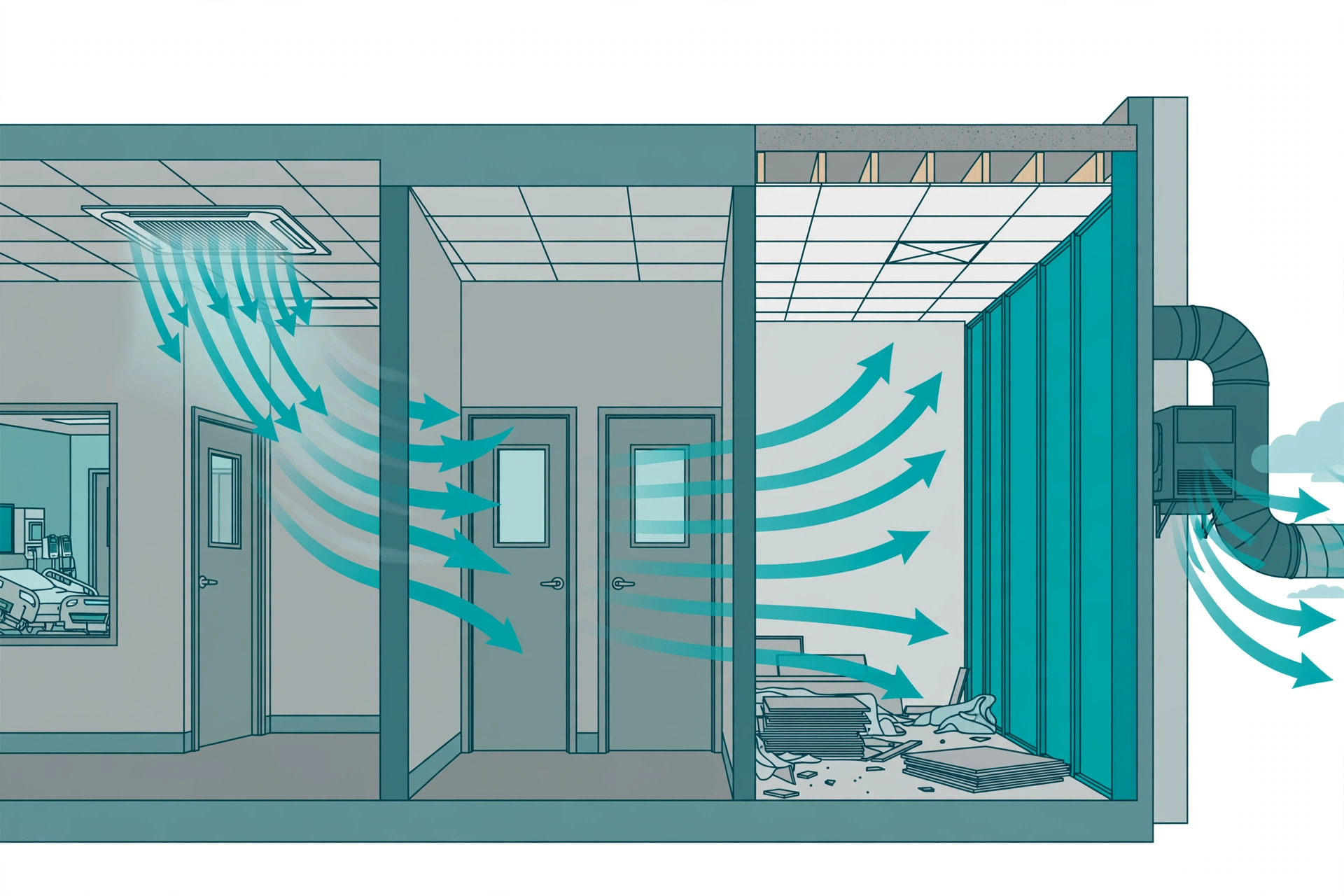
A Class IV construction barrier is the highest level of ICRA containment — critical barriers meeting NFPA 241 that completely isolate major demolition/construction work from occupied areas. Barriers must extend to the ceiling, or to the deck above where ceiling tile is removed; all penetrations sealed with UL-listed firestop meeting the appropriate fire rating; the entire work zone under continuous negative pressure with HEPA-filtered exhaust; and an anteroom required for worker/material transition.
Class IV barrier requirements
- Critical barriers per NFPA 241 — full-height, sealed, dust-tight; plastic or hard construction completed without dust release.
- Extend to structure — to the ceiling, or to the deck above when tiles are removed; no open plenum bypass.
- Sealed penetrations — every hole, pipe, conduit, and puncture sealed; UL-listed firestop where the barrier is rated.
- Negative pressure throughout — entire workspace negatively pressurized via HEPA exhaust; airflow cascades from entry → anteroom → work area.
- HEPA exhaust outdoors — directed outside; if 25+ feet from entrances/intakes/windows, HEPA filtration of exhaust may not be required; indoor discharge must be HEPA-filtered at ≥99.97%.
- HVAC isolated — supply and return diffusers removed or isolated to prevent duct contamination and positive pressurization.
- Anteroom — required; workers HEPA-vacuumed or change coveralls passing through.
Class IV in the ICRA matrix
Class IV applies to major demolition and construction (Type D activity) in medium to high-risk patient areas — and to any lower activity level the assessment elevates based on adjacent population. It’s the containment level for work near oncology, transplant, ICU, and OR areas. The ICRA permit for Class IV work is typically the most scrutinized document on the project.
Duration rule
Class IV projects lasting more than two weeks require hard (solid) barriers — plastic sheeting alone doesn’t qualify, regardless of mil rating. Plan the barrier type at ICRA permitting, not at week three.
Class IV is the maximum — build it like it.
FAQ
What makes a barrier “Class IV”?
NFPA 241 critical barriers, full height to ceiling/deck, sealed UL-firestopped penetrations, continuous negative pressure with HEPA exhaust, isolated HVAC, and an anteroom — for major construction near medium/high-risk patient areas.
Can Class IV barriers be plastic sheeting?
Only for projects under two weeks. Longer Class IV work requires hard barriers.
Does Class IV always require an anteroom?
Yes — worker and material transition through an anteroom with HEPA vacuuming or coverall changes is a Class IV requirement.