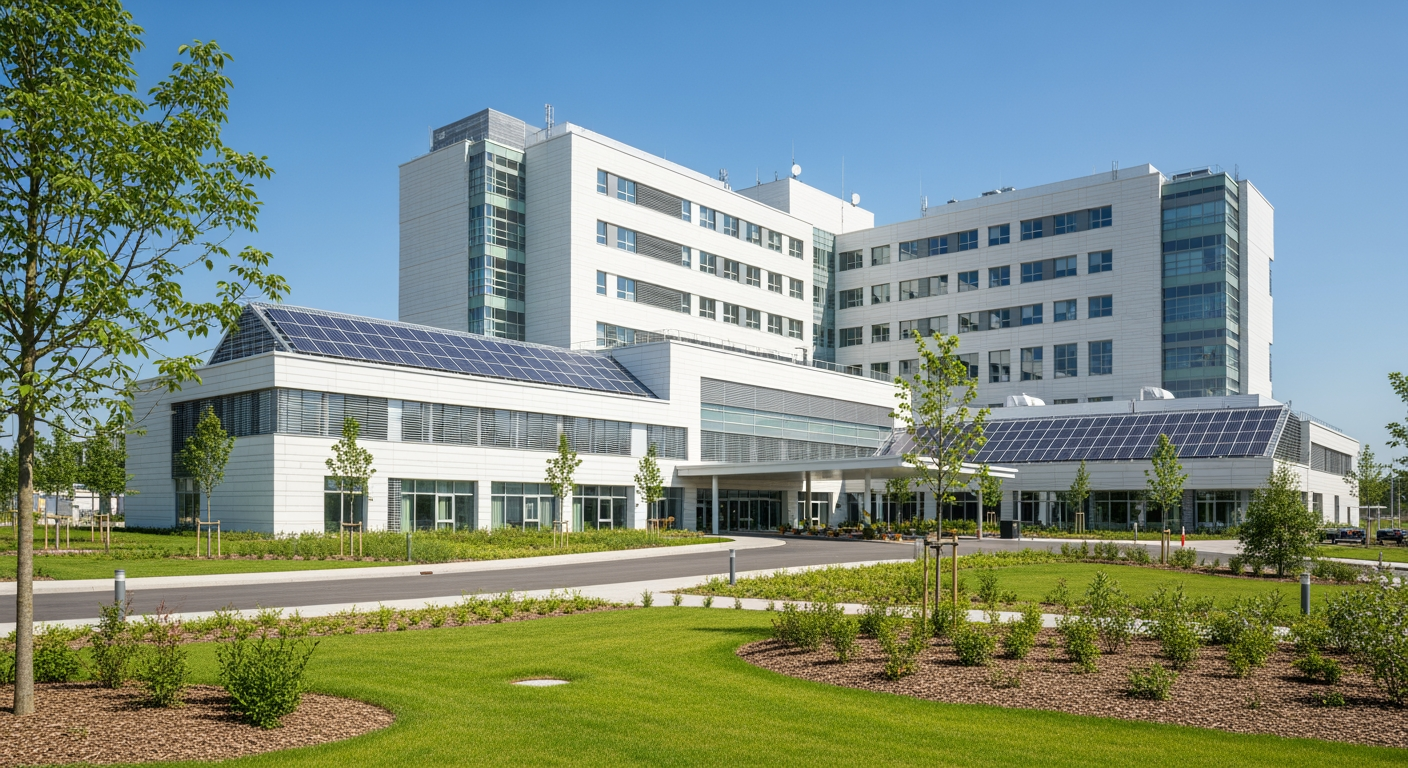
Healthcare Facility Decarbonization: Net-Zero Roadmaps, Scope 1-2-3 Emissions, and Green Building Certification Updates
The Healthcare Sector Carbon Crisis and 2026 Regulatory Acceleration
Healthcare facilities account for approximately 4.4% of global greenhouse gas emissions—a carbon footprint larger than the aviation industry. In the United States, hospitals produce about 2.5 metric tons of CO2 per bed annually, driven primarily by energy consumption (electricity for lighting, HVAC, and medical equipment), natural gas for heating and hot water, anesthetic gas emissions, medical waste incineration, and complex supply chains for pharmaceuticals, medical devices, and consumables.
In 2026, healthcare facilities face unprecedented pressure to decarbonize from multiple directions simultaneously. Regulatory mandates are intensifying: California’s SB-253 requires large healthcare systems and their supply chains to report Scope 1, 2, and 3 emissions starting 2026, with mandatory 25% reductions by 2030. Federal programs like the Health and Climate Pledge commit signatory hospitals to net-zero emissions by 2050. Major accreditation bodies and payers are beginning to embed carbon performance into quality metrics and reimbursement models. Simultaneously, investors, donors, and skilled staff increasingly favor healthcare organizations with strong climate commitments, making decarbonization an organizational competitiveness issue alongside environmental responsibility.
This article addresses the specific operational, technical, and governance approaches that healthcare facilities must implement to achieve measurable decarbonization progress in 2026 and beyond.
Understanding Scope 1, 2, and 3 Emissions in Healthcare Facility Operations
Effective decarbonization requires granular understanding of where emissions originate. The Greenhouse Gas Protocol divides emissions into three scopes:
Scope 1 (Direct Emissions): Emissions from activities directly owned or controlled by the healthcare facility. For hospitals, this includes: natural gas combustion in building HVAC systems and water heaters, diesel or gasoline consumption by facility vehicles, anesthetic gas emissions from operating rooms, medical gas systems (nitrous oxide), and refrigerant leakage from HVAC and laboratory equipment. For a 300-bed hospital, Scope 1 emissions typically account for 30-40% of total emissions and are concentrated in a small number of high-impact sources—primarily natural gas consumption for space heating.
Scope 2 (Indirect Emissions from Energy): Emissions from purchased electricity and steam. This varies dramatically based on regional energy infrastructure. A hospital in a region with wind and hydroelectric power (like Pacific Northwest) will have much lower Scope 2 emissions from the same electricity consumption as a hospital in a coal-dependent region (like West Virginia). For a typical 300-bed hospital, Scope 2 emissions account for 40-50% of total greenhouse gas footprint. The carbon intensity of electricity is declining nationally (cleaner grid) but varies by region from roughly 100 grams CO2 per kilowatt-hour in low-carbon regions to 400+ grams in coal-heavy regions.
Scope 3 (Value Chain Emissions): Indirect emissions from the entire supply chain and operational activities not directly controlled. For healthcare, this is the most complex and largest category, including: pharmaceutical manufacturing (estimated 40% of healthcare’s carbon footprint), medical device production and shipping, single-use medical supplies (gloves, syringes, surgical packs), medical waste processing and incineration, anesthetic gas production, air travel for conferences and consultants, employee commuting, patient and visitor transportation. Scope 3 is often 2-3 times larger than Scope 1 and Scope 2 combined, which means addressing it is essential for achieving net-zero.
Healthcare facilities implementing decarbonization often prioritize in sequence: first, reduce Scope 1 (building efficiency, renewable energy procurement, refrigerant management); second, address Scope 2 (renewable electricity contracts, electrification); third, tackle Scope 3 (supply chain engagement, waste reduction, alternative products). However, this sequential approach can miss opportunities—some Scope 3 reductions (like switching to reusable versus single-use supplies) are implementable immediately alongside Scope 1 and 2 work.
California SB-253 Compliance: Emissions Reporting and Reduction Mandates
California Senate Bill 253, the Climate Corporate Data Accountability Act, fundamentally changes carbon accountability for large healthcare systems operating in California (or serving California patients). Effective January 2026, all large healthcare entities (generally those with $1 billion+ in annual revenue) must report Scope 1, 2, and 3 greenhouse gas emissions to the California Air Resources Board by specified deadlines: 2026 reporting cycle for baseline years, with mandatory third-party verification.
SB-253 also mandates that large entities achieve 25% emissions reductions by 2030 (relative to 2024 baseline) and net-zero by 2045. These are not voluntary targets—they are regulatory requirements with potential enforcement mechanisms for non-compliance.
Implementation implications for healthcare facilities:
- Scope 3 Supply Chain Engagement: Healthcare systems must work with suppliers to measure and reduce their emissions. This is unfamiliar territory for many facilities. Implementation requires: identifying top carbon-emitting suppliers, requesting emissions data (many suppliers will not have baseline data), setting reduction targets collaboratively, and tracking progress. For pharmaceutical suppliers alone, this is a complex undertaking because manufacturers guard formulation details and carbon data is often not disclosed.
- Baseline Establishment and Data Infrastructure: By April 2026, facilities must establish their 2024 baseline emissions (both historical data collection and system for ongoing measurement). This requires investment in emissions tracking software, building automation systems that capture energy consumption, and supply chain data collection processes. Many facilities will need to retrofit older buildings with submetering to understand consumption by department or building zone.
- Governance and Accountability: Emissions reporting must be validated by third-party auditors and often requires board-level oversight. Many healthcare systems are establishing sustainability officer positions or committees with cross-functional representation from facilities, procurement, clinical leadership, and finance.
- Annual Progress Reporting: Unlike one-time certifications, SB-253 requires annual emissions reporting and progress toward reduction targets. This means continuous monitoring, rapid identification of performance gaps, and course correction throughout the decade to 2030.
Energy Star for Hospitals and Building-Level Energy Performance
EPA’s ENERGY STAR for Hospitals program provides a nationally recognized framework for healthcare facility energy performance and a pathway to certification. The 2026 update to ENERGY STAR standards emphasizes portfolio-level energy management, real-time building performance data, and integration of renewable energy.
ENERGY STAR Portfolio Score: Facilities that monitor energy consumption can benchmark their performance against national comparables of similar size, location, and climate. Hospitals achieving ENERGY STAR Portfolio Score of 75+ (top quartile nationally) demonstrate superior energy efficiency and are eligible for ENERGY STAR certification. This certification has become a competitive differentiator: employers and patients increasingly select healthcare providers with demonstrated environmental commitments.
Implementation for 2026:
- Submetering and Data Capture: To optimize energy performance, facilities need granular data on consumption by building zone, department, and end-use (HVAC, lighting, refrigeration, sterilization). Older buildings often lack submetering; retrofitting with smart meters and building management system integration should be a priority in capital planning.
- Commissioning and Retro-commissioning: Many hospital HVAC and building systems operate far below design efficiency due to poor calibration, failed sensors, control logic errors, or changes in building use that were never reflected in system optimization. Retro-commissioning (a systematic process to evaluate how systems actually perform versus design intent and optimize operations) can yield 10-20% energy savings without capital investment. This is often the highest-ROI efficiency intervention.
- HVAC Optimization: HVAC systems typically consume 40-50% of hospital energy. Optimization focuses on: identifying and replacing failed/aging equipment, upgrading controls to modulate output based on actual load rather than running at full capacity constantly, optimizing ventilation rates (many hospitals maintain higher-than-required air changes due to outdated standards), and implementing demand-controlled ventilation (varying ventilation based on occupancy and CO2 levels).
- Renewable Energy and Grid Decarbonization: Purchasing renewable electricity (through power purchase agreements or green tariffs from utilities) reduces Scope 2 emissions without requiring on-site generation. For many healthcare facilities, this is the fastest path to significant Scope 2 reductions. On-site solar, though increasingly common, requires capital investment and roof space that may be limited in urban hospitals.
LEED v5 Healthcare Credits and Green Building Certification
USGBC’s LEED (Leadership in Energy and Environmental Design) version 5, released in 2024 and being adopted in 2026, includes significant updates relevant to healthcare facilities. The revised healthcare credits emphasize operational carbon, water efficiency, and resilience.
LEED v5 for Healthcare Facilities:
- Embodied Carbon Credits: New in LEED v5, embodied carbon accounting recognizes emissions from building materials and construction. For renovation projects, selecting low-carbon materials (like reclaimed wood instead of virgin timber, low-carbon concrete, recycled steel) earns points. This shifts procurement strategy from cost-driven to carbon-driven decision making.
- Operational Energy Performance: LEED v5 requires demonstration of superior operational energy performance (benchmarked against comparable buildings). For healthcare facilities, this aligns with ENERGY STAR certification efforts and incentivizes ongoing performance optimization rather than one-time certification.
- Scope 3 Credit Recognition: Updated LEED standards begin recognizing Scope 3 emissions reduction strategies. Facilities that demonstrate low-carbon supply chain engagement, waste reduction, and employee commute reduction programs can earn points in LEED certification.
- Water Stewardship: Healthcare facilities are water-intensive (clinical processes, laundry, cooling towers). LEED v5 emphasizes water metering, high-efficiency fixtures, water-efficient landscaping, and stormwater management. For facilities in water-stressed regions, water efficiency should be prioritized alongside energy.
For healthcare facilities planning major renovation or new construction, LEED v5 certification should be a design requirement, not an optional add-on. The certification process forces consideration of operational carbon from the design phase onward.
Decarbonization Implementation Roadmap for Healthcare Facilities
Phase 1: Baseline Establishment and Governance (Q2 2026)
Conduct a comprehensive emissions inventory (Scope 1, 2, and 3) using EPA greenhouse gas protocol standards. For facilities subject to SB-253, this is mandated; for others, it’s foundational for any decarbonization strategy. Establish baseline year (typically 2024 or 2025), document data sources and assumptions, and have the inventory verified by a qualified auditor. Simultaneously, establish governance: identify a sustainability officer or committee with decision-making authority and representation from facilities, procurement, clinical leadership, and finance. This committee should meet quarterly minimum to oversee decarbonization initiatives and report progress to board/executive leadership.
Phase 2: Quick-Win Projects (Q2-Q4 2026)
Identify and rapidly implement high-ROI projects that yield near-term emissions reductions while building organizational momentum:
- Retro-commission existing HVAC systems (10-20% energy savings, 3-6 month payback)
- Replace failed/aging HVAC equipment with high-efficiency alternatives
- Execute renewable electricity procurement contracts (significant Scope 2 reductions)
- Pilot program for reusable versus single-use medical supplies in select departments (waste reduction, cost savings)
- Employee commute incentive program (transit subsidies, bike infrastructure, EV charging)
Phase 3: Deep Energy Efficiency (2027-2030)
Implement building-wide efficiency projects: HVAC system upgrades, building envelope improvements (insulation, window replacement), lighting conversion to LED with smart controls, installation of on-site renewable energy, electrification of remaining fossil fuel end-uses (replacing gas water heaters, cooking equipment with electric alternatives). This phase requires significant capital investment but drives the bulk of carbon reductions needed to meet 2030 targets.
Phase 4: Supply Chain Decarbonization (Ongoing, 2026-2030)
Engage major supply partners to measure and reduce their emissions. This is longest-term work because it requires supplier cooperation, typically happens through contract renewal cycles, and involves systemic changes in manufacturing. Priority engagement: pharmaceutical suppliers, medical device manufacturers, waste management vendors, cleaning and laundry services.
FAQ: Healthcare Decarbonization and Net-Zero Pathways
A: Net-zero is ambitious but increasingly demonstrated as feasible. The pathway requires aggressive energy efficiency (40-50% reductions), renewable electricity procurement or on-site generation (eliminating Scope 2), supply chain transformation (Scope 3), and carbon offset programs for any remaining emissions. Healthcare systems beginning decarbonization now can credibly reach 50-60% reductions by 2030 through efficiency and renewable energy, with the final push to net-zero happening over 2030-2045 as supply chains transform and offset technologies mature. The organizations that delay will face far steeper and more expensive paths.
A: The optimal sequence is efficiency first, then renewable energy, then supply chain. Efficiency projects typically have the fastest payback (2-5 years), reducing both emissions and operating costs, freeing capital for renewable energy investments. Renewable electricity procurement comes next (fast implementation, significant Scope 2 reductions). Supply chain decarbonization takes longest because it requires supplier cooperation, but it eventually becomes the limiting factor for achieving net-zero since Scope 3 typically exceeds Scopes 1 and 2 combined. Effective programs address all three simultaneously but sequence capital and staffing investment.
A: ENERGY STAR focuses on operational energy performance (how well a building runs once it’s operational). LEED focuses on design and construction practices that reduce environmental impact, including operational energy but also embodied carbon, water use, indoor environmental quality, and sustainable site practices. A facility can be ENERGY STAR certified and not LEED certified, or vice versa. However, for new construction or major renovations, pursuing both LEED and demonstrating high operational energy performance (toward ENERGY STAR) is the best practice.
A: SB-253 applies to large entities (generally $1B+ revenue) that serve California residents. So a New York healthcare system with California patients must comply. However, the broader trend is that other states and the federal government are moving toward similar emissions reporting and reduction mandates. Healthcare facilities should implement comprehensive emissions management regardless of location, treating decarbonization as a strategic imperative rather than a regulatory compliance exercise in a specific state.
Conclusion: Decarbonization as Healthcare Operations Imperative
Healthcare decarbonization is no longer discretionary—it is operationally embedded in energy costs, supply chain resilience, workforce recruitment, payer relationships, and regulatory compliance. Healthcare facilities beginning their decarbonization journey in 2026 will achieve net-zero more cost-effectively, with less operational disruption, than those delaying action. The combination of aggressive Scope 1 and 2 reductions (achievable through known, proven technologies) and Scope 3 supply chain engagement (requiring partnership and patience) creates a realistic pathway to net-zero by 2045, with substantial progress toward 2030 targets.
The financial case is strong: efficiency improvements reduce operating costs, renewable energy contracts lock in long-term electricity price stability, and supply chain optimization often yields both carbon and cost reductions. The competitive case is equally compelling: healthcare organizations with demonstrated net-zero commitment attract talent, support from major employers and payers, and community trust. The imperative, in 2026, is to move decarbonization from corporate sustainability messaging to operational reality embedded in capital planning, procurement decisions, and organizational accountability structures.