How do you monitor pressure differentials during hospital construction?
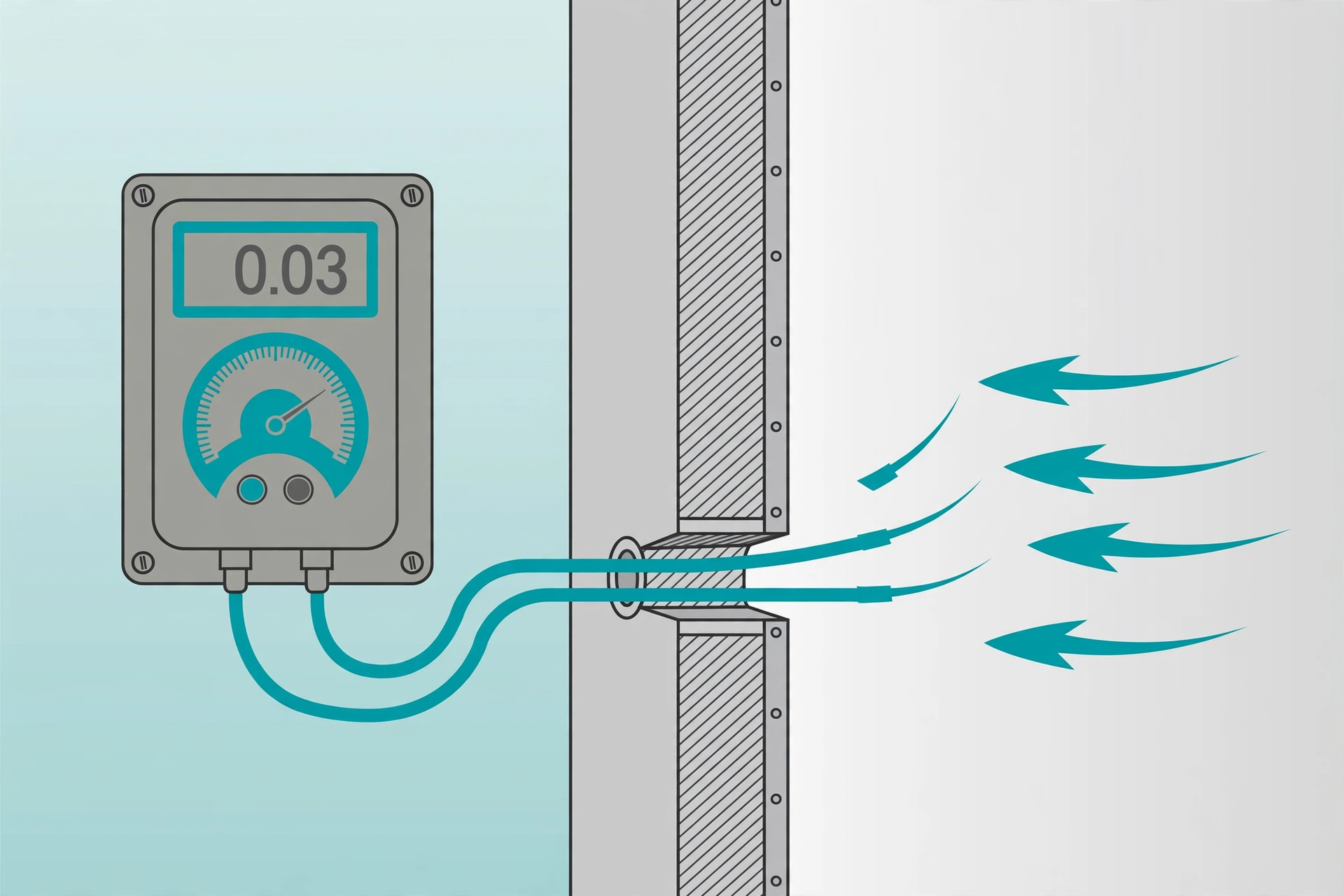
Pressure differentials are monitored with manometers — differential pressure gauges measuring the work zone against adjacent spaces in inches of water column (” w.c.) — with -0.01″ w.c. (2.5 Pa) negative in the construction zone as a widely used facility target, not an ICRA 2.0 or CDC requirement. Best practice is continuous monitoring with data logging and alarming: a manometer with recording capability in each anteroom, alarm set points typically programmed at -0.01, -0.02, or -0.03″ w.c. per the ICRA plan.
The monitoring setup
- Placement: manometers in each anteroom, measuring the differential between the work area and adjacent spaces identified on the infection control schematic.
- Target: a widely used facility target is -0.01″ w.c. negative in the work zone relative to surroundings (common practice, not an ICRA 2.0 or CDC requirement); many programs alarm at -0.01/-0.02/-0.03″ w.c. per their ICRA selection.
- Logging: data-logging or printing capability — the record proves continuous negative pressure, not just a spot check at setup.
- Alarming: audible/visual alarm on pressure loss, so a failed NAM or breached barrier gets immediate response instead of discovery at the next walkthrough.
Simple verification methods
Gauges aren’t the only tool. Smoke tubes, flutter strips, and ball-in-tube indicators at doors give instant visual confirmation of airflow direction — air should visibly flow into the containment. These are excellent for quick checks by anyone on site, but they don’t replace the logged manometer record.
What the record must show
Surveyors and infection preventionists look for continuity: negative differential maintained for the entire work period, with any excursions documented along with the corrective action. A manometer installed but never read is decoration. Assign someone to check readings on a defined frequency, log them, and escalate losses immediately.
If it isn’t logged, it wasn’t monitored.
See negative air pressure in hospital construction and how to build a construction anteroom.
FAQ
What pressure differential should construction containment maintain?
A widely used facility target is -0.01 inches of water column (2.5 Pa) negative relative to adjacent spaces (common practice, not an ICRA 2.0 or CDC requirement), with alarm set points commonly at -0.01/-0.02/-0.03″ w.c.
Where do manometers go?
In each anteroom, measuring between the work area and adjacent spaces on the infection control schematic — with data logging.
Can I verify airflow without a gauge?
Smoke tubes, flutter strips, and ball-in-tube indicators give instant directional confirmation, but they don’t replace the logged manometer record.