What is negative air pressure and why is it used in hospital construction?
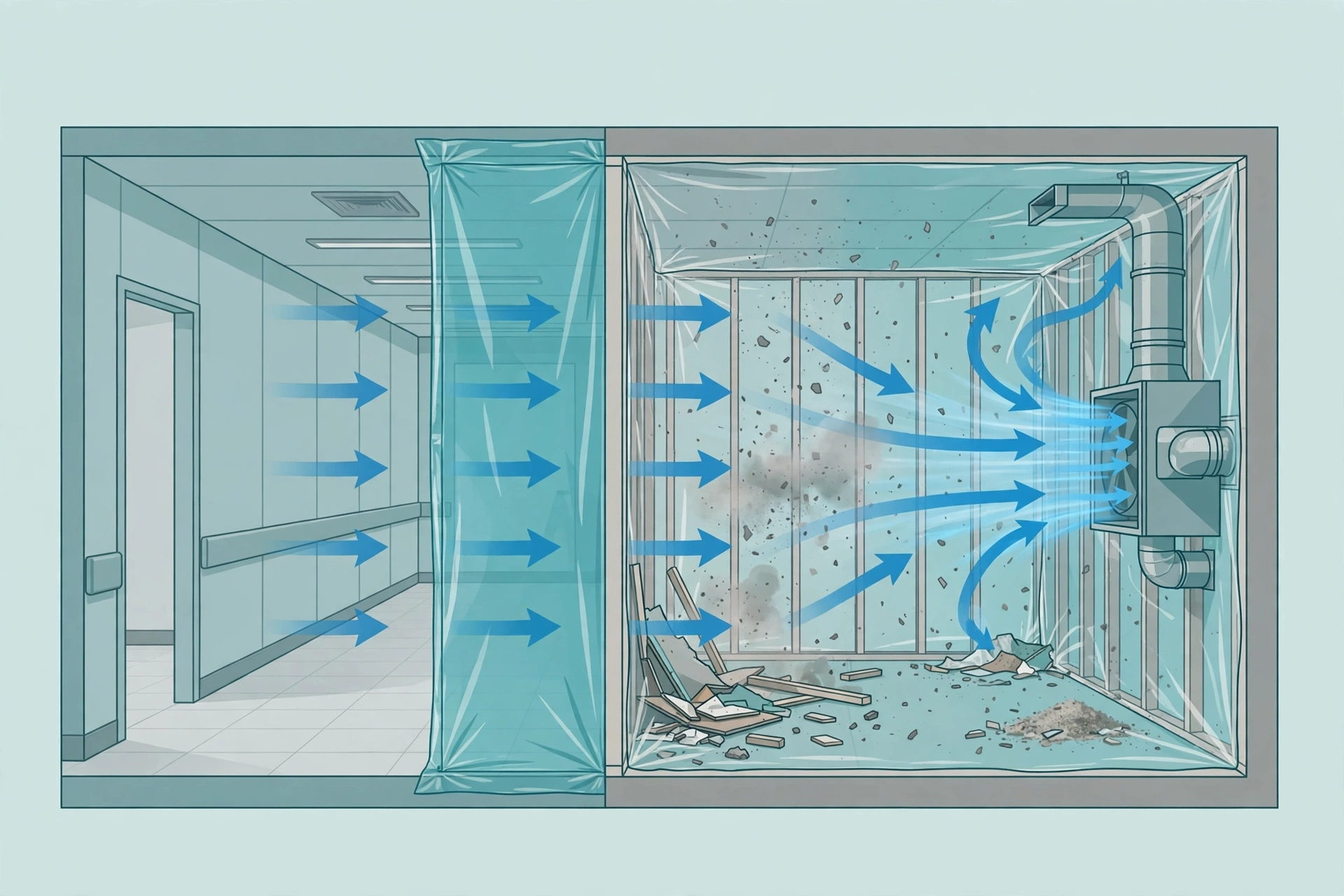
Negative air pressure means the air pressure inside the construction zone is lower than in surrounding areas — so air always flows into the work zone, never out of it. In hospital construction, it’s the primary engineering control that keeps dust, mold spores, and Aspergillus generated by demolition and construction from migrating into occupied patient areas, where they can cause deadly infections in immunocompromised patients.
How it’s created
A sealed containment (barrier) plus a HEPA-filtered negative air machine exhausting more air than enters. The pressure difference — commonly targeted at -0.01″ water column, a widely used facility target rather than an ICRA 2.0 or CDC requirement — is small but decisive: every gap, crack, and door undercut becomes an inward airflow path. Contaminants ride the air, and the air only moves one way.
The cascade principle
With an anteroom, the pressure cascades: clean corridor (highest pressure) → anteroom (intermediate) → construction zone (lowest). Each step inward is a pressure drop, so opening the work-zone door pulls anteroom air in — not work-zone air out. The entire construction area must remain negatively pressurized for the whole project.
Why it matters clinically
Construction dust isn’t just dirt — it’s a vehicle for Aspergillus spores, which are harmless to healthy people but can cause invasive aspergillosis in neutropenic, transplant, and oncology patients, with high mortality. Negative pressure is one of the few controls that works continuously, passively, and independently of worker behavior. Barriers get breached; doors get propped; but as long as the pressure holds, the air still flows the right way.
Pressure is the control that works while nobody’s watching.
See HEPA negative air machines and monitoring pressure differentials.
FAQ
What is negative air pressure in simple terms?
Lower air pressure inside the work zone than outside it, so air always flows inward — carrying dust and spores away from patients, never toward them.
Why is negative pressure critical in hospital construction?
Construction releases Aspergillus spores that can cause fatal infections in immunocompromised patients. Negative pressure keeps contaminated air inside the work zone continuously.
How negative should the pressure be?
A widely used facility target is -0.01 inches of water column (2.5 Pa) relative to adjacent spaces (common practice, not an ICRA 2.0 or CDC requirement), maintained for the entire project.