What is NFPA 241 and how does it relate to healthcare construction?
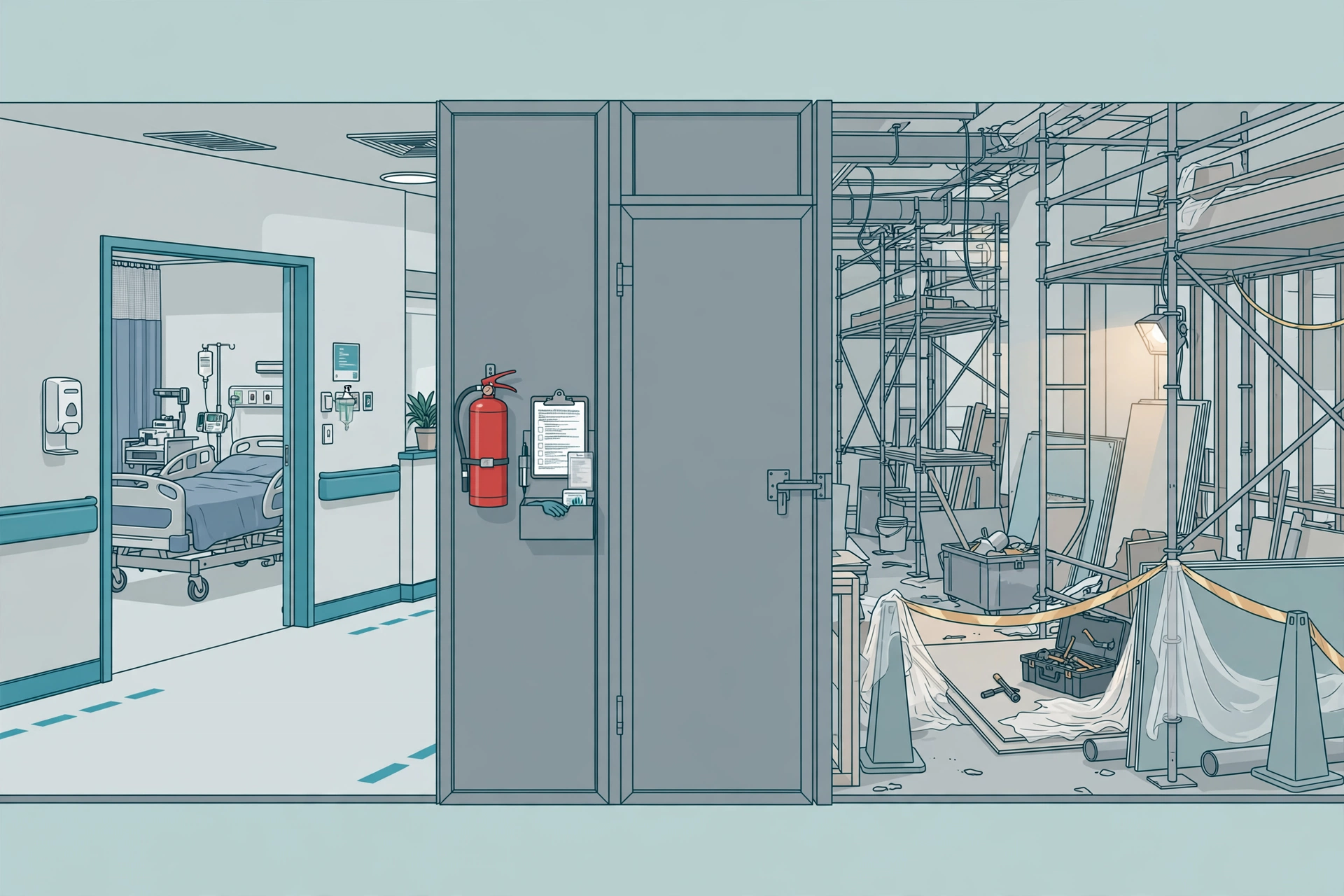
NFPA 241, Safeguarding Construction, Alteration, and Demolition Operations, is the standard for fire safety during construction — temporary wiring, hot work, combustible storage, fire protection impairments, and the temporary barriers and separations that protect occupied areas while work is underway. In healthcare construction, NFPA 241 is the fire-side companion to the ICRA: ICRA protects patients from dust and infection; NFPA 241 protects them from fire during the project.
What NFPA 241 requires
- Temporary barriers: construction separations between work zones and occupied areas — where the project is a higher hazard than the occupied building, 1-hour fire resistance with 45-minute opening protection.
- Hot work controls: permits, fire watch, and combustible control for welding, cutting, and burning.
- Impairment management: procedures when sprinklers, alarms, or detection are impaired — including fire watch when sprinklers are out over 10 cumulative hours in 24 (alarm impairments: 4 hours).
- Housekeeping: control of combustible debris and storage in and around the construction area.
- Access for firefighting: maintaining fire department access and standpipe/hydrant availability.
The healthcare intersection
NFPA 241 shows up by reference across the healthcare compliance world: ICRA Class IV requires “critical barriers meeting NFPA 241,” Joint Commission ILSM measures require smoketight noncombustible temporary partitions, and CMS K-tags cite construction-related fire deficiencies. One construction project, three overlapping standards — coordinate them in a single plan, not three binders.
ICRA guards the air. NFPA 241 guards the fire.
See fire ratings for temporary barriers and Class IV barriers.
FAQ
What does NFPA 241 cover?
Fire safety during construction, alteration, and demolition — temporary barriers, hot work, impairments, housekeeping, and firefighter access.
How does NFPA 241 relate to ICRA?
They’re companions: ICRA controls infection risk from construction; NFPA 241 controls fire risk. ICRA Class IV explicitly requires critical barriers meeting NFPA 241.
Does NFPA 241 require fire watch?
It provides the framework for impairment management, including fire watch when fire protection systems are impaired beyond allowable durations.