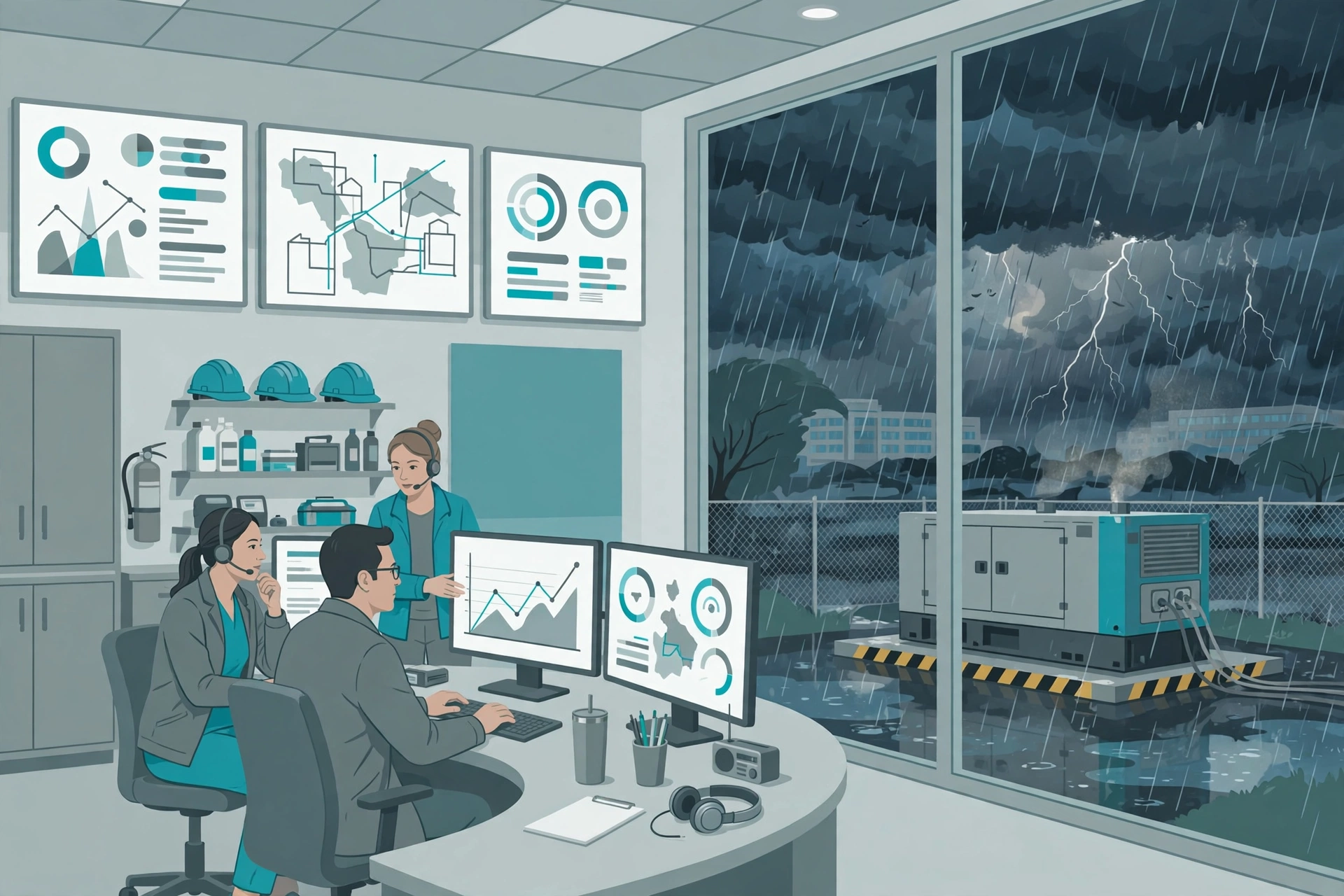
How do healthcare facilities prepare for emergency disruptions and outages?
Healthcare facilities prepare for disruptions through all-hazards emergency planning: a written Emergency Operations Plan covering power loss, water disruption, HVAC failure, IT outages, and supply chain breaks — each with redundant systems (emergency generators, medical gas reserves, water storage), defined downtime procedures for clinical operations, and regular exercises testing the plan. CMS requires this under the Emergency Preparedness Rule (42 CFR 482.15): a risk assessment, policies and procedures, a communication plan, and training/testing — reviewed at least every two years.
The preparation layers
- Power: emergency generators tested monthly under load, fuel for 96+ hours, prioritized circuits for life safety, critical, and equipment branches.
- Water: storage or contingency supply for potable and clinical needs; dialysis and sterile processing have their own continuity plans.
- Medical gases: reserve manifolds and vendor emergency delivery agreements.
- IT/downtime: paper downtime procedures for orders, MAR, and documentation — rehearsed, not just written.
- Staffing: call-back rosters, ride-out teams for storms, fatigue management for extended events.
Exercises that actually teach
Tabletop exercises find plan gaps cheaply; functional exercises (actually switching to generator power, running downtime procedures on a unit) find the gaps tabletops miss. After every exercise and every real event: a formal after-action review with assigned corrective actions and deadlines.
The plan is paper. The exercise is the preparation.
See the CMS Emergency Preparedness Rule and the facility management guide.
FAQ
What does CMS require for emergency preparedness?
A risk assessment, policies and procedures, a communication plan, and training/testing — reviewed at least every two years, with two exercises annually.
How long should hospital generators run?
Plan fuel for 96+ hours; test monthly under load per code requirements.
What are downtime procedures?
Paper-based clinical workflows (orders, medication administration, documentation) used when IT systems fail — they must be rehearsed, not just written.