What is the ASHE ICRA 2.0 matrix and how do I use it?
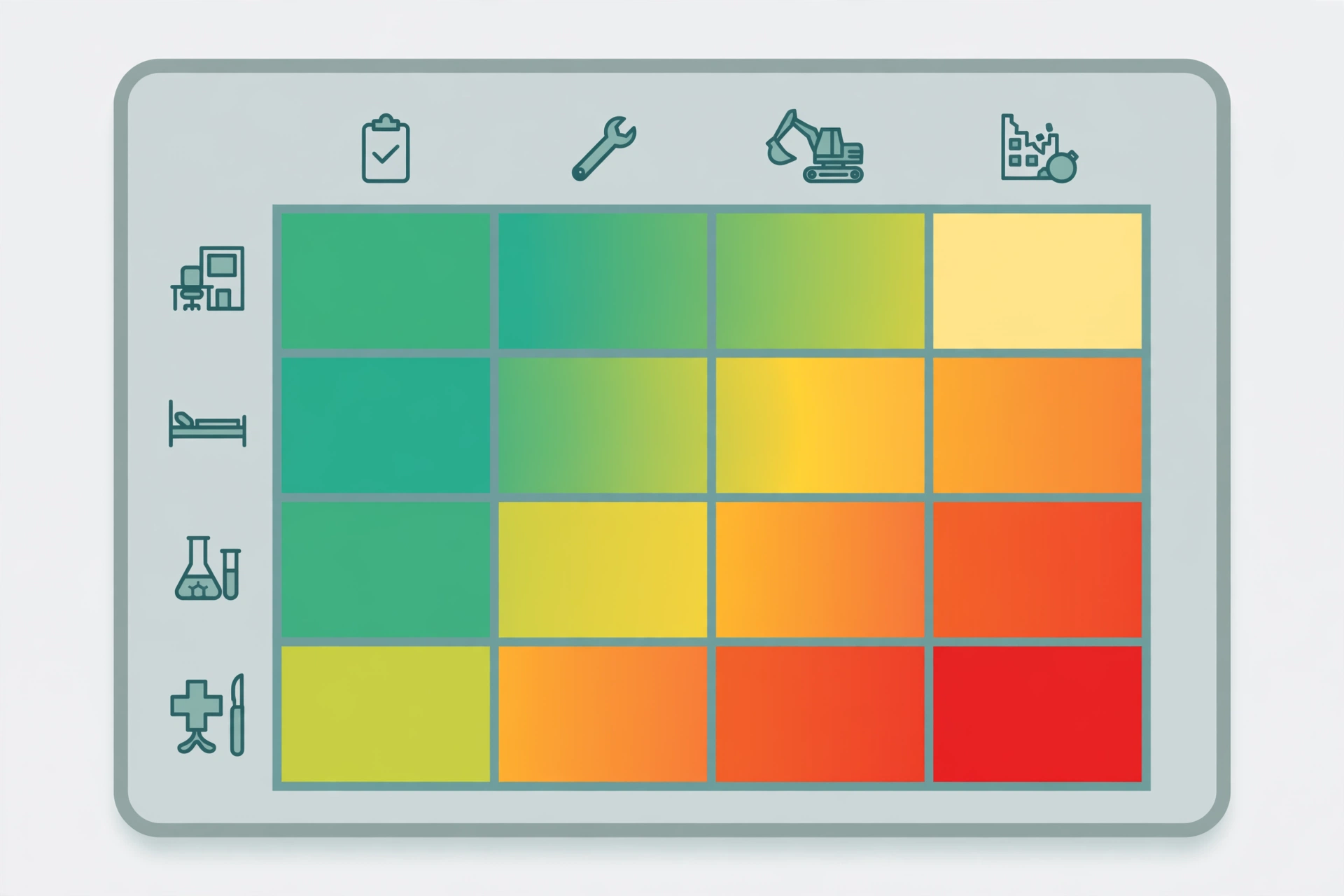
The ASHE ICRA 2.0 matrix (American Society for Health Care Engineering, ©2022) is the industry-standard tool for determining the Class of Precautions (I–V) a construction project requires. You use it in three steps: (1) classify the construction activity (Type A–D), (2) classify the patient risk group (Low, Medium, High, Highest), (3) match them in the matrix to find the class — then apply that class’s minimum precautions. An infection control permit is required for Class III (Type C) and all Class IV/V work.
Try it: Use the interactive ICRA Class Finder — answer 3 questions and get your precaution class instantly.
Step 1 — Construction activity type
- Type A: non-invasive (inspections, painting without sanding)
- Type B: small-scale, short duration
- Type C: large-scale, longer duration
- Type D: major demolition and construction
Step 2 — Patient risk group
- Low: non-patient care areas (offices, public areas)
- Medium: patient care support areas
- High: patient care areas
- Highest: invasive, sterile, or highly compromised care (ORs, ICUs, oncology, transplant)
Step 3 — The matrix
| Risk group | Type A | Type B | Type C | Type D |
|---|---|---|---|---|
| Low | I | II | II | III* |
| Medium | I | II | III* | IV |
| High | I | III | IV | V |
| Highest | III | IV | V | V |
*Class III areas that cannot be sealed and completely isolated should be elevated to include Class IV negative-air exhaust requirements. Environmental hazards (sewage, mold, asbestos, gray/black water) require Class IV for low/medium groups and Class V for high/highest.
What’s new in 2.0
ICRA 2.0 added the Class V tier, expanded the patient risk groups to four, and formalized the permit triggers and environmental-hazard escalations. If your facility still uses the original four-class ICRA, the 2.0 matrix is the current ASHE standard to migrate to.
Activity × risk group = class. The matrix does the math.
FAQ
What are the ICRA 2.0 construction activity types?
Type A (non-invasive), Type B (small-scale short duration), Type C (large-scale longer duration), Type D (major demolition/construction).
What are the ICRA 2.0 patient risk groups?
Low (non-patient care), Medium (patient care support), High (patient care), Highest (invasive/sterile/highly compromised).
When is an infection control permit required?
For Class III (Type C) and all Class IV and V work.