What are the requirements for ICRA Class IV and V projects?
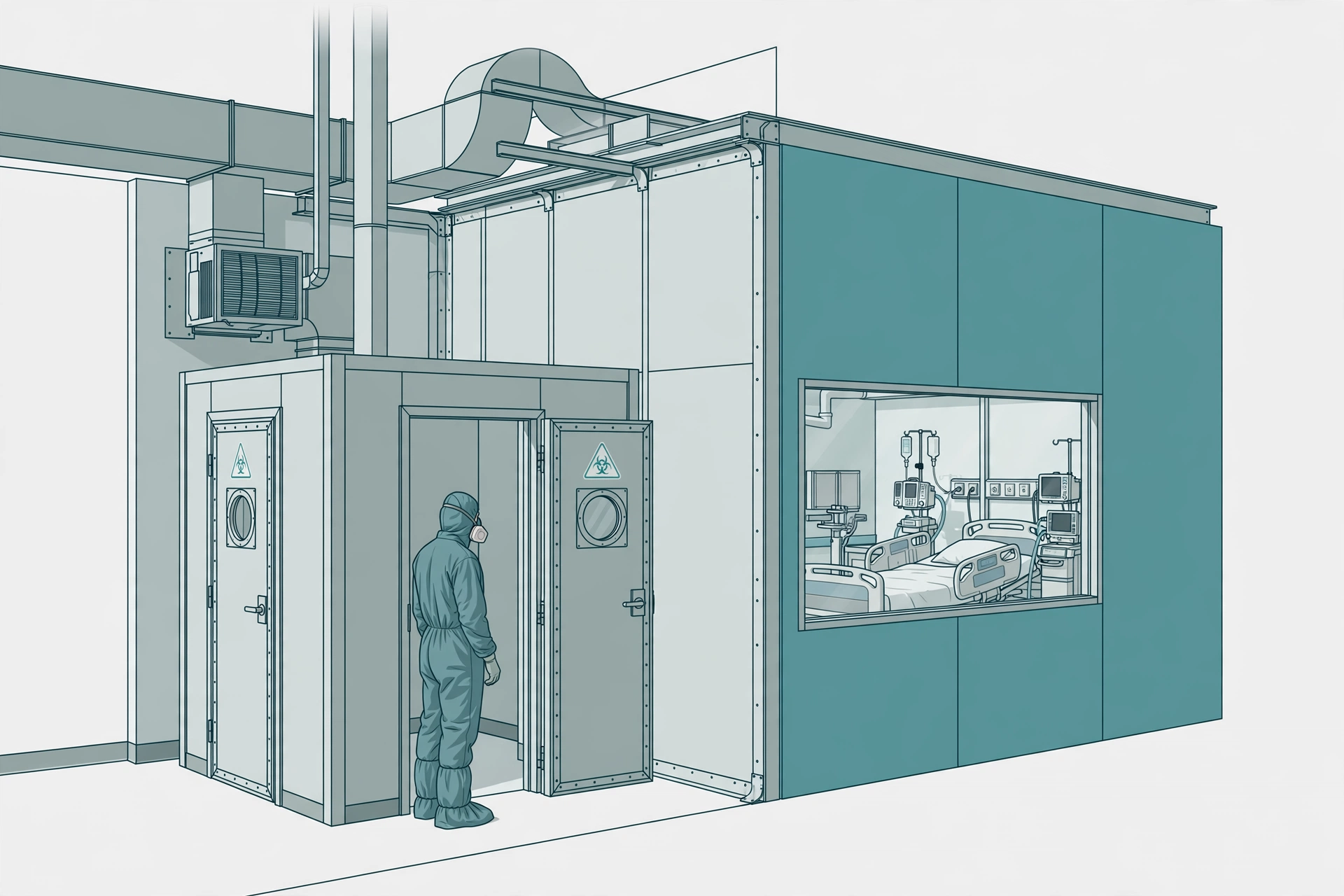
Class IV requires NFPA 241 critical barriers to the ceiling or deck above, sealed UL-firestopped penetrations, continuous negative pressure with HEPA exhaust outdoors, isolated HVAC, a required anteroom, worker decontamination, and an infection control permit before work begins. Class V — the highest level, added in ICRA 2.0 — applies to major demolition/construction in high and highest-risk patient areas and to environmental hazards (sewage, mold, asbestos, gray/black water) in those areas, layering maximum precautions on top of the Class IV package.
Class IV requirements
- Critical barriers per NFPA 241, full height to ceiling or deck above; no open plenum bypass
- All penetrations sealed; UL-listed firestop where the barrier is rated
- Entire workspace continuously negatively pressurized (-0.01″ w.c. is a widely used facility target, not an ICRA 2.0 or CDC requirement) via HEPA exhaust
- Exhaust directed outdoors; indoor discharge HEPA-filtered at ≥99.97%
- Supply and return diffusers removed or isolated
- Anteroom required; workers HEPA-vacuumed or change coveralls
- Projects over two weeks require hard barriers
- Infection control permit and approval before construction
When Class V applies
Per the ICRA 2.0 matrix: Type D (major demolition/construction) in high-risk areas, Type C or D in the highest-risk group (ORs, ICUs, oncology, transplant, sterile areas) — and environmental hazard conditions (sewage, mold, asbestos, gray/black water) in high/highest-risk areas. Class V takes the Class IV containment package and adds the facility’s maximum precautions: heightened monitoring, stricter access control, and elevated approval.
Approval and oversight
Infection control permit and approval are required for all Class IV and V work. Barriers are not removed until the completed project is inspected by Safety and Epidemiology and thoroughly cleaned — HEPA vacuum, wet mop with disinfectant, careful barrier removal to minimize debris spread.
Class IV is maximum containment. Class V is maximum containment, maximum oversight.
See the ASHE ICRA 2.0 matrix and Class IV barriers in detail.
FAQ
What is the difference between Class IV and Class V?
Class IV is the full containment package (critical barriers, negative pressure, anteroom, permit). Class V applies it to the highest-risk scenarios — major work in high/highest-risk patient areas and environmental hazards — with maximum precautions and oversight.
Do Class IV/V projects need a permit?
Yes — infection control permit and approval are required before construction begins for all Class IV and V work.
Can Class V barriers be plastic?
Only for work under two weeks; longer Class IV/V projects require hard barriers.