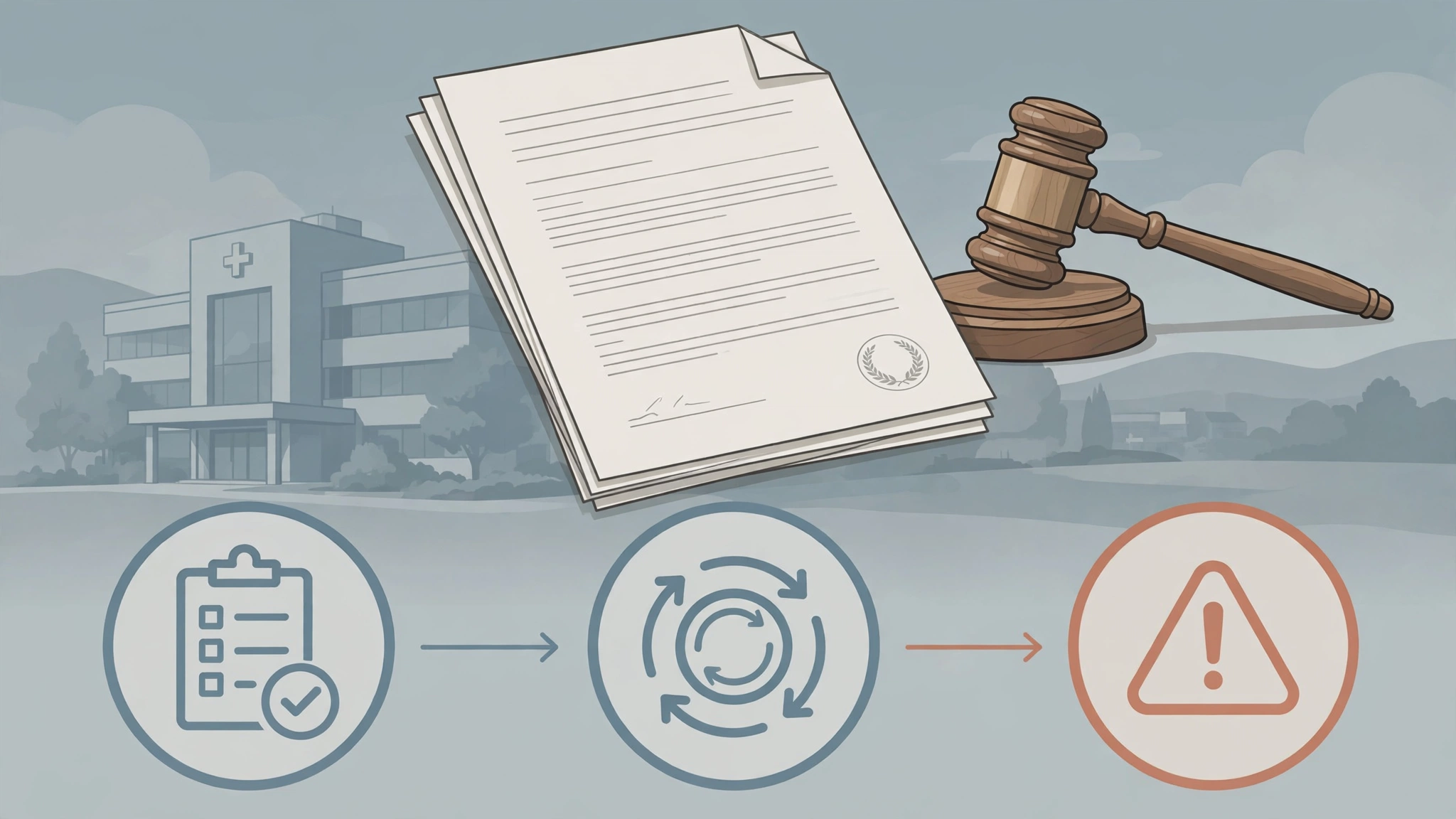
Yes — but termination is the last resort, not the first move. Under 42 CFR 489.53, CMS may terminate a hospital’s Medicare provider agreement for failure to meet the Conditions of Participation, including the physical environment and Life Safety from Fire conditions. Before termination, CMS must give notice and an opportunity to correct — the process is designed to produce correction, with a graduated set of lesser remedies tried first.
Take this to the job site.
This article as a one-page field sheet – the direct answer, the key numbers, and the checklist. Free PDF, prints clean, works offline.
Download the field sheet (PDF)
Get the weekly brief
Surveys, water, plant and readiness — what we measured and what changed in facility operations, every week.
The remedies short of termination
CMS has a full toolkit before it reaches termination:
- Directed plans of correction — CMS dictates what must be fixed and by when
- Denial of payment for new admissions — the financial pressure valve
- Civil money penalties — per-day fines that accumulate until correction
- Temporary management — CMS installs oversight when leadership can’t or won’t correct
- Directed in-service training — for systemic competency failures
How termination actually works
When lesser remedies fail — or for Immediate Jeopardy that isn’t promptly removed — CMS issues notice of its intent to terminate. The notice states the reasons and the effective date, and CMS gives concurrent notice to the public. Payment remains available for up to 30 days after the effective date for inpatient hospital services already underway (§489.55). A terminated provider can only get a new agreement when CMS finds the reason for termination has been removed, there’s reasonable assurance it won’t recur, and all prior responsibilities have been fulfilled.
The provider’s rights
Termination isn’t unilateral and final on the spot: providers may appeal under 42 CFR Part 498. And the classic accelerated track — 23-day termination for hospital emergency-department violations posing Immediate Jeopardy under §489.24 — shows how fast things move when patients are in immediate danger. The lesson: treat every plan of correction as binding, because CMS tracks whether you kept your promises.
Termination is rare because correction usually works — make sure yours does.
See what happens when a hospital fails a life safety survey and continuous compliance monitoring.
The CMS Enforcement and Termination Process: Regulatory Pathways, Tracks, and Timelines
Termination of a hospital’s Medicare provider agreement is governed strictly by federal regulations codified at 42 CFR Part 489 (Provider Agreements) and survey enforcement protocols detailed in 42 CFR Part 488 and the CMS State Operations Manual (SOM), Chapter 3. When facility maintenance or life safety deficiencies occur, CMS does not act arbitrarily; enforcement proceeds along defined regulatory tracks determined by the severity of the finding and the risk to patient health and safety.
1. The Compliance Escalation Ladder: Standard vs. Condition vs. Immediate Jeopardy
CMS surveyors evaluate hospital physical environment compliance against specific standards within 42 CFR §482.41 and §482.15. Citations escalate through three distinct levels of regulatory severity:
- Standard-Level Deficiency (42 CFR §488.24 & §488.28): A standard-level deficiency occurs when a specific technical standard within a Condition of Participation is unmet, but the deficiency neither jeopardizes patient health and safety nor substantially impairs the hospital’s capacity to render adequate clinical care. Examples include isolated unsealed ceiling penetrations in a non-patient storage room, an overdue weekly generator inspection entry, or an uncalibrated pressure gauge where physical airflow direction remains correct.
- Enforcement consequence: The hospital remains in substantial compliance with the Condition. It must submit an acceptable Plan of Correction (PoC) on Form CMS-2567 within 10 calendar days. Compliance is expected within 60 days (42 CFR §488.28(d)). A standard-level deficiency does not initiate termination proceedings.
- Condition-Level Deficiency (42 CFR §488.24(b) & SOM Chapter 3 §3012): A Condition-level deficiency is certified when deficiencies are of such character, severity, or widespread prevalence as to substantially limit the hospital’s capacity to furnish adequate care, or which adversely affect the health and safety of patients. In physical environment surveys, multiple related standard deficiencies (e.g., widespread failure of fire door latching, multiple compromised smoke compartments, and systemic gaps in emergency generator testing) or a single severe systemic breakdown lead surveyors to cite the entire Condition (42 CFR §482.41) as out of compliance.
- Enforcement consequence: The hospital is declared in substantial noncompliance. This finding officially triggers the CMS 90-day termination track under SOM Chapter 3 §3012.
- Immediate Jeopardy (IJ) (42 CFR §489.3, §489.53(d)(2), SOM Appendix Q & SOM Chapter 3 §3010): Immediate Jeopardy is defined as a situation in which the provider’s noncompliance has placed the health and safety of patients at likelihood of serious injury, serious harm, serious impairment, or death. In healthcare facility engineering, typical IJ triggers include: complete loss of primary and backup emergency electrical power; total failure of hospital fire alarm notification or suppression systems without an approved continuous fire watch; hazardous exhaust fumes or toxic chemicals drawn into clinical HVAC air intakes; or medical gas cross-connections (e.g., nitrogen piped into oxygen outlets).
- Enforcement consequence: Immediate notification to the CMS Regional Office and immediate initiation of the 23-calendar-day expedited termination track.
2. The Two Published CMS Termination Tracks (SOM Chapter 3 §3010 & §3012)
CMS enforces two formal administrative termination procedures detailed in Chapter 3 of the State Operations Manual:
Track 1: The 23-Day Immediate Jeopardy Track (SOM §3010 / 42 CFR §489.53(d)(2))
When a survey team identifies Immediate Jeopardy that is not fully abated before the survey team exits the building, CMS enforces an accelerated 23-calendar-day termination clock:
- Day 1 (Identification & Preliminary Notice): The survey team notifies facility leadership of the IJ finding immediately upon identification. The CMS Regional Office issues a formal preliminary notice of termination stating that the provider agreement will terminate in 23 calendar days unless the immediate jeopardy is removed.
- Days 1–3 (Immediate Removal Plan): The facility must develop and submit an immediate IJ Removal Plan (typically within 24 to 48 hours). The removal plan must detail immediate operational safeguards—such as contracting round-the-clock professional fire watch staff, installing temporary mobile chillers/generators, or transferring affected high-risk patients.
- Days 4–20 (On-Site Verification Revisit): The State Survey Agency conducts an unannounced, on-site revisit survey before Day 23 to inspect physical repairs and verify that the immediate jeopardy has been successfully abated.
- Outcome A (IJ Removed): If the survey agency confirms that the immediate threat to patient safety has been eliminated, the 23-day termination clock is officially halted. However, if underlying Condition-level deficiencies remain, the facility is transitioned to the 90-day termination track.
- Outcome B (IJ Not Removed): If the hospital fails to submit an acceptable removal plan or if the revisit confirms that jeopardy persists, CMS issues a final termination notice and concurrent notice to the public at least 2, but not more than 4, days before the effective termination date (42 CFR §489.53(d)(2)(i)(B)). On Day 23, the Medicare provider agreement is terminated.
Track 2: The 90-Day Substantial Noncompliance Track (SOM §3012 / 42 CFR §489.53(a)(3))
When a hospital is cited for Condition-level noncompliance without Immediate Jeopardy, CMS initiates the formal 90-calendar-day termination procedure:
- Day 0–10 (Deficiency Notice & Warning Letter): The State Survey Agency transmits Form CMS-2567 (Statement of Deficiencies). The CMS Regional Office sends a formal termination warning letter notifying the hospital of intent to terminate the Medicare agreement within 90 calendar days from the survey exit date.
- Day 10 (Plan of Correction Window): The hospital has exactly 10 calendar days from receipt of Form CMS-2567 to submit a credible Plan of Correction (PoC). To be legally acceptable to CMS, the PoC must detail: (1) how corrective actions were accomplished for affected areas; (2) how the hospital identified other areas with potential for the same deficiency; (3) what systemic procedural and preventive maintenance changes were instituted; and (4) how the hospital will monitor compliance to ensure sustained correction. All corrective actions must carry specific completion dates, which ordinarily cannot exceed 60 days (42 CFR §488.28(d)).
- Revisit Survey Window (Days 45–70): Following receipt of an approved PoC and a credible allegation of compliance from the hospital, the State Survey Agency conducts an unannounced full revisit survey. Surveyors re-inspect physical systems, test equipment, and audit preventive maintenance logs.
- Day 75 (Mandatory Public Notice): Under 42 CFR §489.53(d)(1) and SOM §3012, if the hospital fails to demonstrate compliance during the revisit, or fails to submit an acceptable PoC, CMS must give notice of termination to the public at least 15 calendar days before the effective date of termination through local media and official government portals.
- Day 90 (Final Termination): If substantial compliance with all Conditions of Participation is not certified by Day 90, the hospital’s Medicare provider agreement officially terminates.
3. Financial and Operational Impact of Termination
The execution of a CMS termination notice has immediate and catastrophic legal, financial, and operational ramifications:
- Loss of Medicare and Medicaid Reimbursement: Effective at 12:01 AM on the termination date, the hospital can no longer bill Medicare, Medicaid, or other federal healthcare programs for newly admitted patients.
- The 30-Day Inpatient Payment Exception (42 CFR §489.55): Under 42 CFR §489.55, federal regulations provide a strict, limited financial exception: payment may continue for up to 30 calendar days after the effective date of termination exclusively for inpatient hospital services furnished to Medicare beneficiaries who were admitted to the facility prior to the effective date of termination. This 30-day window is designed to ensure safe clinical stabilization, discharge, or orderly inter-facility transfer without abandoning hospitalized patients.
- Immediate Loss of Deemed Accreditation: When CMS terminates a provider agreement, accrediting organizations with deeming authority (such as The Joint Commission, DNV Healthcare, or HFAP) immediately revoke the hospital’s deemed accreditation status.
- Stringent Reinstatement Requirements (42 CFR §489.57): A terminated hospital cannot simply file a new application to rejoin Medicare. Under 42 CFR §489.57, CMS will execute a new provider agreement only after: (1) the hospital proves that the underlying reason for termination has been permanently removed; (2) CMS establishes “reasonable assurance” that the deficiencies will not recur; and (3) the State Survey Agency conducts a complete, initial survey confirming 100% compliance across every federal Condition of Participation.
4. Cross-Links to Deficiency Patterns and Survey Readiness
Understanding where facility issues trigger enforcement allows engineering leadership to preempt citations before they reach condition-level scrutiny:
- To review the concrete operational maintenance violations that most frequently escalate into condition-level findings, see our detailed guide on common CMS facility maintenance deficiencies and repeat patterns.
- To prepare physical plant documentation binders, escort survey teams, and manage surveyor interviews during state and federal inspections, see our step-by-step walkthrough on how to prepare for a CMS validation survey of your facility.
FAQ
Where facility and life-safety findings fit on the ladder
Facility issues reach the termination track through a specific mechanism: life-safety and physical-environment deficiencies are among the most common sources of condition-level findings and immediate-jeopardy determinations in hospitals. The pattern surveyors cite is rarely a single broken item — it is a failed system: sprinkler or alarm impairments without interim measures, egress obstructions, or a preventive-maintenance record that shows the hospital did not know its own building.
- Deficiency cited — standard or condition level, with a plan-of-correction deadline.
- Immediate jeopardy — where a life-safety failure places patients at likelihood of serious harm, the timeline compresses to days, and termination proceedings can begin while correction is still being verified.
- Termination track — if condition-level compliance is not achieved and verified within the regulatory timelines, CMS moves to terminate the Medicare agreement; hospitals typically also face a revisit survey to confirm correction.
The practical lesson for facility leaders: the findings that escalate are the ones where documentation shows the hospital saw the problem and did not act. What that looks like from inside a failed survey is documented in what happens if a hospital fails a CMS life safety survey.
What regulation governs CMS termination of provider agreements?
42 CFR 489.53 — Termination by CMS. Appeals go through 42 CFR Part 498.
Does CMS have to warn a hospital before terminating?
Yes — notice and opportunity to correct are required, except on the accelerated Immediate Jeopardy track where the timeline compresses.
Can a terminated hospital get Medicare back?
Only when CMS finds the cause removed, with reasonable assurance against recurrence and all prior obligations fulfilled.
Can a hospital lose its Medicare agreement over facility or life safety issues?
Yes. Life-safety and physical-environment deficiencies are a common source of condition-level findings and immediate jeopardy, which start the termination track. Escalation usually follows a failed system — impairments without interim measures, blocked egress, absent maintenance records — not a single broken item.
Updated 2026-10-31: strengthened against the CMS primary text (Clarity topic gap pass).
Get the weekly brief
Surveys, water, plant and readiness — what we measured and what changed in facility operations, every week.