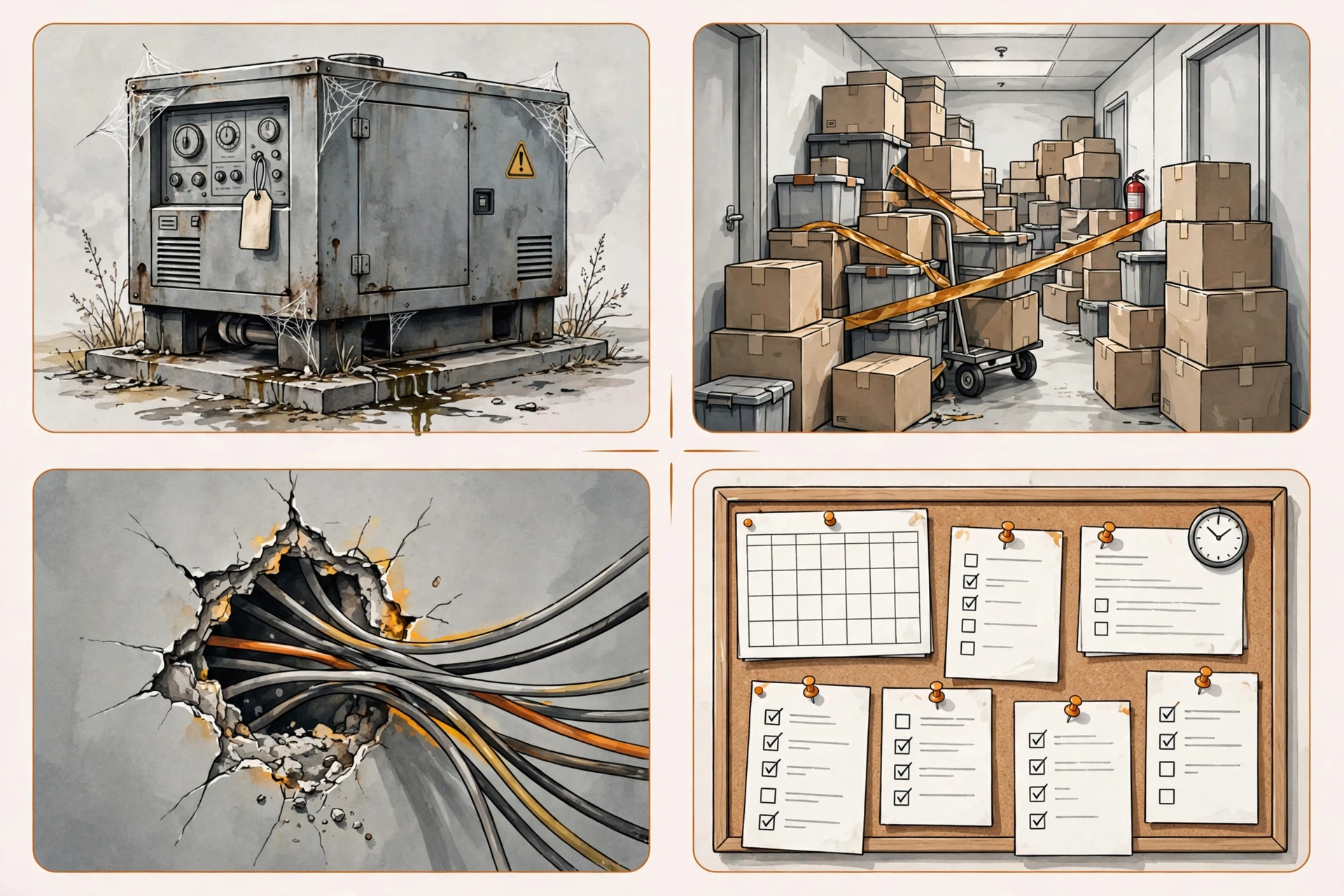
The most common CMS facility-maintenance deficiencies are documentation and testing failures, not broken equipment: generators not inspected weekly or load-tested monthly, fire drills falling into predictable patterns, fire alarm and sprinkler testing missed or unlogged, smoke barrier penetrations left unsealed after contractor work, and exits obstructed by storage or equipment. National K-tag data puts generator inspections, exit access, smoke barriers, fire drills (K-712), and fire alarm testing at the top year after year.
Take this to the job site.
This article as a one-page field sheet – the direct answer, the key numbers, and the checklist. Free PDF, prints clean, works offline.
Download the field sheet (PDF)
Get the weekly brief
Surveys, water, plant and readiness — what we measured and what changed in facility operations, every week.
The repeat offenders
- Generator inspections and tests — weekly inspections and monthly 30-minute load tests missed, wrong frequency, or done but undocumented. ~11% of facilities cited nationally.
- Exit access — obstructed egress, exits discharging into fenced areas, storage in exit paths, camouflaged doors. ~11% cited.
- Smoke barriers — unsealed penetrations from contractor wiring and phone lines, missing ratings. ~11% cited.
- Fire drills (K-712) — predictable patterns instead of unexpected times; times not varying by at least an hour. ~10% cited.
- Fire alarm testing and maintenance — missed NFPA-frequency tests, missing documentation, neglected off-premises transmission testing. ~8% cited.
- Sprinkler coverage — missed areas (closets, storage, attics), obstructions from ductwork or storage, spacing problems. ~8% cited.
- Corridor clutter — wheeled equipment parked in egress corridors beyond what’s permitted; carts left unattended.
- Fire door deficiencies — damaged doors, non-latching hardware, wedged-open rated doors.
The pattern behind the pattern
Nearly every item on this list is a routine that slipped — the weekly check nobody owned, the log nobody filed, the contractor penetration nobody reinspected. CMS doesn’t expect perfection; it expects a program that catches its own misses. The facilities that avoid these citations aren’t better funded — they’re better disciplined about the unglamorous recurring tasks.
Every item on this list is preventable with routine discipline.
See what documentation CMS expects for preventive maintenance and CMS environment-of-care requirements.
Facility Maintenance Deficiencies by Concrete Operational Category
State survey agencies and CMS regional offices evaluate hospital physical plant maintenance against 42 CFR §482.41 (Physical Environment) and incorporated Life Safety Code (NFPA 101, 2012 edition) and Health Care Facilities Code (NFPA 99, 2012 edition) standards. When survey deficiencies are cataloged, citations cluster into five distinct operational categories. Each category presents predictable inspection patterns and recurring corrective-action documentation breakdowns.
1. Fire Protection and Active Suppression Systems (§482.41(b))
Fire protection citations center on inspection, testing, and maintenance (ITM) intervals mandated by NFPA 25 (water-based fire protection) and NFPA 72 (fire alarm signaling), enforced through CMS Life Safety Code K-tags:
- Automatic Sprinkler System Inspection and Testing (K-353 / NFPA 25): Recurring survey findings include missed quarterly waterflow alarm tests, missed semi-annual valve supervisory switch (tamper) tests, and missing annual main drain test records. Main drain tests verify that supply piping has not suffered severe pressure loss from scale, corrosion, or partially closed valves; surveyors examine the differential between static and residual pressure. Five-year internal pipe inspections for foreign organic or inorganic material are frequently unperformed or undocumented.
- Sprinkler Head Clearances and Head Integrity: Surveyors cite storage placed within 18 inches of standard spray sprinkler deflectors (or within 36 inches of ESFR storage sprinklers). In mechanical rooms, pharmacy storage, and janitorial closets, uninsulated piping, storage racks, and newly hung cable trays obstructing sprinkler discharge patterns result in immediate deficiency citations. Sprinkler heads with corrosion, paint overspray from maintenance contractors, or loaded with lint/grease in laundry and dietary areas are cited for immediate replacement.
- Fire Alarm and Off-Premises Transmission (K-345 / NFPA 72): Beyond quarterly component testing, citations frequently occur because hospitals fail to verify and document off-premises transmission of alarm, supervisory, and trouble signals to the municipal fire dispatch or listed supervising station. Duct smoke detector testing and annual sensitivity testing records are commonly incomplete.
- Sprinkler and Alarm Impairment Procedures (§482.41(b)(8)): Under 42 CFR §482.41(b)(8), if an automatic sprinkler system is shut down for more than 10 hours in a 24-hour period, the hospital must either evacuate the building (or affected area) or implement an approved continuous fire watch until the system is restored. Failure to maintain an active, timestamped fire watch log during planned or emergency system impairments is an immediate, severe finding.
- Inspection Pattern & Documentation Failure: Surveyors routinely cross-check third-party vendor inspection tags attached to risers against the hospital’s internal work order log. Deficiencies noted on vendor reports (such as a seized inspector’s test valve or an impaired gauge) that lack a corresponding, closed maintenance work order are cited as failure to maintain systems in reliable operating condition.
2. Physical Barriers: Smoke, Fire, and Corridor Compartmentation (§482.41(b))
Hospital safety relies on passive compartmentation to allow defend-in-place strategies during fire events. Compartmentation failures represent a substantial share of environment-of-care survey findings:
- Above-Ceiling Smoke and Fire Barrier Penetrations (K-324 / NFPA 101 Chapters 8, 18, 19): The most recurring physical finding during surveyor ceiling-tile lifts is unsealed penetrations in 1-hour smoke barriers and 2-hour fire-rated partitions. Telecommunications cabling, low-voltage wiring, nurse call runs, and medical gas pipe penetrations installed by contractors or IT staff without approved firestop assemblies violate compartmentation. Using unlisted materials—such as standard expanding spray foam or generic caulking rather than a tested UL-listed firestop system matching the hourly rating and penetrant sleeve detail—is cited as noncompliant.
- Fire and Smoke Door Assemblies (K-211 / NFPA 80 & NFPA 105): Under NFPA 80, fire-rated door assemblies must undergo documented annual inspections evaluating door self-closing devices, latch throw engagement, coordinator operations on double doors, and clearance gaps. Maximum permitted undercuts (3/4-inch floor clearance under NFPA 80) and perimeter clearances (1/8-inch between door and frame) are strictly inspected. Non-latching hardware, damaged vision panels, and unapproved surface attachments are cited.
- Corridor Door Positive Latching (§482.41(b)(1)(ii)): 42 CFR §482.41(b)(1)(ii) specifically mandates that corridor doors and doors to rooms containing flammable or combustible materials must be provided with positive latching hardware. The regulation explicitly states: “Roller latches are prohibited on such doors.” Surveyors push against doors without operating handles; doors that fail to latch securely under closing pressure receive automatic citations.
- Compromised Egress Corridors and Door Wedging: Wedging open rated fire or smoke barrier doors with wooden doorstops, kick-down holders, or oxygen carts completely negates smoke compartmentation. In egress corridors, wheeled equipment (crash carts, IV poles, mobile diagnostic units) left unattended or parked outside designated 30-minute operational windows obstructs the minimum required 8-foot corridor width.
- Inspection Pattern & Documentation Failure: Surveyors request the hospital’s Barrier Management Program (BMP) and annual fire door inspection log. The typical breakdown is possessing a vendor inventory of doors but failing to document remediation for the 10% to 15% of doors that failed initial latching checks.
3. HVAC, Airborne Isolation, and Environmental Controls (§482.41(d)(4))
Under 42 CFR §482.41(d)(4), hospitals must provide “proper ventilation, light, and temperature controls in pharmaceutical, food preparation, and other appropriate areas.” Surveyors audit technical environmental parameters under NFPA 99 and ANSI/ASHRAE/ASHE Standard 170:
- Airborne Infection Isolation (AII) and Protective Environment (PE) Pressurization: AII rooms require continuous negative pressure (minimum -0.01 inch water column / -2.5 Pa) to contain airborne pathogens, while PE rooms (bone marrow transplant, oncology suites) require continuous positive pressure (+0.01 inch w.c. / +2.5 Pa) to protect vulnerable patients. Operating rooms require positive pressure, 20 total air changes per hour (ACH), and controlled relative humidity (20% to 60%).
- Daily Pressure Verification Documentation: CMS expects documented daily physical or automated verification of directional airflow for all active isolation rooms when occupied. Surveyors cross-check digital building automation system (BAS) logs against manual nursing or facility smoke-tube/flutter-strip logs. Discrepancies between digital sensor readings and physical airflow indicators are cited as calibration and maintenance failures.
- Fire and Smoke Damper Actuation Testing (NFPA 80 & NFPA 105): All combination fire/smoke dampers and smoke dampers must be tested within one year of installation and every four years thereafter in hospitals (every six years in other healthcare occupancies). Deficiencies cite missed 4-year cycle dates, missing visual inspection confirmation, or dampers tagged as “inaccessible” by testing contractors where the hospital never installed access hatches or documented alternate containment measures.
- Temperature and Humidity Control in Critical Clinical Spaces: Compounding pharmacies (USP <797> cleanrooms), surgical operating suites, and sterile processing department (SPD) clean and decontamination rooms must maintain strict temperature and humidity bands. Surveyors examine continuous temperature and humidity trend data; unaddressed excursions where relative humidity falls below 20% or rises above 60% in sterile storage threaten sterile packaging integrity and draw direct §482.41(d)(4) and §482.42 citations.
- Inspection Pattern & Documentation Failure: Facilities teams often record sensor errors as transient alarms in BAS archives without opening a maintenance work order to recalibrate actuators, replace slipping damper drive belts, or balance air handlers.
4. Emergency Power Supply Systems (EPSS) (§482.41(a)(1) & §482.15(e))
Emergency electrical systems are essential to hospital life support and surgical safety. 42 CFR §482.41(a)(1) requires emergency power and lighting in operating, recovery, intensive care, and emergency rooms, and stairwells, while 42 CFR §482.15(e) enforces NFPA 110 testing standards:
- Weekly Generator Operational Inspections (K-918 / NFPA 110 Chapter 8): Facility personnel must perform and record weekly visual inspections of all emergency generators. Checks must verify starting battery electrolyte levels, battery voltage and float charger operation, jacket-water heater (engine block heater) operation and coolant temperatures, engine oil levels, fuel supply levels, and exhaust system integrity.
- Monthly Generator 30-Minute Load Testing: Emergency generators must be tested under load at least monthly for a minimum of 30 continuous minutes. NFPA 110 mandates that the test be conducted under one of two operating conditions: (1) loading that achieves at least 30% of the manufacturer’s nameplate kW rating, or (2) loading that maintains the minimum exhaust gas temperature recommended by the engine manufacturer. If the 30% threshold or recommended temperature is not met during monthly tests, the hospital must conduct an annual supplemental load bank test.
- Automatic Transfer Switch (ATS) Exercise: Emergency power must restore critical electrical branch circuits within 10 seconds of utility power interruption. Monthly generator tests must exercise automatic transfer switches; surveyors verify that the monthly rotation activates different transfer switches and that time delays (starting delay, transfer delay, and cool-down delay) are documented.
- Triennial (36-Month) 4-Hour Load Testing: At least once every 36 months, hospitals must conduct a continuous 4-hour load test on each emergency generator. NFPA 110 requires the 4-hour test to be run at a minimum of 30% nameplate load for the first 3 hours and at least 75% nameplate load for the continuous final hour.
- Annual Fuel Quality Testing: NFPA 110 requires annual laboratory testing of stored diesel fuel to evaluate fuel degradation, water accumulation, particulate contamination, and biological growth. Failing to test bulk storage tanks annually or failing to polish/treat degraded fuel leads to survey citations.
- Battery-Powered Emergency Egress Lighting (K-291 / NFPA 101 §7.9.3): Dedicated battery-powered emergency illumination units must undergo a monthly 30-second functional illumination check and an annual 90-minute continuous battery discharge test. Surveyors check logs for every battery unit along required egress corridors, surgical suites, and generator rooms.
- Inspection Pattern & Documentation Failure: The most common EPSS deficiency is running monthly tests without logging kW output, exhaust gas temperatures, or ATS transition seconds, rendering the test legally unverified.
5. Sanitation, Waste Management, and Physical Plant Infrastructure (§482.41(a)(2), (b)(4), (c))
Sanitation and utility safety standards connect building engineering directly to infection prevention and environmental safety:
- Routine Storage and Prompt Disposal of Trash (§482.41(b)(4)): Trash, regulated medical waste, and biohazard sharps must be handled through strict disposal procedures. Soiled linen and trash holding rooms must maintain negative pressure, self-closing doors, and positive latching hardware. Overflowing waste bins or waste carts parked in open service corridors draw physical environment citations.
- Emergency Water and Gas Supplies (§482.41(a)(2)): Hospitals must maintain functional facilities for emergency gas and water supplies. Facility documentation must demonstrate an engineered plan for alternate potable water sourcing (tanker truck hookups, bulk bottled water reserves) and sanitary sewage contingency measures if municipal water or sewer infrastructure fails.
- Backflow Prevention and Potable Water Protection: Reduced pressure zone (RPZ) backflow prevention assemblies installed on main domestic water services, boiler feeds, and cooling tower make-up water must undergo documented annual testing by a certified backflow tester. Missing annual certifications risk cross-contamination of hospital drinking and patient-care water.
- Medical Gas Cylinder Storage and Infrastructure (NFPA 99 Chapter 11): Medical gas cylinders must be properly secured in approved racks, chains, or cylindrical stands to prevent tip-over hazards. Cylinders must be strictly segregated by gas type and status (separating full, in-use, and empty cylinders). Compressed gas storage areas must comply with ventilation and fire-rating requirements, and area alarm panels (monitoring medical air, oxygen, and vacuum pipeline pressures) must be tested and logged annually.
- Inspection Pattern & Documentation Failure: Surveyors check mechanical room cleanliness, looking for domestic water piping with sweating insulation, standing water in condensate drip pans, or unanchored compressed gas cylinders in outpatient procedural clinics.
FAQ
Why the same deficiencies recur — and the documentation connection
Facility deficiencies recur for operational, not technical, reasons:
- Rounds that find but don’t close: Environment of Care rounds identify the blocked corridor, the propped door, the overdue inspection — and the item reappears next quarter because ownership and deadlines were never attached. A rounds program is judged by its closure rate.
- Inspections performed, evidence scattered: fire damper, extinguisher, generator, and emergency-lighting records split across vendors, binders, and inboxes cannot be produced as one story on survey day.
- Preventive maintenance treated as optional under workload: deferred PM is the seed bed of physical-environment findings — which is why surveyors ask for the PM documentation described in CMS preventive maintenance documentation requirements.
The dataset view agrees: deficiency analyses repeatedly show physical-environment tags among the most cited in hospitals — not because the requirements are obscure, but because the maintenance-and-evidence system behind them is where small hospitals and large ones alike run thin.
The Anatomy of a Repeat Deficiency: Why Findings Recur
CMS surveyor data and State Operations Manual (SOM) guidance show that physical environment deficiencies recur because of structural gaps in maintenance management rather than isolated technical faults:
- The “Single-Instance Repair” Trap: When a deficiency is cited on Form CMS-2567 (such as an unlatched fire door on Unit 3 West), maintenance teams frequently fix only the single cited door. Because the underlying preventive maintenance procedure, technician training, or quarterly audit checklist was not revised across all hospital wings, identical unlatching doors are cited on the next survey cycle.
- Fragmented Contractor Documentation: Hospitals rely on specialized third-party vendors for life safety inspections—elevator mechanics, fire damper testers, generator technicians, and fire alarm specialists. When contractors submit multi-page inspection summaries listing “deficiencies noted,” these reports are often filed in maintenance binders without generating internal work orders to track repairs. Surveyors review the vendor’s deficiency appendix and immediately verify whether the hospital completed the noted repairs.
- Failure to Close the Loop in QAPI (§482.21): Under 42 CFR §482.21, the hospital governing body and clinical leadership must ensure that facility safety data feeds directly into the Quality Assessment and Performance Improvement program. Repeat citations occur when facility maintenance metrics remain siloed within the physical plant department. To break repeat cycles, corrective action plans must mandate three consecutive quarters of 100% audit compliance before a corrective action is officially retired.
- Standard-to-Condition Escalation: When surveyors identify recurring maintenance failures across multiple survey cycles (such as ongoing barrier penetrations or consecutive missed generator logs), CMS survey procedures instruct inspectors to evaluate the “manner and degree” of noncompliance under 42 CFR §488.26. Repeat standard-level failures are formally elevated to a Condition-level deficiency under §482.41, putting the hospital’s Medicare certification at risk.
What is the most cited CMS life safety deficiency?
Generator inspections and testing consistently rank at or near the top nationally, followed by exit access, smoke barriers, and fire drills.
Are most CMS facility citations about broken equipment?
No — the majority are missed tests, missing documentation, and predictable drill patterns. The equipment usually works; the program around it doesn’t.
How do I find my facility’s weak spots?
Walk this list against your own building quarterly: generator logs, drill matrix, alarm/sprinkler test records, barrier penetrations, egress paths. Fix what you find before a surveyor does.
Why do CMS facility maintenance deficiencies recur in hospitals?
Because the systems behind them recur: rounds that identify findings without closing them, inspection evidence scattered across vendors and binders, and preventive maintenance deferred under workload until it surfaces as a survey finding.
Updated 2026-10-31: strengthened against the CMS primary text (Clarity topic gap pass).
Get the weekly brief
Surveys, water, plant and readiness — what we measured and what changed in facility operations, every week.