What documentation does CMS expect for preventive maintenance?
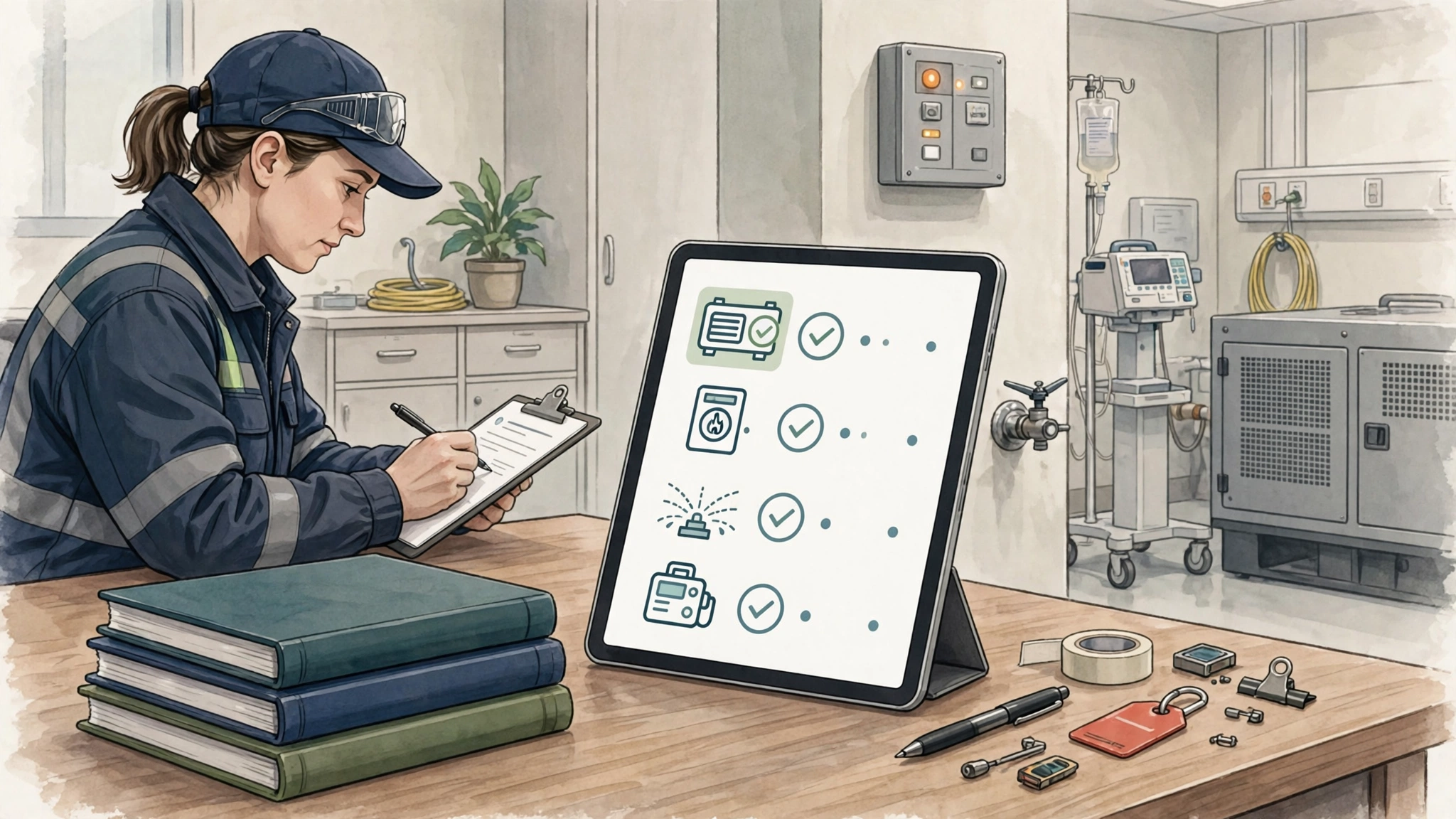
CMS expects complete, dated records proving every required inspection, test, and maintenance activity actually happened at the required frequency — for fire protection systems, emergency power, medical equipment, and building systems. The maintenance itself can follow manufacturer recommendations or a risk-based Alternative Equipment Maintenance (AEM) program, but the documentation is non-negotiable: CMS’s most common life safety citations are missed tests and missing logs, not broken equipment.
The core document set
- Fire alarm and detection — testing per NFPA 72 frequencies, with records of each test
- Sprinkler and standpipe systems — inspection, testing, and maintenance per NFPA 25, documented
- Fire extinguishers — monthly inspections and annual maintenance, tagged and logged
- Emergency generators — weekly inspections and monthly 30-minute load tests (K-tag data shows this is one of the most cited items nationally), plus annual full-load tests
- Medical gas and vacuum systems — inspection, testing, and maintenance records
- Medical equipment — maintenance per manufacturer recommendations or the facility’s AEM program, with completion records
- Fire and smoke doors, dampers — inspection records per NFPA 80/105 frequencies
- Emergency lighting and exit signs — monthly and annual test records
Manufacturer recommendations vs. AEM
CMS allows two paths: maintain equipment per manufacturer recommendations, or operate a documented Alternative Equipment Maintenance (AEM) program that sets risk-based frequencies. AEM isn’t “maintain less” — it’s a formal program with risk assessments justifying each frequency. If you claim AEM, surveyors will ask to see the program document and the risk rationale. No program document, no AEM — you’re held to manufacturer intervals.
The documentation standard
Every record needs: what was done, when, by whom, and the result (pass/fail with corrective action for failures). “PM completed” with no date is not a record. Failed tests without documented corrective action are findings. Build the log so a surveyor who’s never seen your building can reconstruct the entire maintenance history.
The equipment is rarely the problem. The logbook is.
See common CMS facility deficiencies and CMS environment-of-care requirements.
FAQ
What is a CMS AEM program?
An Alternative Equipment Maintenance program — a documented, risk-based alternative to manufacturer-recommended maintenance frequencies, with risk assessments justifying each interval.
How far back should maintenance records go?
At least 12 months of continuous records. Surveyors expect to see the full testing history, not a recent sample.
Do failed tests need documentation?
Yes — the failure and the corrective action. A failed test with no follow-up is worse than a missed test; it proves you knew and didn’t act.