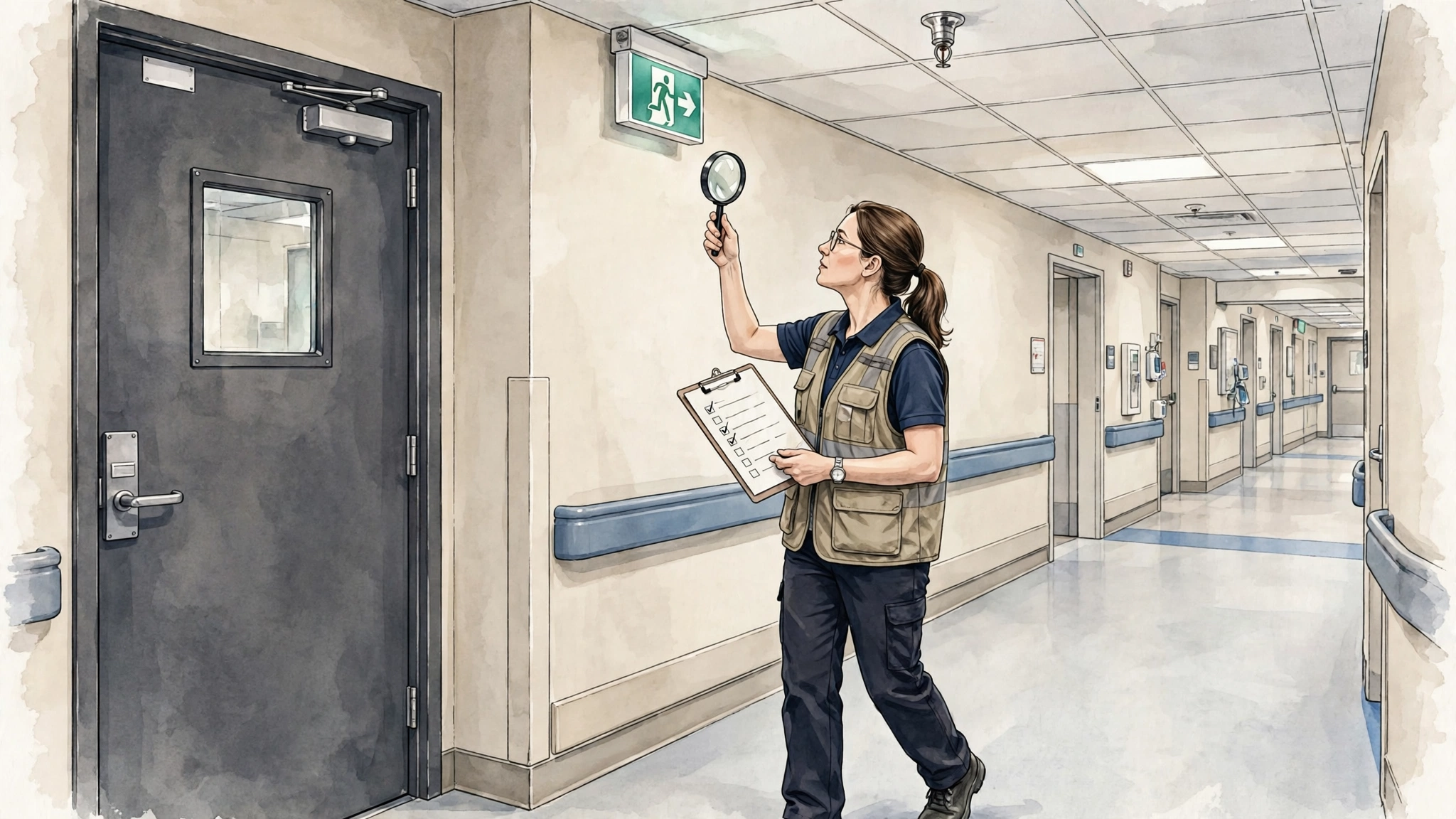
CMS surveyors evaluate life safety compliance against the 2012 editions of NFPA 101 (Life Safety Code) and NFPA 99 (Health Care Facilities Code), which CMS adopted in 2016. State-agency surveyors trained as Life Safety Code specialists walk the building with the K-tag checklist — hundreds of specific requirements covering construction, compartmentation, egress, fire protection, and building services — and every deficiency gets a K-tag citation tied to the exact Code section.
Take this to the job site.
This article as a one-page field sheet – the direct answer, the key numbers, and the checklist. Free PDF, prints clean, works offline.
The K-tag system
Life safety deficiencies are cited as K-tags (e.g., K-712 for fire drills, K-tags in the 100s–700s for the full range). Each tag maps to a specific NFPA 101-2012 section. The surveyor documents what was observed, where, and which Code section it violates. Tags aggregate upward: enough serious tags, and the surveyor cites the Life Safety from Fire condition at the condition level.
What the walkthrough covers
- Building construction and compartmentation — smoke barriers, fire barriers, penetrations, door ratings and latching
- Means of egress — corridors, stairwells, exit access, emergency lighting, exit signage
- Fire protection systems — sprinklers, standpipes, fire alarm and detection, extinguishers — with testing and inspection records
- Building services — medical gas, emergency power, HVAC, elevators
- Interior finish and furnishings — flame-spread ratings, cubicle curtains, decorations
- Special features — cooking facilities, hyperbaric, laboratories
Records get surveyed too
The walkthrough is half the survey. The other half is documentation: fire drill logs (quarterly per shift, with varying times), generator inspection and load-test records, fire alarm and sprinkler testing records, and ILSM documentation for any active project or deficiency. CMS’s most common life safety citations are documentation failures — missed tests, missing logs, predictable drill patterns — not exotic Code interpretations.
Know the tags before the surveyor writes them.
See NFPA 101 for healthcare and CMS environment-of-care requirements.
FAQ
The building tour and the record review — what each is for
A life safety survey has two intertwined halves. The building tour tests the physical plant as it actually is: egress routes and exit discharge, fire and smoke barrier integrity (including above the ceiling), door operation and latching, sprinkler and alarm condition, hazardous-area protection, and the state of construction areas and their interim measures. Surveyors open doors, look above tiles, and follow the exit path to the public way — the tour cannot be staged, because it samples whatever the building presents that day.
The record review tests the management system behind the plant: inspection, testing, and maintenance documentation for fire alarm, sprinkler, generators, dampers, and emergency lighting; ILSM assessments and documentation where impairments exist; and the facility’s own rounds and corrective actions. Findings are cited against the Life Safety Code edition CMS enforces and the physical-environment condition — mechanics detailed in how CMS enforces NFPA 101.
Preparation that works on both halves at once — building walked the way a surveyor walks it, records assembled the way a surveyor asks for them — is laid out in preparing for a CMS validation survey.
Which edition of the Life Safety Code does CMS enforce?
The 2012 editions of NFPA 101 and NFPA 99, adopted by CMS in 2016. Newer NFPA editions don’t apply for CMS purposes until CMS adopts them.
What are K-tags?
The numbered deficiency tags (K-100s through K-700s) CMS uses to cite specific Life Safety Code violations, each tied to an NFPA 101-2012 section.
Who performs CMS life safety surveys?
State survey agency Life Safety Code specialists — or accrediting-organization surveyors (Joint Commission, DNV, etc.) for deemed facilities.
How do CMS surveyors evaluate life safety compliance in hospitals?
Through a building tour that samples the plant as it is — egress, barriers (including above ceilings), doors, sprinkler and alarm systems, construction areas — paired with a record review of inspection, testing, maintenance, and ILSM documentation. Findings cite the CMS-adopted Life Safety Code and the physical-environment condition.
Get the weekly brief
Surveys, water, plant and readiness — what we measured and what changed in facility operations, every week.