How do hospitals balance facility costs with patient experience goals?
Hospitals balance cost and experience by treating the physical environment as clinical infrastructure: the evidence is strong that noise, lighting, thermal comfort, and wayfinding affect outcomes (sleep, delirium, falls, satisfaction scores that drive reimbursement). The practical balance: invest where environment touches outcomes — quiet HVAC in patient rooms, circadian lighting, clear wayfinding — and drive efficiency where patients never see it — central plants, controls optimization, procurement. Cut the back-of-house; protect the bedside.
Take this to the job site.
This article as a one-page field sheet – the direct answer, the key numbers, and the checklist. Free PDF, prints clean, works offline.
Where to spend
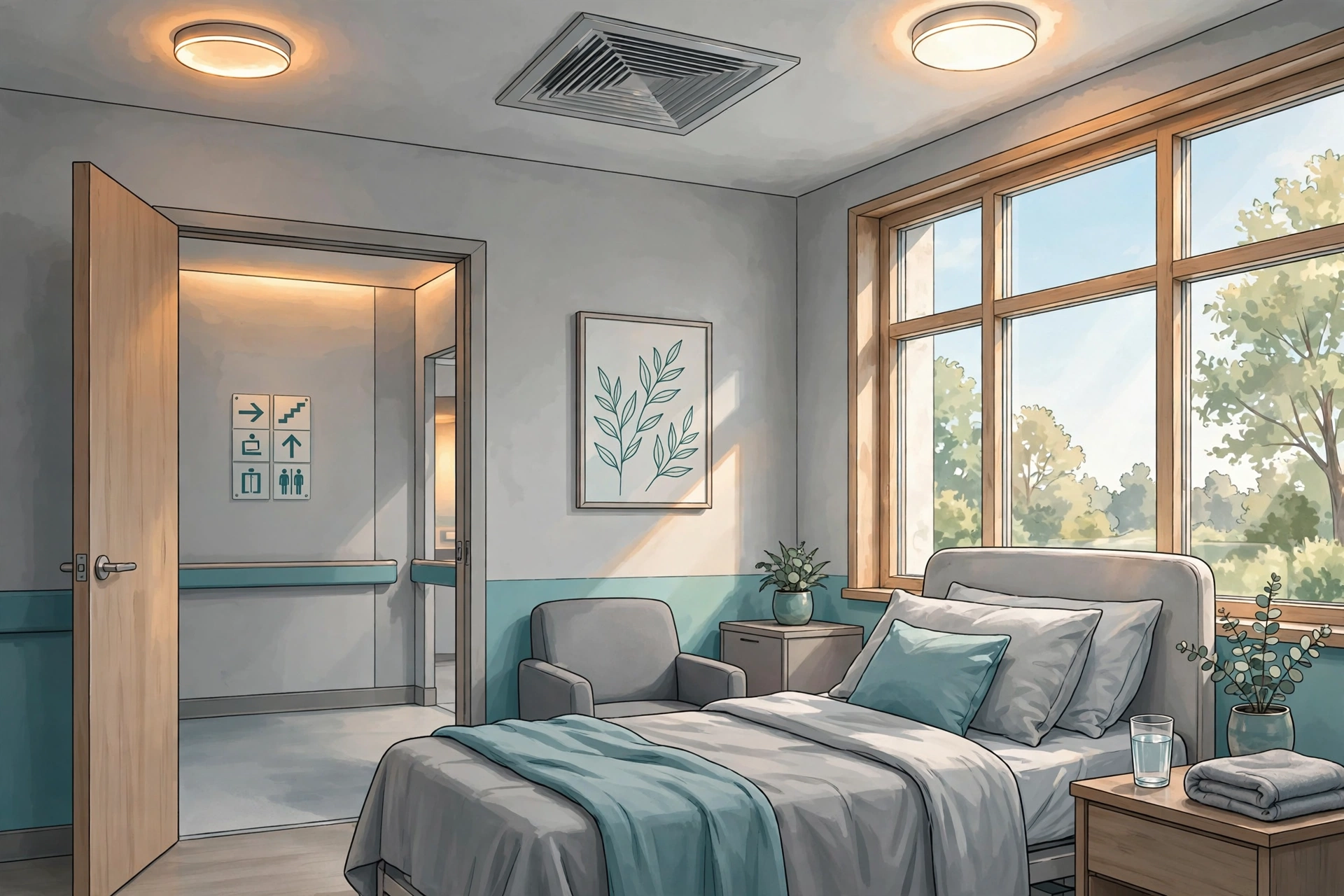
- Acoustics: quiet HVAC and sound masking in patient rooms — sleep quality is an outcome and a satisfaction driver.
- Lighting: circadian-supportive lighting reduces delirium risk and improves staff alertness.
- Thermal comfort: responsive room-level control; nothing erodes satisfaction like a room that’s always wrong.
- Wayfinding: clear signage and intuitive circulation reduce stress for patients and families — and staff interruptions.
Where to save
Central plant efficiency, building automation optimization, strategic energy procurement, and preventive maintenance that avoids premium emergency repairs. None of these touch the patient — all of them fund the things that do.
Cut the back-of-house. Protect the bedside.
See operational efficiency and facility performance metrics.
FAQ
The costs patients actually perceive
Patients cannot see a chiller plant. What they experience — and what shows up in surveys and complaints — is a short list of facility conditions:
- Temperature and air movement in the room they cannot leave;
- Noise at night: alarms, carts, doors, and above-ceiling work scheduled without regard to rest;
- Cleanliness as judged by the eye — bathrooms, floors, and the state of the room on arrival;
- Wayfinding and wait spaces: lighting, signage, seating, and whether the building feels cared for.
The tradeoff discipline is to name which list a proposed cut touches. Savings taken from preventive maintenance on patient-area HVAC, night staffing, or cleaning frequency are not invisible — they are deferred patient-experience costs with interest. Savings from energy scheduling, contract rebids, and space consolidation genuinely are invisible to patients. Facility leaders who sort every proposal into those two buckets make the cost–experience balance explicitly, instead of discovering it in next quarter’s scores. The campus-level view in best practices for managing large healthcare campuses shows the same sorting applied at scale.
Does the hospital environment affect patient outcomes?
Yes — noise, lighting, thermal comfort, and wayfinding are linked to sleep, delirium, falls, and satisfaction scores.
Where should hospitals cut facility costs?
In invisible systems: central plants, controls, procurement, preventive maintenance — not in the patient environment.
How does facility spending connect to reimbursement?
Patient satisfaction scores (HCAHPS) influenced by the environment feed into value-based reimbursement.
Which facility costs most affect patient experience when cut?
Cuts patients feel first are patient-area HVAC maintenance, night noise control, and cleaning frequency. Costs that can usually be reduced invisibly are energy scheduling waste, contract pricing, and under-used space.
Get the weekly brief
Surveys, water, plant and readiness — what we measured and what changed in facility operations, every week.