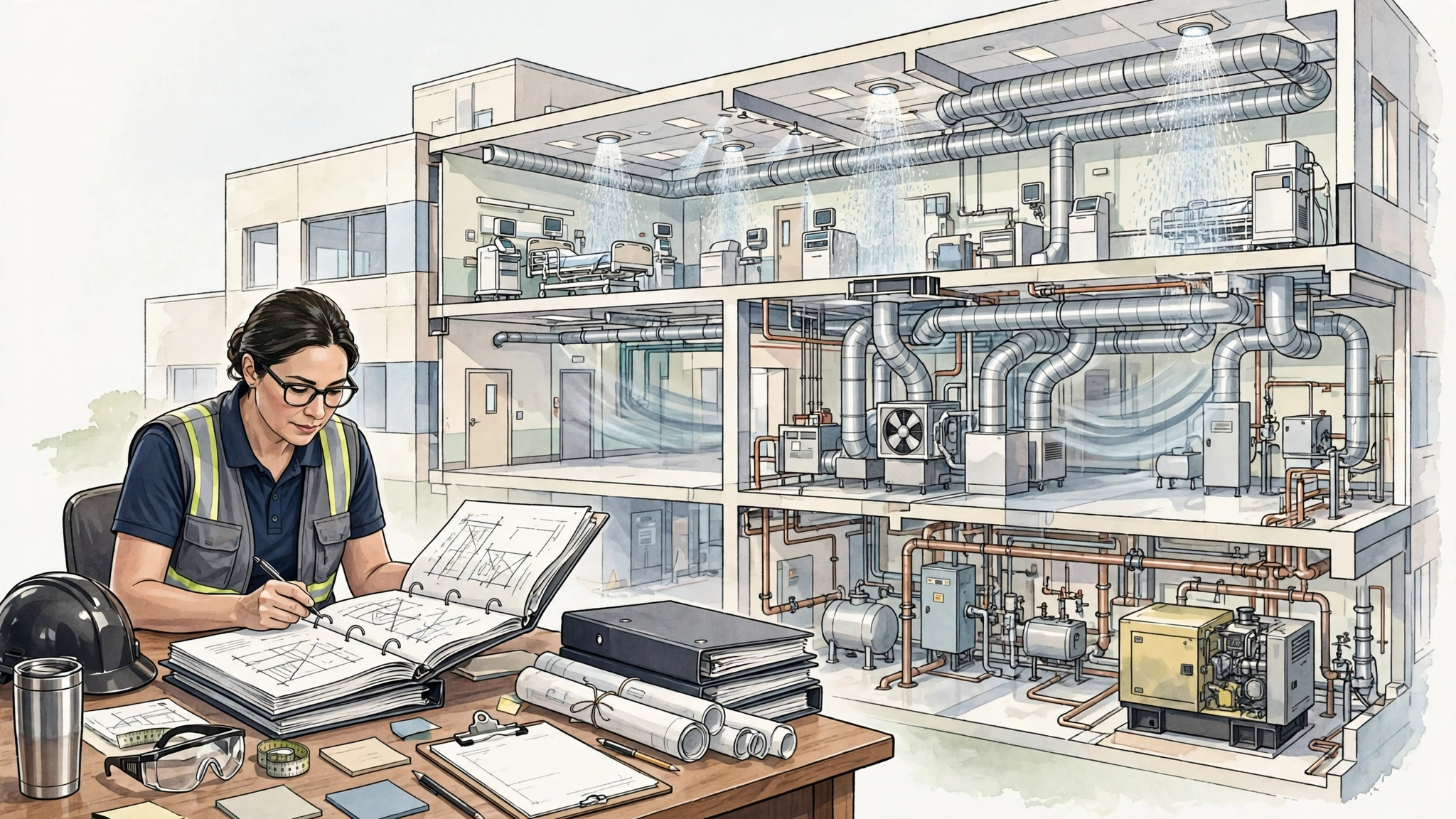
What this page covers: a practical prep plan for a Joint Commission Environment of Care (now Physical Environment) survey: rounds documentation, staff readiness, and a 90-day countdown checklist. Who it is for: facility managers and EOC or safety committee leads with a survey window open.
Preparing for a Joint Commission Environment of Care survey means demonstrating that your facility systematically manages safety, security, hazardous materials, fire safety, medical equipment, and utilities — with documented EOC rounds, complete testing and inspection records, the written plans surveyors still ask for, and staff who can explain what they do when something goes wrong. As of January 1, 2026, Accreditation 360 moved the hospital and critical access hospital EC and Life Safety requirements into a new Physical Environment chapter, with a few topics relocated to National Performance Goals. Update your binder labels and standard numbers — the preparation work is the same.
Start with the three plans surveyors still open
Joint Commission no longer requires hospitals and critical access hospitals to keep separate written management plans for safety, security, hazardous materials and waste, utilities, and medical equipment. Surveyors now ask for three written plans: your fire response plan (required by NFPA 101-2012 and scored under PE.03.01.01), your water management plan (PE.04.01.05), and your emergency operations plan (EM.12.01.01). Make all three easy to find in five minutes, make sure the fire response plan covers staff roles at and away from the point of origin, alarm transmission, compartment isolation, patient relocation, and extinguisher use, and confirm your emergency plan has been reviewed within CMS’s two-year cycle under 42 CFR 482.15. Don’t shred the old management plans — they still document who owns each program and how you monitor it — but they are no longer what the survey turns on. Ambulatory care sites are the exception: they still need the written EOC management plans.
Make your rounds documentation airtight
Environment of Care rounds are where surveys are won or lost. Surveyors don’t just read your rounds reports — they re-walk your findings. For every deficiency your rounds identified, you need: the finding, the corrective action, the responsible party, and the completion date. Open items without dates are findings waiting to happen. Pay special attention to:
- Fire protection and suppression systems inspection, testing, and maintenance (formerly EC.02.03.05; now evaluated against NFPA 101 and the CMS K-tags through the Physical Environment chapter) — a perennial top finding
- Ventilation and pressure relationships in critical care, surgical, and isolation areas (formerly EC.02.05.01)
- Medical equipment inspection and maintenance records
- Hazardous materials storage, labeling, and spill response supplies
- Security incident tracking and response
Prepare your people, not just your paper
Surveyors interview frontline staff using tracer methodology — they follow real patients and real processes. Your EVS tech should be able to explain cleaning protocols for an isolation room. Your maintenance tech should know what to do when a fire alarm panel shows a trouble signal. Run mock tracers quarterly: pick a high-risk process (e.g., negative-pressure room verification) and trace it end to end.
The 90-day countdown checklist
- Verify your fire response, water management, and emergency operations plans are current, findable in five minutes, and match how the building actually operates
- Close or date every open EOC rounds finding
- Confirm fire drills occurred at the required frequency with documented critiques
- Verify ILSM policy is current and staff can articulate it
- Test emergency power systems and document results
- Walk every behavioral health area for ligature risks
- Confirm hazardous materials inventories match what’s actually stored
Don’t walk into survey season guessing.
See what the 2026 physical environment standards require, or run your program through the healthcare compliance audit tool.
FAQ
Is the Environment of Care chapter gone under Accreditation 360?
For hospitals and critical access hospitals, yes in name. Effective January 1, 2026, Accreditation 360 folded the EC and LS chapters into a new Physical Environment chapter, and moved a few topics — workplace violence worksite analysis, security risks, utility systems, and imaging safety — into National Performance Goals. The requirements didn’t disappear; they were restructured, and the number of required written management plans dropped to three. Keep preparing the same domains; update your terminology.
How far back do surveyors look at EOC documentation?
Expect them to review at least 12 months of rounds, testing, and inspection records. Gaps in documentation read as gaps in the program.
What sinks most EOC surveys?
Open rounds findings without corrective-action dates, missing fire protection testing documentation, and staff who can’t explain basic emergency procedures during interviews.