What ILSM measures does The Joint Commission expect during construction?
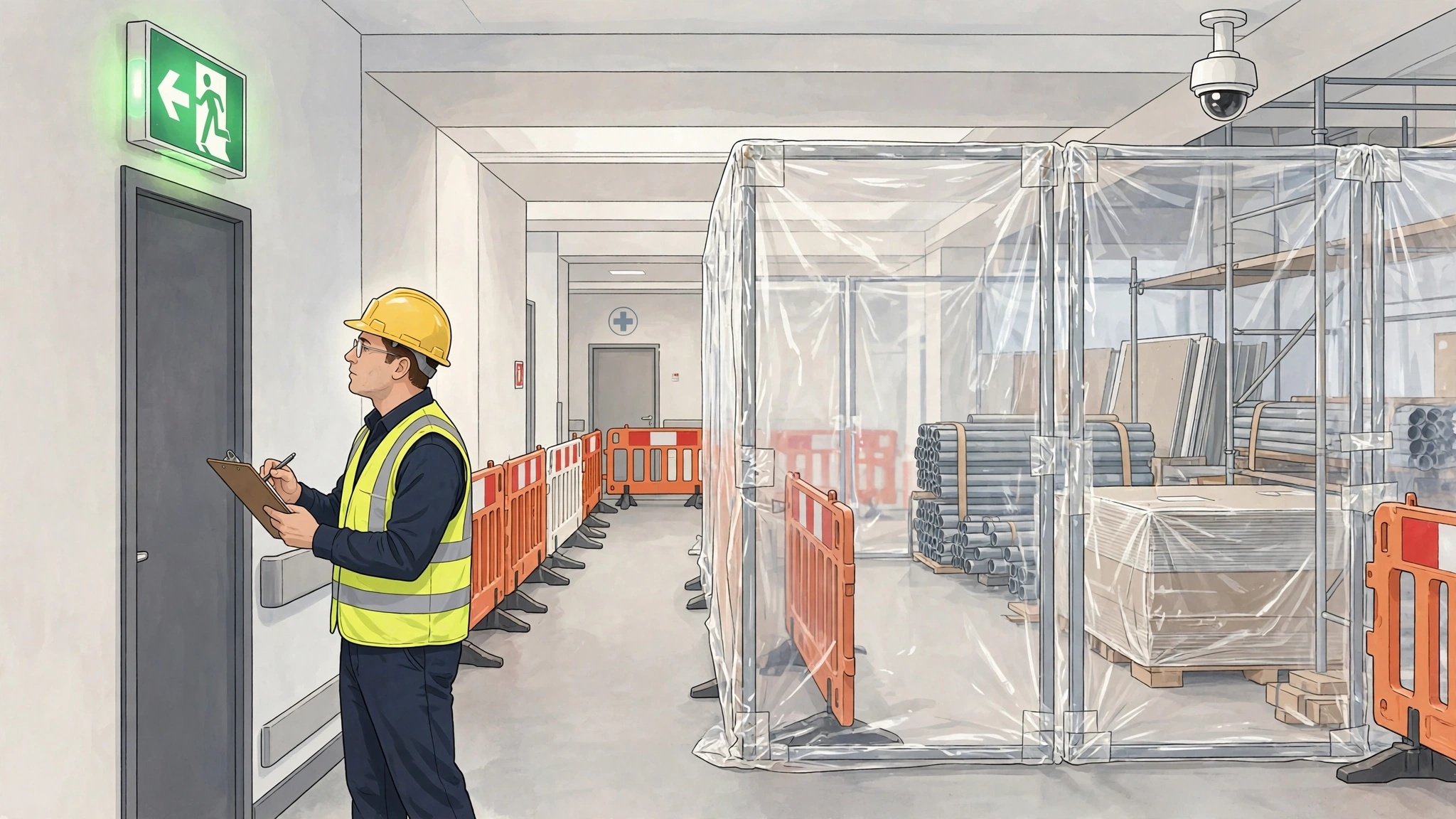
The Joint Commission expects hospitals to implement Interim Life Safety Measures (ILSM) under standard LS.01.02.01 whenever construction — or a Life Safety Code deficiency — degrades the building’s normal fire and life safety protections. The expected measures, spelled out in the standard’s elements of performance, are: posted alternate-exit signage, daily egress-route inspections, temporary equivalent fire systems while a system is impaired, additional firefighting equipment, smoketight noncombustible temporary barriers, increased surveillance, enforced storage and debris-removal practices, training on firefighting equipment, an additional fire drill per shift per quarter, monthly testing of temporary systems, and staff training on the deficiencies, hazards, and compensating measures in place.
The measures, mapped to what surveyors check
- Alternate exit signage — everyone affected must know where the alternate exits are.
- Daily egress inspections — routes of egress in affected areas inspected every day, problems resolved immediately.
- Temporary equivalent systems — when a fire alarm, detection, or suppression system is impaired, a temporary but equivalent system goes in, and it’s inspected and tested monthly (or once per project if the project runs under a month).
- Additional firefighting equipment — provided where the assessment calls for it, with staff trained in its use.
- Smoketight, noncombustible partitions — temporary construction barriers that won’t contribute to fire development or spread.
- Increased hazard surveillance — documented inspections of buildings, grounds, and equipment, with attention to construction areas, storage, excavations, and field offices.
- Storage, housekeeping, debris removal — practices that keep flammable and combustible load at the lowest feasible level.
- Additional fire drill — one extra drill per shift per quarter in affected areas.
- Training — on firefighting equipment, on impaired structural or compartmentation features, and on the building deficiencies, construction hazards, and temporary measures in effect.
The two clocks that force action
Mirroring the 2012 Life Safety Code: a fire alarm system out more than 4 cumulative hours in 24 triggers an ILSM assessment — evacuate the zone or post a fire watch. A sprinkler system out more than 10 cumulative hours in 24 means evacuate the affected areas or post a fire watch. Short repeated outages add up inside the same 24-hour window.
ILSM never runs alone — ICRA runs beside it.
See ICRA vs ILSM: how the two programs divide the work and the Joint Commission’s stance on ILSM during construction.
FAQ
Which Joint Commission standard covers ILSM?
LS.01.02.01 — Interim Life Safety Measures, with elements of performance covering signage, inspections, temporary systems, equipment, barriers, surveillance, housekeeping, training, drills, and system testing.
When does a fire watch become mandatory?
When a fire alarm system is out more than 4 cumulative hours in 24, or a sprinkler system is out more than 10 cumulative hours in 24 — the affected areas are evacuated or a fire watch is posted, per the facility’s ILSM policy.
How often must temporary fire systems be tested?
Monthly — or once per project if the project duration is less than one month.