Updated Nov 2, 2026 — refreshed TJC LS.01.02.01 crosswalk and internal life safety links.
Updated Oct 31, 2026 — added the free ILSM field summary, compliance pack, and book-for-bots downloads to this guide.
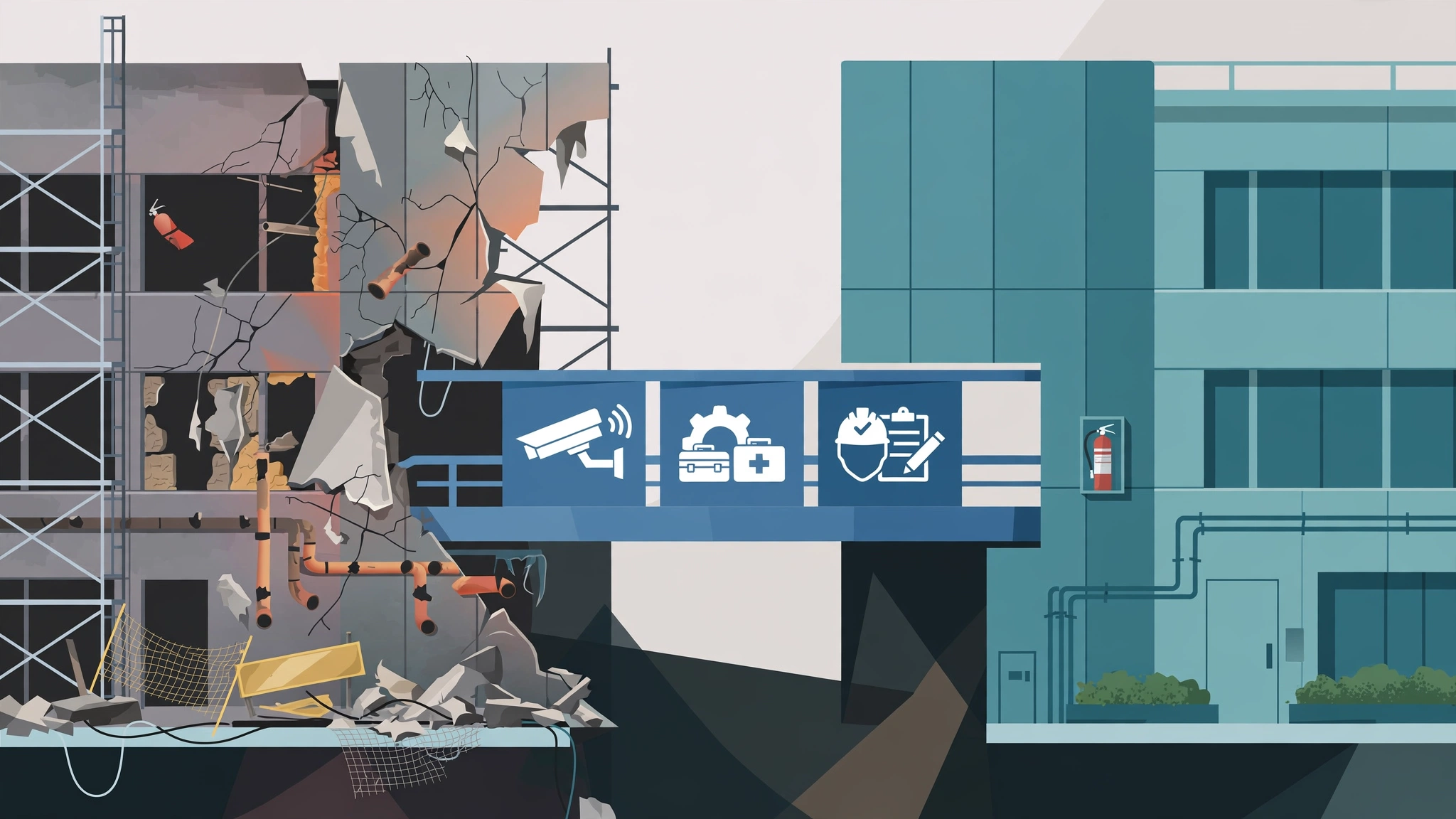
Interim Life Safety Measures (ILSM) are the documented, compensatory actions a healthcare facility takes when construction activity or a Life Safety Code deficiency temporarily degrades the building’s normal fire and life safety protections. Think of ILSM as the bridge between “the building isn’t fully protected right now” and “patients, staff, and visitors are still safe” — a formal set of extra precautions that stays in force until full protection is restored.
Featured Compliance Definition
What Are Interim Life Safety Measures (ILSM)? Interim Life Safety Measures (ILSM) are a mandatory series of 11 operational, physical, and administrative compensating actions required by The Joint Commission (Standard LS.01.02.01) and CMS (42 CFR § 482.41) whenever construction, renovation, or physical plant deficiencies temporarily compromise a healthcare facility’s fire alarm, sprinkler, smoke barrier, or egress protections.
Need a Field Clarification or Specific Code Interpretation?
Healthcare facility codes (ASHRAE 170, NFPA 101/99, ASHE ICRA 2.0) are interpreted differently across jurisdictions and accrediting bodies (Joint Commission, CMS, DNV). If you are resolving an active jobsite condition, preparing for survey, or need technical peer review, connect with our engineering team or run your numbers through our interactive audit tools.
Get the weekly brief
Surveys, water, plant and readiness — what we measured and what changed in facility operations, every week.
Equip Your Job Site or Feed Your AI Assistant
Field-tested compliance tools built directly from Joint Commission Standard LS.01.02.01 and CMS 42 CFR § 482.41 requirements.
FREE
ILSM Field Summary
2-page field overview: the two statutory triggers, 11 elements summary, and 4-hr / 10-hr fire watch rules.
Direct download • No email gate
$7
Daily Compliance Pack
Printable/fillable working pack: 11-element daily tracker, 15–30 min fire watch patrol log, PCRA worksheet, and impairment notification sheets.
Instant checkout • Square verified
$17
ILSM Book for Bots
Feed to ChatGPT or Claude: 5 AI-run routines (/assess, /log, /pcra, /subcontractor, /survey-defense) with embedded output router.
Software made of words • Instant delivery
Take this to the job site.
This article as a one-page field sheet – the direct answer, the key numbers, and the checklist. Free PDF, prints clean, works offline.
What “interim” really means
A hospital’s life safety systems — compartmentation, egress, fire alarm, detection, suppression — are designed to work as an integrated whole. When construction opens up a smoke barrier, or a deficiency takes a sprinkler zone offline, that integration breaks. ILSM compensates with human and procedural measures: more eyes (surveillance), more equipment, more training, more drills, temporary equivalent systems. They don’t replace the engineered systems — they hold the risk down until the engineered systems are back.
The two triggers
- Construction projects that affect life safety features — egress paths, fire/smoke barriers, alarm, detection, or suppression systems.
- Life Safety Code deficiencies that can’t be corrected immediately — the deficiency is documented (often in the e-Statement of Conditions) and ILSM covers the gap.
Each trigger gets a case-by-case ILSM assessment: which protections are degraded, which of the standard measures apply, who implements them, and how they’re documented. Blanket ILSM (“we always do all of them”) and missing ILSM (“we didn’t think this project needed it”) both fail surveys — the assessment is the evidence that someone actually thought it through.
The Mandatory 11 ILSM Elements (The Joint Commission Standard LS.01.02.01)
Under Joint Commission Standard LS.01.02.01, hospitals cannot simply claim “construction in progress.” Facilities must conduct a documented risk assessment for every project or impairment and select from the 11 formal compensatory elements detailed below:
| Item | ILSM Compensating Measure | Operational Protocol & Engineering Standard | Required Frequency |
|---|---|---|---|
| ILSM 1 | Free & Unobstructed Egress | Ensure exits, corridors, and stairwells remain clear of construction debris, carts, and staging materials. Temporary exit signs must be posted if routes are diverted. Cross-reference NFPA 101 Corridor Width Requirements. | Daily documented rounds |
| ILSM 2 | Free Access to Emergency Services | Maintain unencumbered roadway and door access for municipal fire department, ambulances, and emergency apparatus. Verify hydrants and FDC connections are never blocked by contractor dumpsters. | Daily physical inspection |
| ILSM 3 | Temporary Fire Detection Systems | When permanent fire alarm or smoke detection systems are disabled, install temporary equivalent detection (heat detectors, wireless temporary pull stations) connected to the primary FACP or monitoring desk. | Monthly testing & certification |
| ILSM 4 | Temporary Smoke-Tight Partitions | Erect noncombustible, smoke-tight partitions (e.g., drywall or polycarbonate with Class A flame spread) to isolate construction areas from patient care spaces. Coordinated directly with ASHE ICRA 2.0 Class III–V Barrier Matrices. | Daily integrity checks |
| ILSM 5 | Additional Firefighting Equipment | Stage supplemental portable ABC dry chemical or pressurized water fire extinguishers in construction staging areas, hot work zones, and temporary storage yards. | Weekly inspection & tags |
| ILSM 6 | Combustible Storage Restrictions | Prohibit accumulation of scrap wood, cardboard packaging, plastic sheeting, and trash. All combustible refuse must be removed at the end of each work shift in covered metal bins. | Continuous / End-of-shift |
| ILSM 7 | Additional Fire Drills | Conduct at least one additional fire drill per shift per quarter in areas affected by construction, simulating altered egress routes and revised compartmentation lines. | 1 extra drill/shift/quarter |
| ILSM 8 | Daily Egress Inspections | Formal physical inspection of all designated escape routes, exit doors, stairwell pressurization doors, and release hardware in the affected zone. Logged on facility safety sheets. | Daily pre-shift log |
| ILSM 9 | Increased Hazard Surveillance | Intensified safety surveillance rounds by facilities engineers, safety officers, and infection preventionists across construction corridors, utility shafts, and demolition boundaries. | Minimum twice-daily rounds |
| ILSM 10 | Staff Education on Deficiencies | Educate nursing, clinical staff, and facility occupants in the affected building zone regarding blocked doors, temporary exit pathways, and impaired smoke barrier boundaries. | Prior to work / Shift huddles |
| ILSM 11 | Departmental Emergency Training | Conduct hands-on training for staff in affected clinical departments covering fire extinguisher operation (PASS protocol), building alarm response (RACE), and horizontal evacuation through NFPA 101 Fire and Smoke Compartments. | Quarterly / Project startup |
Put These 11 Elements to Work Immediately
During an unannounced Life Safety survey or CMS audit, surveyors request the daily inspection logs for every active barrier breach and impairment. A single missing day triggers a direct Requirement for Improvement (RFI).
What’s In The Toolkit:
• Fire Watch Shift Log: 15–30 min round tracking.
• PCRA Matrix Form: Pre-construction scoring.
• Impairment Notice: AHJ & underwriter sign-offs.
• AI Bot Routines: 5 automated workflows ($17).
Fire Watch Impairment Protocol & Statutory Triggers
The most intensive operational tool within the ILSM hierarchy is the implementation of a continuous Fire Watch. Under NFPA 101 § 9.6.1.6, NFPA 101 § 9.7.6.1, and Joint Commission Standard LS.01.02.01, a Fire Watch is not discretionary—it is triggered by statutory time limits whenever automatic life-safety systems fail or undergo planned maintenance:
Fire Alarm System Impairment
Statutory Trigger: Out of service for more than 4 hours in a 24-hour period.
- Immediate notification to the local Municipal Fire Department / AHJ.
- Continuous physical patrol of affected areas every 15 to 30 minutes.
- Dedicated personnel equipped with two-way radio/phone (no secondary duties permitted).
- Written Fire Watch Log recording patrol times, signatures, and noted hazards.
Automatic Sprinkler Impairment
Statutory Trigger: Out of service for more than 10 hours in a 24-hour period.
- Mandatory notification to property insurance underwriter and AHJ.
- Continuous physical rounds documenting zone riser pressures.
- Pre-staging of charged booster fire hoses and supplemental water extinguishers.
- Evacuation pre-alert status if outage exceeds 24 consecutive hours.
Every facility must integrate its Fire Watch logs directly into its CMS Conditions of Participation: Environment of Care documentation binder. Surveyors will audit the exact timestamps between the system impairment notice and the first logged patrol.
ILSM vs. the fire safety plan vs. ICRA
Your fire safety plan is the permanent program — RACE/PASS, alarm response, evacuation. ILSM is the temporary overlay on that plan for a specific degradation. ICRA is the parallel program protecting against infection risk from the same construction. One project, three programs, one coordinated story — that’s what surveyors expect to see.
New to the ILSM framework?
Start with the Joint Commission’s stance on ILSM during construction, then read how ICRA and ILSM divide the work on one project.
Compliance & Life Safety Disclaimer: ILSM policies must be formally adopted as part of the hospital’s Life Safety Management Plan and reviewed by the Safety Committee. Consult your Authority Having Jurisdiction (AHJ) for municipal variance requirements.
FAQ
Are ILSM a Joint Commission requirement or a best practice?
A requirement — standard LS.01.02.01, with elements of performance surveyors score directly.
Do ILSM apply to the whole building or just the affected area?
The measures apply where the assessment says they apply — typically the affected area plus adjacent spaces whose egress, alarm, or compartmentation is impacted. The assessment defines the boundary.
What’s the difference between ILSM and a fire watch?
A fire watch is one possible ILSM-level response — the most intensive one, used when alarm or suppression is out beyond the 4-hour/10-hour thresholds. ILSM is the full framework; fire watch is its heaviest tool.
Download the Hospital ILSM Inspection & Assessment Toolkit
Equip your facility safety committee, construction superintendents, and life safety officers with our field-ready compliance forms:
- ILSM Daily Pre-Shift Inspection Checklist (.PDF / .DOCX): Standardized 11-point inspection log with surveyor signature sign-off.
- Pre-Construction Life Safety Risk Assessment Form: Matrix for scoring barrier breaches, temporary routing, and fire watch triggers.
- Fire Watch Patrol Tracking Log: 15-minute verification sheets meeting Joint Commission LS.01.02.01 criteria.
Equip Your Hospital with Professional ILSM Tools
Choose the compliance tier that matches your facility’s active construction or impairment needs:
ILSM Quick Field Sheet
2-page quick reference summarizing statutory triggers, the 11 elements, and 4-hr / 10-hr fire watch thresholds.
direct download
- 4-Hour Fire Alarm Rule
- 10-Hour Sprinkler Outage Rule
- 11 ILSM Elements Table
- Surveyor EC Binder Tips
- Print-Ready A4 PDF
Daily Compliance Pack
Printable and fillable working logs, checklists, and notification records for facility directors and general contractors.
one-time
- 11-Element Daily Inspection Sheet
- 15–30 Min Fire Watch Patrol Log
- Pre-Construction Risk Matrix (PCRA)
- AHJ & Underwriter Notification Record
- Instant Delivery Page Access
ILSM Book for Bots
The intensive AI version: drop into ChatGPT or Claude to run interactive assessments, generate logs, and prep for surveys.
one-time
- 5 Executable AI Routines (/assess, /log…)
- Embedded Command Router
- Subcontractor Agreement Drafter
- Mock Surveyor Cross-Examination
- Instant Delivery Page Access
All payments securely processed by Square • Apple Pay, Google Pay & Corporate Cards Accepted
Life Safety Management Compliance Notice
Interim Life Safety Measures must be formally adopted as part of the healthcare organization’s Life Safety Management Plan and approved by the Safety Committee. While NFPA 101 and The Joint Commission establish national baseline parameters, municipal fire codes and local Authorities Having Jurisdiction (AHJs) frequently enforce more stringent Fire Watch response windows or notification procedures. Always verify local AHJ variance requirements prior to initiating construction impairments.
Get the weekly brief
Surveys, water, plant and readiness — what we measured and what changed in facility operations, every week.