Should patients be relocated during major hospital renovation?
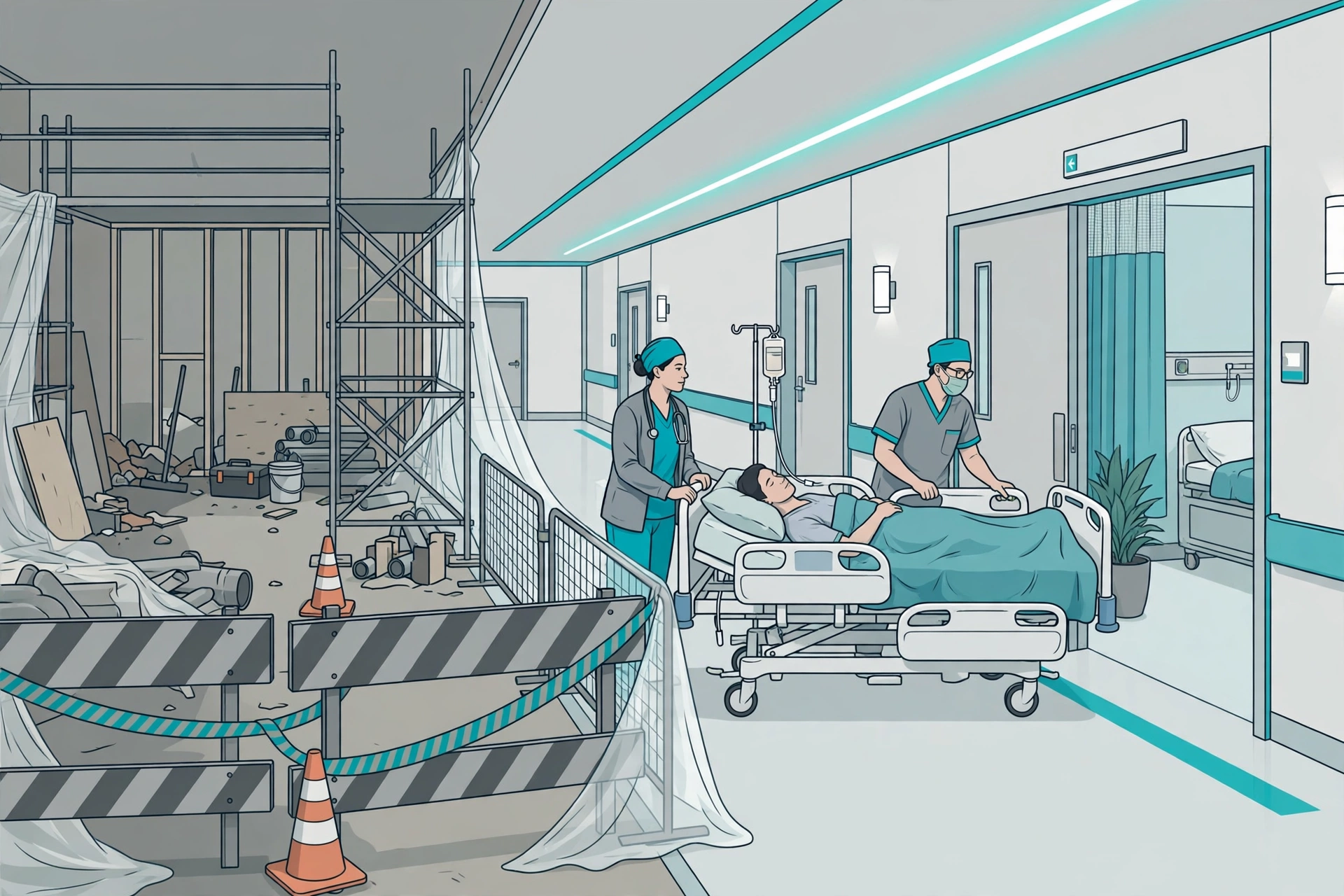
Sometimes — and the decision belongs in the ICRA, made before construction starts. Relocation is strongly recommended for the highest-risk patients (bone marrow transplant, solid organ transplant, prolonged neutropenia) when major demolition or construction occurs nearby. For lower-risk populations, well-executed ICRA precautions — containment, negative pressure, HVAC isolation — can make staying safe. The deciding factors: patient vulnerability, construction intensity, proximity, and whether the precautions can truly be maintained for the project’s duration.
When relocation is the right call
- Major demolition (Type D activity) adjacent to BMT, transplant, or neutropenic units
- Environmental hazards uncovered: mold, sewage, asbestos disturbance
- HVAC systems serving the unit must be shut down or heavily disrupted
- The facility can’t credibly maintain Class IV/V precautions for the full duration
- A prior aspergillosis case linked to construction on the campus
When staying works
Lower-acuity units at greater distance, with verified barriers, continuous negative pressure, isolated HVAC, and active surveillance — staying is reasonable and often necessary (you can’t relocate an entire ICU). The key word is verified: precautions on paper don’t protect anyone.
Make it a plan, not a reaction
Relocation decisions made mid-project — after dust is in the air — are the worst kind. The ICRA team identifies relocation candidates during assessment, designates receiving units, and sets triggers for escalation (e.g., barrier failure, positive air sampling, a clinical case) that convert “stay” to “move” automatically.
Decide before demolition, not during it.
See protecting immunocompromised patients and how to perform an ICRA.
FAQ
Do patients need to leave during hospital renovation?
The highest-risk patients (transplant, neutropenic) should be relocated from near major construction; others can stay under verified ICRA precautions.
Who decides on patient relocation?
The ICRA team — infection preventionist, nursing leadership, and facilities — during the pre-construction assessment.
What triggers an emergency relocation mid-project?
Barrier failure, positive air sampling for Aspergillus, a linked clinical case, or loss of HVAC protection — set these triggers in advance.