What is the Joint Commission’s stance on ILSM during construction?
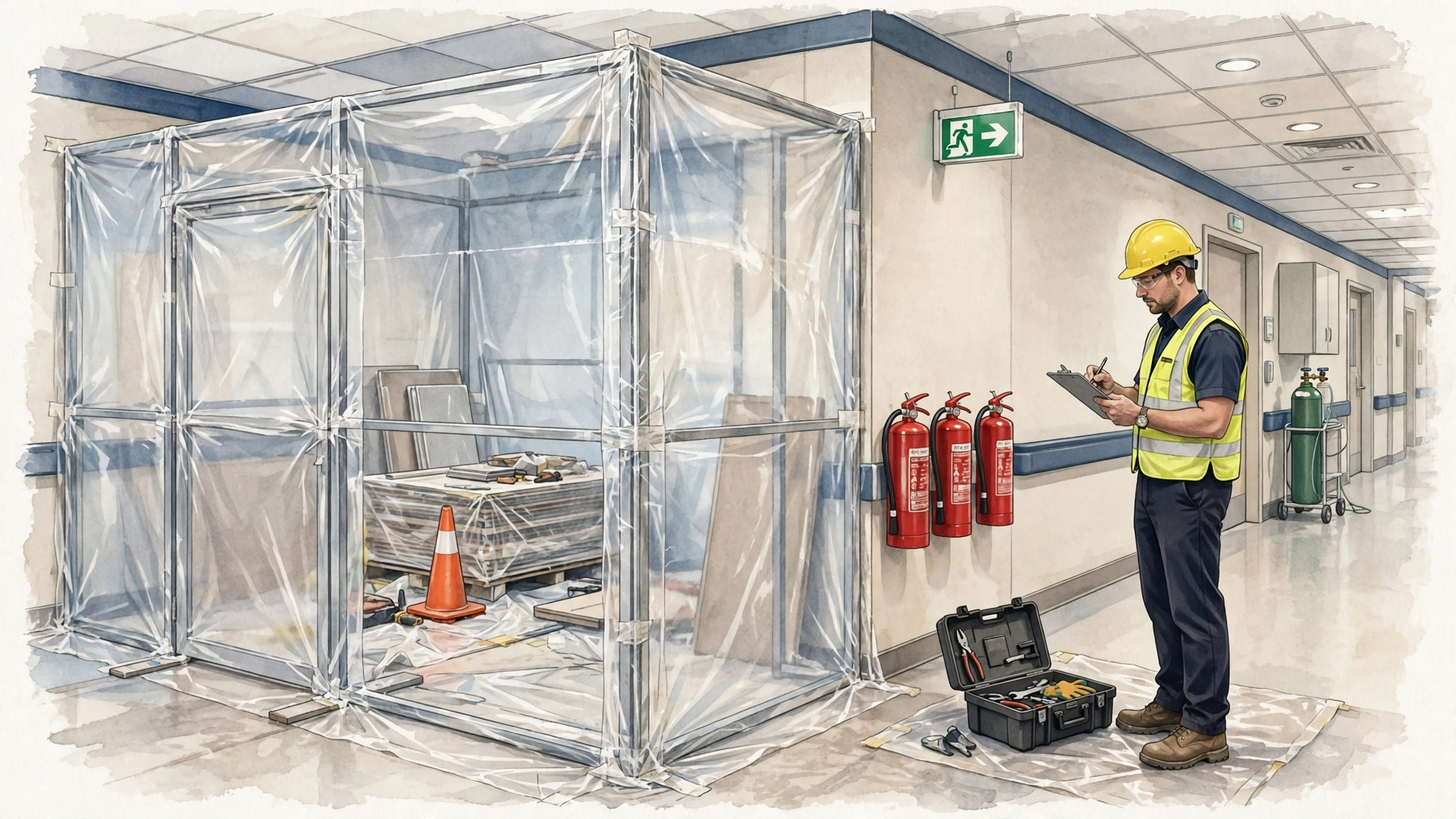
The Joint Commission requires Interim Life Safety Measures (ILSM) whenever construction activity — or a Life Safety Code deficiency — compromises the building’s normal fire and life safety protections. ILSM is not optional and not informal: it’s a documented, enforced set of compensatory measures that stays in place until the deficiency is corrected or the construction ends.
When ILSM is triggered
Two triggers: (1) any construction project that affects life safety features (egress, compartmentation, fire alarm, suppression), and (2) any identified Life Safety Code deficiency that can’t be corrected immediately. The assessment is case-by-case — a ILSM assessment form maps each deficiency or project against the measures below, and the ones that apply get implemented and documented.
The 11 ILSM measures
The Joint Commission’s ILSM framework consists of these compensatory actions, applied as relevant to the situation:
- Free and unobstructed exits — escape routes maintained for occupants and construction workers; construction-area exits inspected daily.
- Emergency access — unobstructed access for fire, police, and emergency forces.
- Fire systems operational — alarm, detection, and suppression in working order; temporary equivalent systems provided when any system is impaired, inspected and tested monthly.
- Smoketight partitions — temporary construction partitions built of noncombustible or limited-combustible materials that won’t contribute to fire spread.
- Additional firefighting equipment — provided, with personnel trained in its use.
- Smoking prohibition — enforced in and adjacent to construction areas per EOC standards.
- Housekeeping and debris removal — storage and housekeeping practices that keep flammable/combustible load at the lowest feasible level.
- Additional fire drills — minimum two per shift per quarter in affected areas when staff response (rescue, alarm, confinement, extinguishment, evacuation) is altered for an extended period.
- Increased hazard surveillance — documented inspections of buildings, grounds, and equipment with attention to excavations, construction areas, and storage.
- Compensatory training — personnel trained to compensate for impaired structural or compartmentation fire safety features.
- Organization-wide education — safety education promoting awareness of the deficiencies, construction hazards, and the ILSM in place.
What surveyors check
Surveyors verify that the ILSM policy exists, that an assessment was actually performed for the project or deficiency, and that the selected measures are documented as implemented — not just listed on a form. Daily inspection logs, drill records, and training documentation are the evidence. An ILSM policy nobody can produce during a survey is the same as no policy.
ILSM and ICRA run together on every project.
See how they divide the work in ICRA vs ILSM on the same project, and the ICRA Class I–V matrix and barriers guide.
FAQ
Are ILSM required for small renovation projects?
If the project affects life safety features — egress paths, compartmentation, alarm or suppression — yes, regardless of project size. The assessment is case-by-case, but small doesn’t mean exempt.
How long do ILSM stay in effect?
Until the deficiency is corrected or the construction project ends and normal life safety protections are restored and verified.
Who is responsible for ILSM implementation?
Facility leadership owns the program; the safety officer typically administers the assessment and documentation, with construction management and clinical leadership coordinating affected areas.