What is the difference between soft and hard containment barriers?
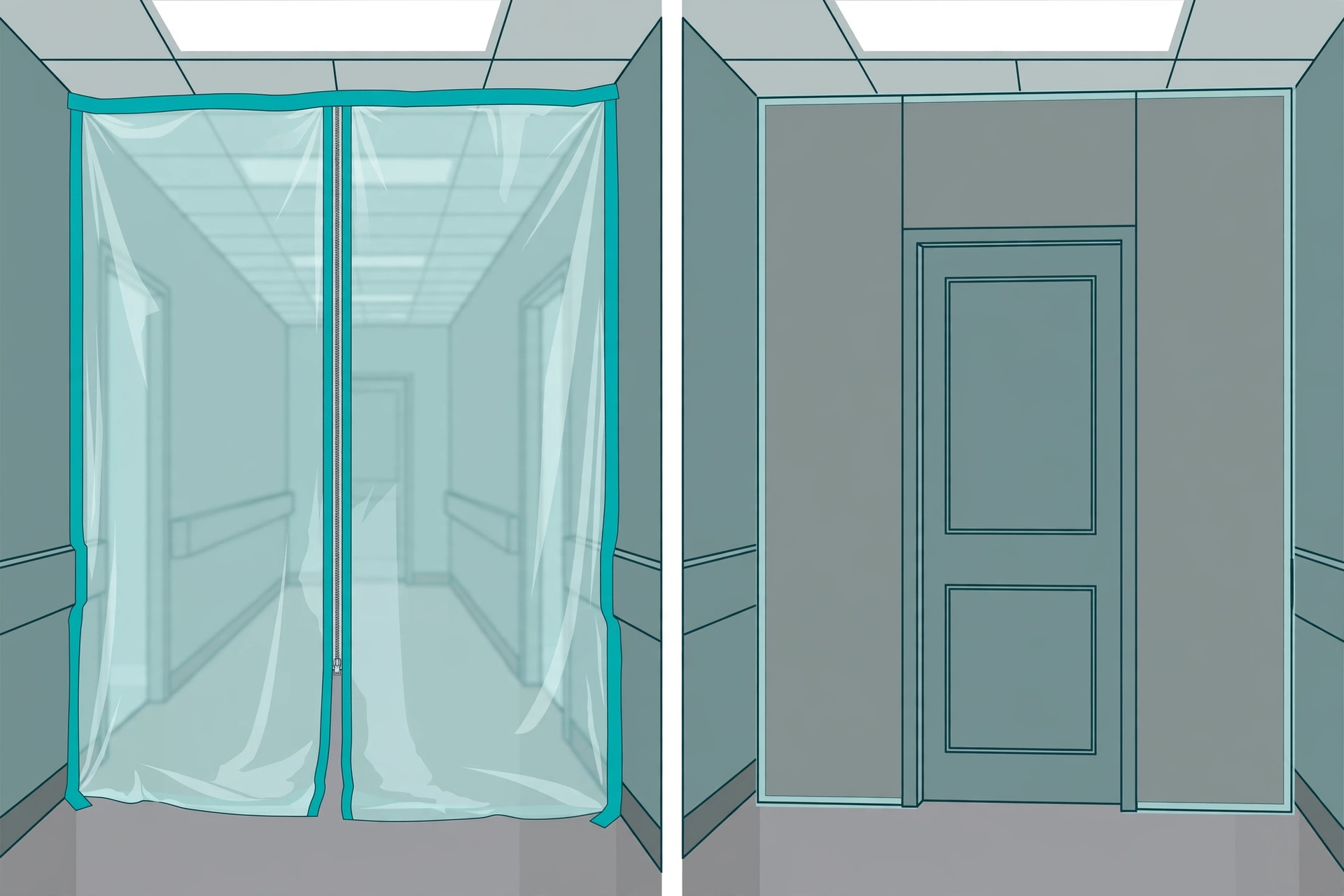
Soft barriers are polyethylene sheeting (fire-retardant, 6-mil) hung and sealed to contain dust — fast to install, suitable for short-duration, lower-risk work. Hard barriers are rigid walls (metal studs with drywall, plywood, or modular panel systems) sealed floor to ceiling — required for Class III/IV projects lasting more than two weeks, for hot work areas, and anywhere the barrier must also meet fire-rating requirements. The ICRA class and project duration decide; preference doesn’t.
Soft barriers: when and how
- Material: fire-retardant polyethylene, 6-mil thickness, completely sealed top to bottom, continuously supported where sagging can occur.
- Entry/exit: double-layered overlapping plastic with a weighted flap at least 2 feet wide at the bottom, or a full-length zipper door sealed at the bottom during work.
- Limits: not for Class III/IV projects over two weeks; never where torch cutting, welding, or burning occurs.
- Best for: short-duration work (days, not weeks), low-to-moderate dust, areas where speed of setup matters.
Hard barriers: when and how
- Construction: metal studs secured to floor, ceiling, and sides; drywall or plywood; door in frame with no gaps (sealed with tape as needed).
- Required for: Class III/IV work exceeding two weeks; high-traffic areas; hot work zones; projects where the barrier needs a fire rating.
- Fire rating: where the project is a higher hazard than the occupied building, NFPA 241 calls for 1-hour fire resistance with 45-minute protection at openings.
- Best for: long-duration projects, high-risk patient areas adjacent, and anywhere durability matters.
The decision rule
Duration over two weeks, hot work, or fire-rating needs → hard barrier. Short, low-risk work → soft barrier is acceptable. When in doubt, the ICRA permit and the infection preventionist make the call — and “we’ve always used poly” is not a justification for a six-week Class IV project.
The barrier type follows the ICRA class — not the budget.
See the ICRA Class I–V matrix and barriers guide and what a Class IV barrier requires.
FAQ
Can plastic sheeting be used for long construction projects?
Not for Class III/IV projects lasting more than two weeks — those require solid (hard) barriers.
Can soft barriers be used near hot work?
No. Plastic barriers may not be used where torch cutting, welding, or burning occurs.
Who decides between soft and hard barriers?
The ICRA process — the infection preventionist and facilities/safety team, based on the ICRA class, duration, and adjacent patient risk.