What are the ventilation requirements for procedure rooms vs operating rooms?
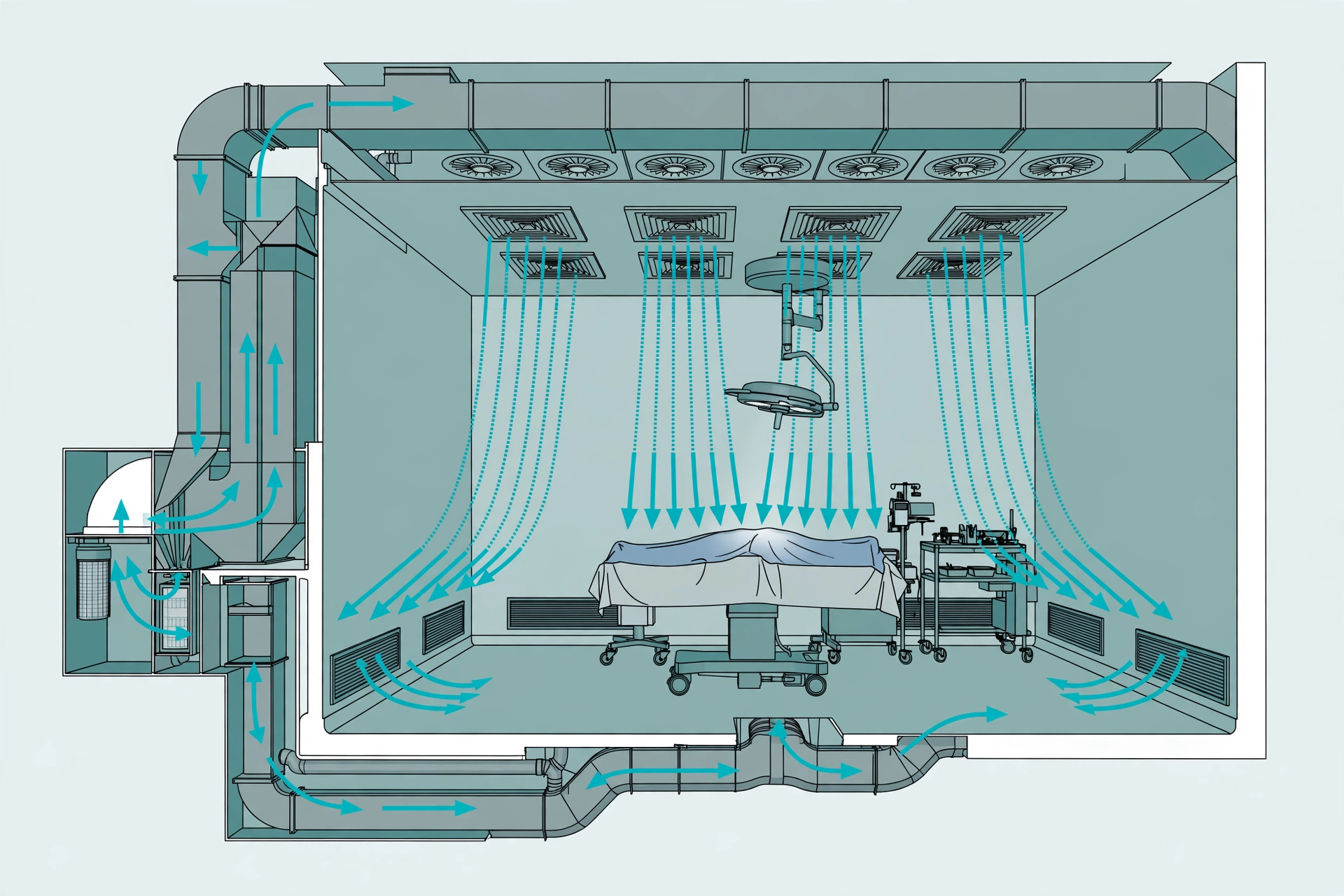
Under ASHRAE 170-2021, operating rooms require positive pressure, 20 total air changes per hour (4 outdoor ACH), MERV-16 filtration, 20–60% relative humidity, and 68–75°F. Procedure rooms require positive pressure, 15 total ACH (3 outdoor ACH), MERV-14 filtration, 20–60% RH, and 70–75°F. The operating room is the more stringently ventilated space — more air changes, finer filtration — reflecting the open surgical wound and the sterile field.
Side by side (ASHRAE 170-2021)
| Parameter | Operating room | Procedure room |
|---|---|---|
| Pressure | Positive | Positive |
| Total ACH | 20 | 15 |
| Outdoor ACH | 4 | 3 |
| Filtration | MERV-16 | MERV-14 |
| Humidity | 20–60% | 20–60% |
| Temperature | 68–75°F | 70–75°F |
Design details that matter
Operating rooms also require a primary diffuser array over the surgical table (extending 12 inches beyond the table footprint on each side), unidirectional downward airflow at 25–35 cfm/sq ft, and low sidewall return grilles. Both rooms prohibit recirculation by room units. Always verify against the edition your AHJ has adopted — filtration levels in particular changed between editions.
The OR gets the most air in the building — by design.
FAQ
How many air changes does an operating room need?
20 total ACH with at least 4 outdoor ACH, positive pressure, per ASHRAE 170-2021.
How many air changes does a procedure room need?
15 total ACH with at least 3 outdoor ACH, positive pressure.
Why do ORs need more ventilation than procedure rooms?
The open surgical wound and sterile field demand finer filtration and higher dilution — 20 ACH and MERV-16 versus 15 ACH and MERV-14.