What is the defend-in-place strategy in healthcare facilities?
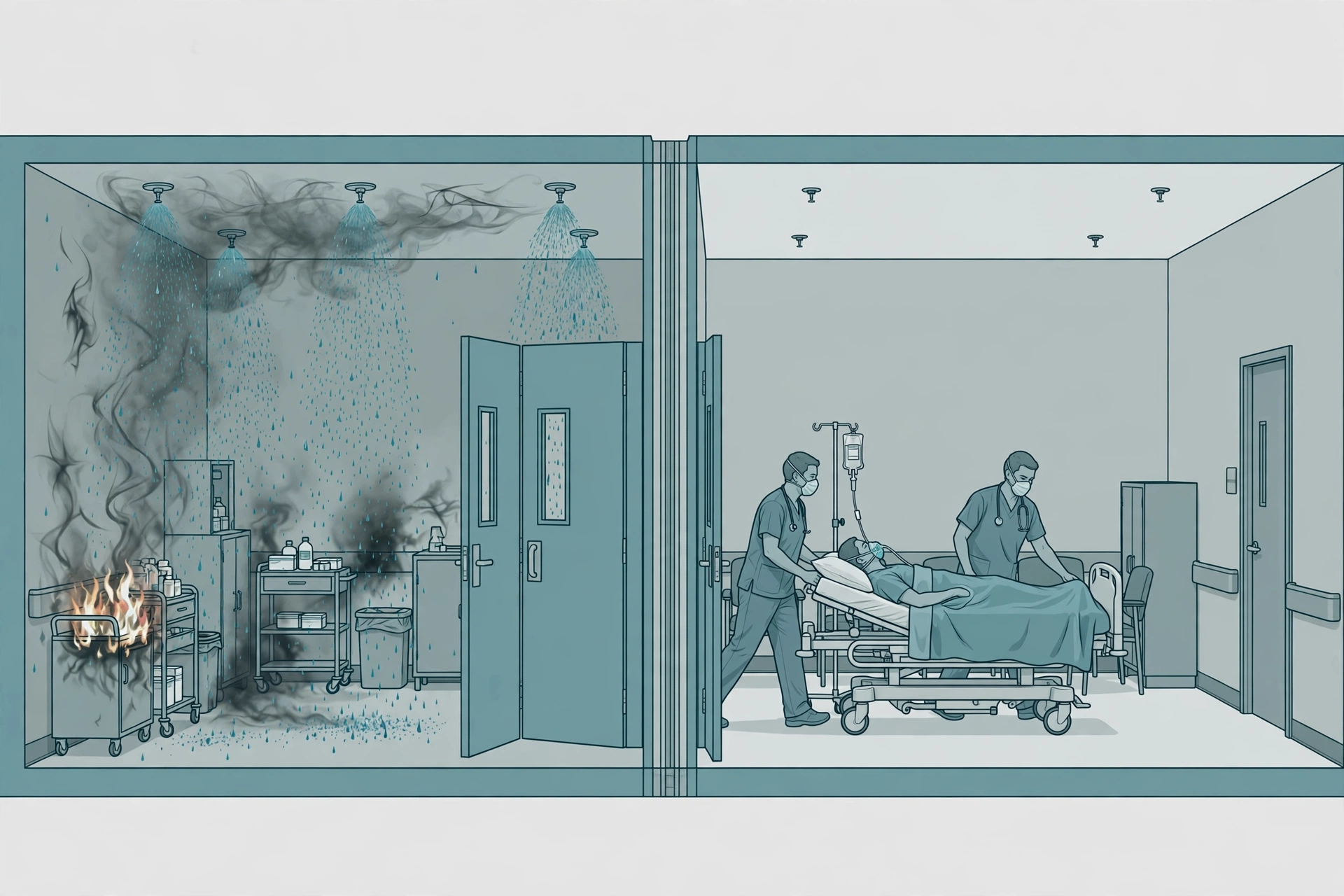
Defend-in-place is the fire safety strategy for healthcare occupancies: instead of evacuating patients — most of whom can’t walk, and some of whom can’t survive being moved — the building is designed to protect them where they are. Fire-rated and smoke-resistive construction, automatic sprinklers, smoke compartments, and trained staff contain the fire and its products while patients relocate horizontally past a smoke barrier to an adjacent compartment, rather than down stairs and out of the building.
How it works
- Compartmentation: each floor divided into at least two smoke compartments by smoke barriers; fire areas further subdivided by fire barriers.
- Horizontal relocation: on alarm, staff move patients through smoke-barrier doors into the adjacent compartment — no stairs, no elevators, no outdoors.
- Suppression and detection: sprinklers control the fire; detection and alarm alert staff early.
- Staff action: the strategy depends on trained staff executing the fire plan — closing doors, relocating patients, and accounting for everyone.
What defend-in-place demands of the building
Every element must work: smoke barriers intact and sealed (penetrations firestopped), corridor doors that close and latch, corridors clear for bed movement, sprinklers and alarms maintained and tested. A propped-open smoke-barrier door or a missing ceiling tile defeats the strategy — which is why surveyors focus so relentlessly on barriers, doors, and penetrations.
The patients stay. The building does the moving.
See NFPA 101 for healthcare and common NFPA 101 deficiencies.
FAQ
What is defend-in-place?
The healthcare fire strategy of protecting patients where they are — via compartmentation, sprinklers, and horizontal relocation past smoke barriers — instead of full evacuation.
Why don’t hospitals just evacuate?
Most patients can’t self-evacuate, and moving critical patients (ventilated, surgical, neonatal) can be more dangerous than the fire. The code is engineered around that reality.
What defeats defend-in-place?
Propped smoke-barrier doors, unsealed penetrations, blocked corridors, impaired sprinklers — anything that lets fire or smoke move faster than staff can relocate patients.