Direct Answer: Retrofitting automated surgical-pack delivery into an existing hospital corridor works cleanest in concept when designers bypass lightweight ASTM C635 drop-ceiling grids and congested mechanical plenums with a slab-anchored, flush under-grid clean spine that lowers tamper-locked sterile pods vertically into an Operating Room Load Port Dock—paired with unscrubbed circulating-nurse or contactless verification rather than scrubbed-glove touchpads.
Hospital Delivery Topologies Compared
| Delivery Topology | Structural & Plenum Impact | ICRA / ASHRAE 170 Risk | Sterile Custody & Corridor Fit |
|---|---|---|---|
| Corridor Floor AMRs | Zero ceiling work; competes for elevator and hall clearance. | Tracks floor particulates; door-hold delays risk pressure balance. | Unattended carts in mixed corridors depend on onboard locks. |
| Pneumatic Tubes (TransLogic) | Above-tile 4-in or 6-in tubing across smoke barriers. | Sealed carrier; limited to small pharmacy and lab payloads. | Cannot transport heavy orthopedic pans or delicate scopes. |
| Above-Tile Plenum Track | Heavy steel clashes with NFPA 99 med-gas, HVAC, and sprinklers. | Popping legacy ceiling tiles triggers ICRA Class IV Aspergillus containment. | High renovation disruption above occupied clinical wings. |
| Flush Under-Grid Clean Spine | Slab-anchored threaded rods through sealed sleeves; ASCE 7 braced. | Plenum stays largely undisturbed; cleanable wiped-down housing. | Vertical Z-hoist lowers locked pods straight into OR Load Port Docks. |
Why Semiconductor Cleanrooms Built This First—And Where Hospitals Differ
Semiconductor wafer fabrication facilities encountered this exact corridor bottleneck decades ago. When 300mm wafer cassettes outgrew wheeled floor carts, cleanroom integrators such as Daifuku Cleanroom Overhead Hoist Transport (OHT) moved sealed Front Opening Unified Pods (FOUPs) onto ceiling-level rails that drop vertically onto equipment load ports without stirring floor particulates or blocking technicians.
Hospitals already rely on sealed overhead delivery for lightweight items via pneumatic tube networks, yet 6-inch tubes cannot carry 25-to-30-pound orthopedic instrument pans, delicate endoscopes, or bulk sterile case packs. At the same time, wheeled floor robots share narrow surgical corridors with stretchers, staff, and airborne infection precautions. Unless a hospital was built with walk-on interstitial mechanical floors, the ceiling plane looks like the obvious highway—until building codes push back.
Why You Cannot Hang Robots From Drop-Ceiling Grids
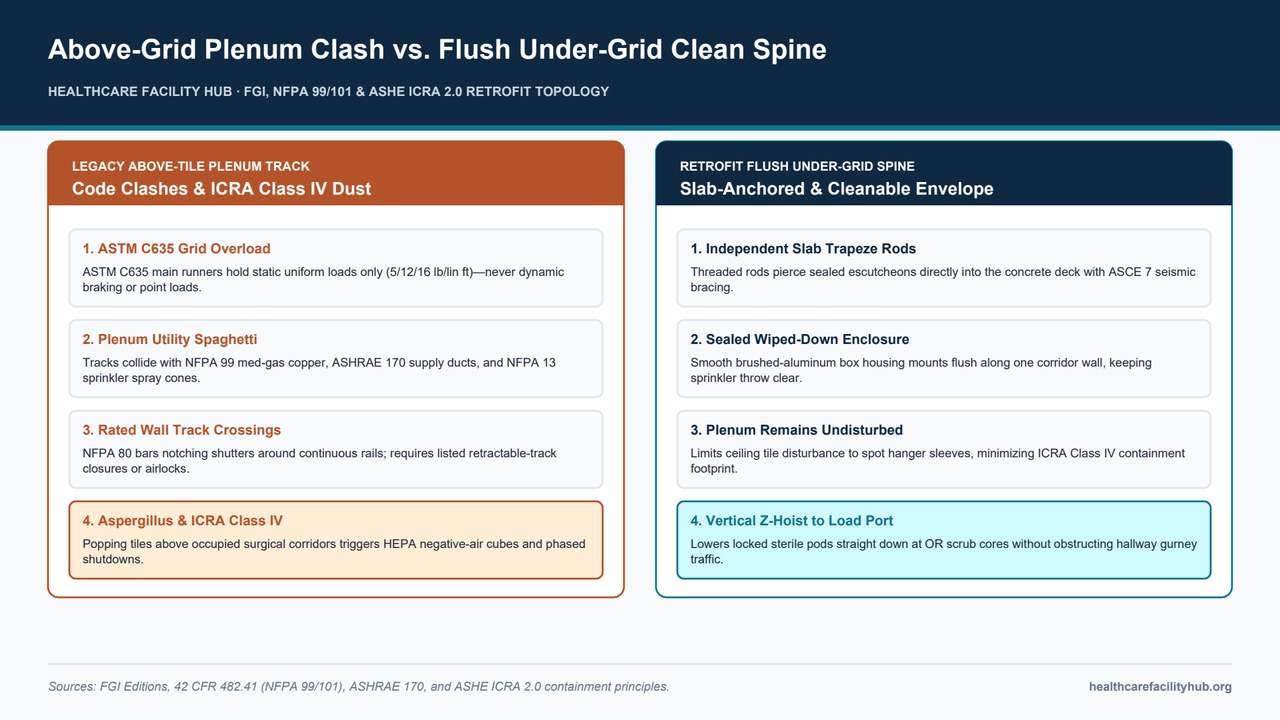
Existing hospital suspended ceiling grids (ASTM C635) have main runners rated only for static uniform loads—5 lb/lin ft light-duty, 12 lb/lin ft intermediate-duty, or 16 lb/lin ft heavy-duty acoustic tiles and troffers. Dynamic braking forces, payload mass, and seismic sway require independent threaded trapeze hangers anchored straight into the structural concrete slab or steel superstructure above, braced per ASCE 7.
Threading a continuous monorail above legacy ceiling tiles also collides with dense corridor plenum utilities: 42 CFR 482.41 hospital physical environment rules (incorporating NFPA 99 medical-gas copper mains and NFPA 101 Life Safety smoke compartments—where NFPA 80 prohibits simply notching fire/smoke shutters around continuous rails, requiring listed retractable-track closures or transfer airlocks with annual drop-testing), NFPA 13 sprinkler spray cones, and pressurized ductwork governed by ASHRAE 170 ventilation and pressure relationships. Worse, popping acoustic tiles above occupied clinical corridors releases dormant fungal spores—triggering Aspergillus infection risks and full Class IV negative-air barriers.
As a forward-looking retrofit concept, a flush under-grid clean spine places a compact, sealed, wiped-down aluminum box enclosure tightly beneath the ceiling plane along one corridor wall, supported by structural deck rods passing through gasketed ceiling sleeves. Because the plenum stays closed except at spot hanger locations, facilities slash ASHE ICRA 2.0 containment complexity while keeping surgical suite filtration and positive pressure undisturbed.
Get the weekly brief
Surveys, water, plant and readiness — what we measured and what changed in facility operations, every week.
Code-by-Code Hospital Overhead Robotics Retrofit Checklist
Before issuing an engineering RFP, pin your governing state edition on the FGI Codes & Guidelines editions portal and walk through all six compliance boundaries below alongside CMS Environment of Care requirements and 42 CFR 482.42 infection control standards.
| Code / Authority | Where Overhead Robotics Collide | Required Retrofit Engineering Control |
|---|---|---|
| FGI Codes / Handbooks | State-adopted minimum corridor headroom, cleanability, and Safety Risk Assessment. | Pin your state-adopted edition; run PCRA/SRA first and mount spine along one corridor wall above door swing. |
| 42 CFR 482.41 · NFPA 101, 99 & 80 | Slab-to-slab smoke compartment walls, med-gas copper, and EES backup power. | No cutouts notched around continuous tracks; fit UL-listed retractable-track fire closures or transfer airlocks tied to FACP + annual NFPA 80 drop-tests. |
| NFPA 13, ASTM C635 & ASCE 7 | Sprinkler spray obstruction; ASTM C635 runners hold static uniform loads only (5/12/16 lb/lin ft). | Anchor trapeze rods straight to structural concrete deck with ASCE 7 bracing—zero dynamic load on ASTM C635 grids. |
| 42 CFR 482.42 · ASHE ICRA 2.0 | Dormant Aspergillus spores above ceiling tiles over surgical and ICU corridors. | Enforce ICRA Class IV negative-air HEPA containment cubes for every structural hanger sleeve penetration. |
| ASHRAE 170 & Acoustics | Positive OR pressure (+0.01 in. w.g.) and motor vibration in patient corridors. | Isolate spine hangers with elastomeric dampers; terminate hoist inside enclosed Load Port vestibules. |
| 21 CFR Part 11 & FDA Scope | Electronic custody logs, biometric workflow, and medical-device classification. | Keep pods passive/sealed (no clinical claims) to stay outside FDA 510(k) clearance; log circulating-RN release. |
The OR Scrub-Core Chain-of-Custody Catch
Even a structurally sound ceiling spine fails if its release lock breaks sterile technique. Early automation concepts often assume a surgeon can press a fingerprint reader on the pod dock before opening a tray—but a scrubbed, gowned, and sterile-gloved surgeon cannot touch an unscrubbed biometric pad.
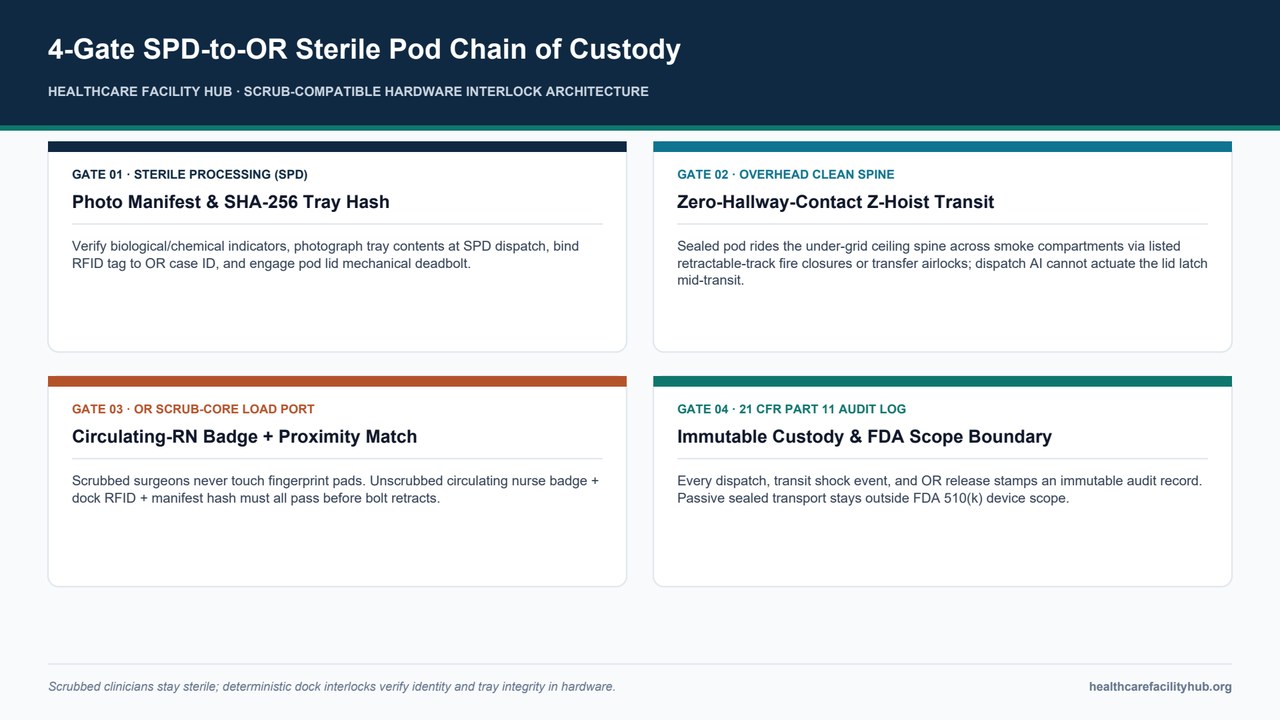
- SPD Visual Manifest & Deadbolt Lock: Sterile Processing staff verify chemical and biological sterilization indicators, capture a timestamped tray photograph, compute a SHA-256 manifest hash, bind the pod RFID tag to the scheduled OR case, and engage a mechanical solenoid deadbolt.
- Air-Gapped Transit Authority: Dispatch software routes the overhead Z-hoist along the spine, while holding zero electrical or software authority to retract the lid bolt mid-corridor.
- Scrub-Compatible Load Port Release: At the Operating Room scrub core, the hardware interlock checks station RFID, origin manifest parity, and an unscrubbed circulating nurse badge or contactless proximity credential logged under 21 CFR Part 11 electronic record principles before releasing the lid.
- FDA & OSHA Safety Boundaries: Passive sealed transport pods stay outside FDA 510(k) medical-device clearance unless claiming active sterilization or fluid/organ preservation, while hoists and docks must satisfy OSHA robotics safety standards, FDA medical-device cybersecurity guidance, 21 CFR Part 820 quality system discipline, and hospital AI governance controls.
Copy-Paste AI Facility Retrofit & RFP Spec Prompt
Download the AI-ready Markdown blueprint (.md) above and paste the structured block below into Claude, ChatGPT, or Gemini with your wing measurements to generate a phased PCRA/ICRA work plan and vendor compliance matrix:
role: Hospital Facilities & ICRA Retrofit Planner
reference_blueprint: https://healthcarefacilityhub.org/hospital-ceiling-robotics-overhead-sterile-pod-retrofit-guide.md
facility_inputs:
  state_adopted_fgi_edition: "2022 or 2026 FGI (verify AHJ)"
  corridor_clear_height_ft: 9.0
  structural_deck_height_ft: 13.5
  smoke_barrier_crossings_count: 3
  active_or_suites_served: 8
  max_surgical_pack_weight_lb: 30
required_outputs:
  - ASHE ICRA 2.0 Class IV containment phasing for deck hanger sleeves
  - NFPA 80/101 listed retractable-track fire closures or transfer airlocks (zero cutouts) with annual drop-test schedule
  - NFPA 13 sprinkler clearance and ASCE 7 seismic hanger spec
  - Scrub-compatible SPD-to-OR Load Port interlock RFP requirements
Frequently Asked Questions
Can automated ceiling delivery tracks hang directly from existing hospital drop-ceiling grids?
No. Standard ASTM C635 suspended acoustic ceiling main runners are rated only for static uniform loads (5 lb/lin ft light-duty, 12 lb/lin ft intermediate-duty, or 16 lb/lin ft heavy-duty) such as tiles and light fixtures. Automated overhead tracks carry dynamic braking and payload forces that must anchor independently through the ceiling plane into structural concrete or steel framing with ASCE 7 seismic bracing.
How do automated overhead rails pass through rated hospital smoke or fire walls under NFPA 80?
Under NFPA 80 and NFPA 101, fire/smoke shutters cannot simply have cutouts notched around a continuous monorail rail. Barrier crossings require UL-listed retractable or split-track fire closures—or pass-through transfer airlocks—interlocked to the facility fire alarm control panel (FACP) with documented annual NFPA 80 drop-testing.
Why do scrubbed surgeons not use fingerprint scanners to unlock sterile surgical pods?
Once scrubbed and sterile-gloved, a surgeon cannot touch a shared biometric pad without breaking sterile technique. Operating room load ports instead authenticate via the unscrubbed circulating nurse's badge and credential, or contactless dock proximity paired with the SPD manifest hash and OR schedule.
Do overhead hospital surgical-pod transport systems require FDA 510(k) clearance?
Passive transport rails and locked totes moving packaged supplies between SPD and the OR suite generally sit outside FDA 510(k) premarket clearance, governed instead by FGI, NFPA 80/99/101, ASHRAE 170, OSHA/UL 3100, and 21 CFR Part 11 custody logs—unless the pod claims active sterilization or clinical fluid/organ modification.
Get the weekly brief
Surveys, water, plant and readiness — what we measured and what changed in facility operations, every week.