How do ILSM interact with a hospital’s fire safety plan?
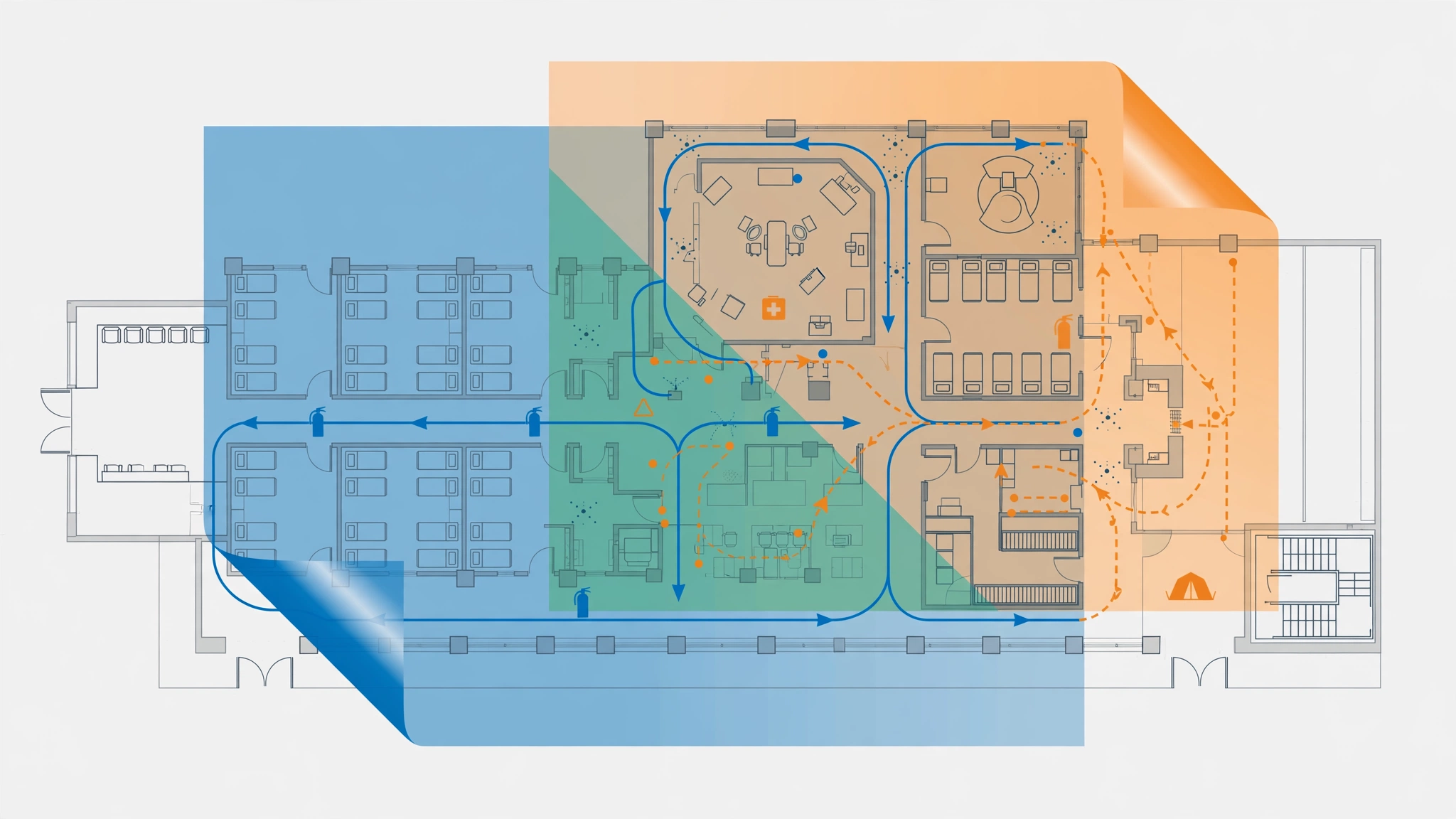
ILSM doesn’t replace the fire safety plan — it layers on top of it. The fire safety plan is the permanent program: RACE (rescue, alarm, confine, extinguish/evacuate), PASS for extinguishers, alarm response procedures, evacuation routes, and the regular drill schedule. ILSM is the temporary overlay that modifies that plan for a specific area while protections are degraded — and every modification must be communicated to the staff who execute the plan.
Where the two connect
- Altered staff response. The pivotal question on every ILSM assessment: does this project or deficiency change how staff perform rescue, alarm, confinement, extinguishment, or evacuation? If yes, the fire safety plan is effectively amended for that area — and staff must be trained on the amendment.
- Drill frequency. When staff response is altered for an extended period, the ILSM assessment triggers additional fire drills (minimum one extra per shift per quarter) in the affected area — on top of the plan’s normal schedule.
- Temporary systems. A temporary but equivalent alarm or suppression system becomes part of the fire safety picture for the area; staff must know it exists, how it’s monitored, and that it’s tested monthly.
- Fire watch. When impairments cross the 4-hour/10-hour thresholds, the fire watch becomes the human fire-detection system for the zone — the most direct ILSM-to-fire-plan integration there is.
- Communication. Alternate exit signage, occupant notification of the deficiency and the measures in place — the fire safety plan only works if people know the current version.
The integration test
Ask your charge nurse in the affected area: “The alarm goes off right now — what do you do differently than last month?” If she can answer, ILSM and the fire safety plan are integrated. If she describes the standard plan with no awareness of the construction overlay, they’re two documents that never met — and that’s a survey finding.
One plan, one overlay, one story.
See the ICRA/ILSM construction guide and what the life safety survey checks.
FAQ
Does ILSM change evacuation routes?
It can — when construction blocks or reroutes egress, alternate routes must be designated, signed, and communicated. Staff must know the current routes, not the ones on the old evacuation map.
Do we update the written fire safety plan for each ILSM?
The ILSM assessment and its documentation serve as the project-specific amendment. The base plan stays; the ILSM record shows what changed, where, for how long, and who was told.
What happens to the fire safety plan when ILSM terminates?
The overlay lifts: temporary systems removed, normal routes and responses restored, staff informed that standard procedures are back in effect — all documented at closeout.