When are ILSM required during hospital construction?
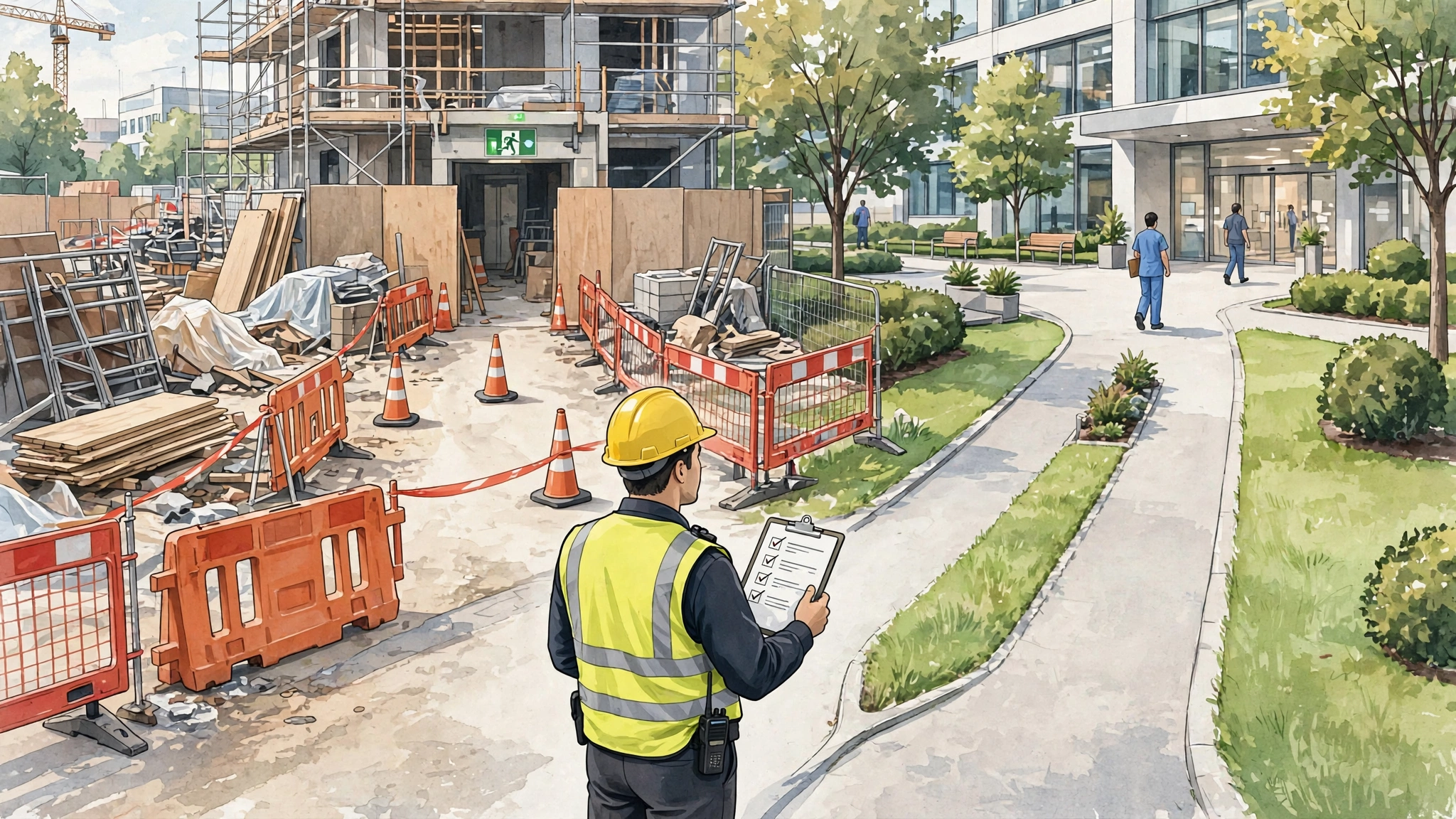
ILSM is required whenever hospital construction affects life safety features — egress paths, fire and smoke barriers, fire alarm, detection, or suppression systems — or whenever a Life Safety Code deficiency exists that can’t be corrected immediately. The trigger isn’t the project’s size or budget; it’s whether the building’s normal fire and life safety protections are degraded, even temporarily.
Construction triggers
- Blocking or rerouting an approved exit or egress path
- Opening, penetrating, or modifying fire or smoke barriers
- Taking a fire alarm, detection, or suppression system (or part of one) out of service
- Work that impairs compartmentation — corridor walls, smoke doors held open, unsealed penetrations
- Major renovation of an occupied floor or unit
- Excavation or exterior work affecting emergency vehicle access
- Hot work in or adjacent to occupied areas
- Any project where dust, debris, or equipment staging degrades egress or increases fuel load
Deficiency triggers
When a Life Safety Code deficiency is identified — through EOC rounds, the building assessment, or a survey — and it can’t be fixed on the spot, ILSM covers the gap until correction. The deficiency goes in the e-Statement of Conditions with a Plan for Improvement; ILSM is the compensating protection in the meantime.
The assessment decides — case by case
Not every project triggers every measure. The ILSM assessment maps the specific degradation against the standard measures and selects the ones that apply. A project that only affects one corridor’s egress might need signage, daily inspections, and surveillance — not a fire watch. The requirement is the assessment itself: a documented, reasoned determination for every project, signed and filed. Skipping the assessment because “this one’s small” is the most cited ILSM failure there is.
Small project? The assessment still applies.
See do ILSM apply to small renovation projects and the ICRA/ILSM construction guide.
FAQ
Who decides whether ILSM is required for a project?
The facility’s ILSM assessment process — typically the safety officer with facilities and project management — evaluates each project or deficiency case by case and documents the determination.
Does cosmetic work trigger ILSM?
Only if it affects life safety features. Repainting a corridor doesn’t; replacing the corridor’s smoke doors does.
What if we’re unsure whether a project triggers ILSM?
Run the assessment. A documented “no ILSM required” determination with reasoning is defensible; no assessment at all is not.